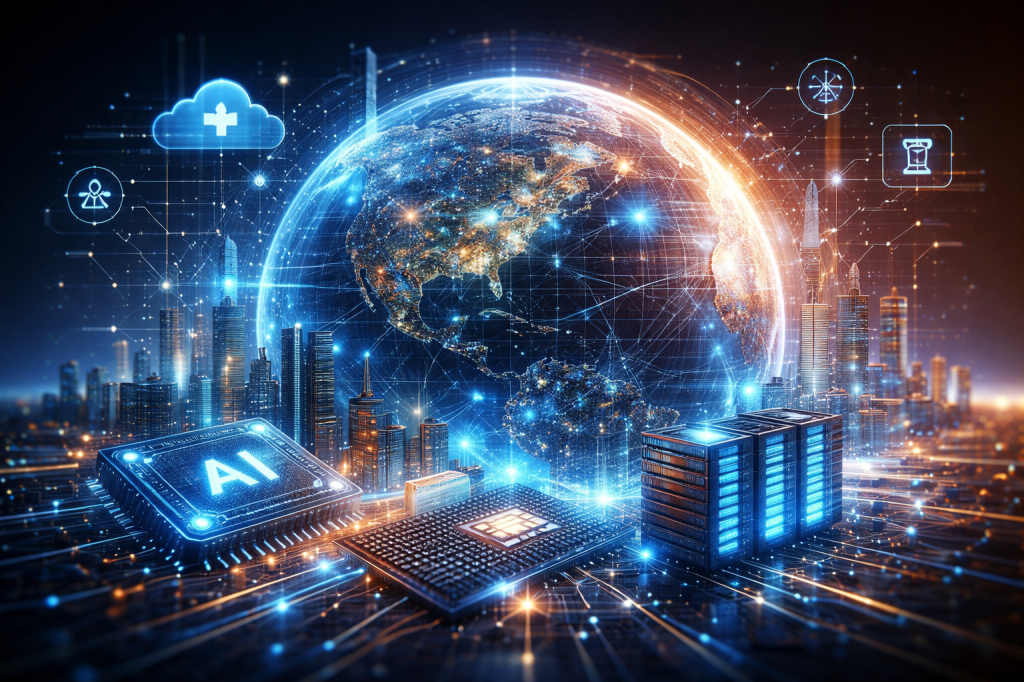
For much of modern history, power has been defined through geography, military strength, and economic sovereignty of nation-states. From the Treaty of Westphalia to the Cold War, states were the primary actors shaping global order. However, the 21st century is witnessing a profound structural shift—power is no longer confined within political borders but is increasingly embedded in technology ecosystems that control artificial intelligence, semiconductor supply chains, and data infrastructure. This transformation is not merely technological; it is redefining sovereignty, governance, and the very meaning of economic dominance.
Historical Evolution: From Territorial Sovereignty to Networked Power
Historically, economic power transitioned from land ownership to industrial capacity and later to financial capital. The post-World War II era institutionalized this through multilateral systems, where nation-states negotiated trade, finance, and development. Yet, the digital revolution introduced a new variable—control over information and computation. Unlike oil or minerals, data flows are borderless, and their value multiplies through network effects. This has enabled technology firms and ecosystems to accumulate influence that rivals, and sometimes surpasses, that of states. The rise of Silicon Valley, East Asian semiconductor clusters, and platform economies illustrates how power has shifted from physical assets to intangible yet deeply strategic digital infrastructures.
Control Points of the New Power Structure: AI, Semiconductors, and Data
At the heart of this transition lie three critical control points. First, artificial intelligence has emerged as a meta-technology, capable of enhancing productivity, surveillance, military capabilities, and decision-making systems. Entities that control advanced AI models and compute infrastructure increasingly dictate the pace and direction of innovation. Second, semiconductors represent the backbone of this digital economy. The concentration of advanced chip manufacturing in a few geographies has created chokepoints, turning supply chains into instruments of geopolitical leverage. Third, data infrastructure—cloud systems, digital platforms, and communication networks—has become the new terrain of economic and strategic competition. Control over these layers allows ecosystems to shape markets, consumer behavior, and even political narratives.
The Rise of Techno-Industrial Ecosystems Over Traditional States
What distinguishes this new phase is not just the emergence of powerful technology firms but the consolidation of entire ecosystems—integrated networks of companies, research institutions, capital, and policy influence. These ecosystems operate across borders, often beyond the regulatory reach of individual states. For example, a single digital platform can influence millions of users globally, while semiconductor alliances determine the technological capabilities of entire industries. In this context, sovereignty is no longer absolute; it is negotiated within and sometimes constrained by these ecosystems. Governments increasingly depend on private technological capabilities for national security, economic growth, and public service delivery.
Geopolitics Reimagined: Fragmentation, Alliances, and Strategic Dependencies
This shift is also reshaping geopolitics. Traditional alliances based on ideology or geography are being supplemented—or replaced—by technology alliances. Countries are aligning themselves based on access to chips, AI frameworks, and digital infrastructure. Export controls, technology bans, and supply chain diversification strategies are becoming tools of statecraft. However, this also creates new vulnerabilities. Nations without strong domestic capabilities risk becoming dependent on external ecosystems, leading to a form of “digital dependency” that mirrors earlier patterns of colonial economic control. The competition is no longer just for markets but for control over the foundational technologies that define those markets.
Implications for Emerging Economies: Between Opportunity and Dependency
For countries like India, this transition presents a paradox. On one hand, there is an unprecedented opportunity to leapfrog stages of development by leveraging digital infrastructure and participating in global value chains. On the other hand, the lack of control over core technologies—particularly semiconductors and advanced AI—creates structural dependencies. The challenge is not merely to adopt technology but to embed domestic capabilities within these ecosystems. This requires strategic investments in R&D, policy frameworks that encourage innovation, and the development of resilient industrial clusters that can integrate into global networks without being subordinated by them.
The Future of Sovereignty: From Political Control to Technological Autonomy
Looking ahead, the concept of sovereignty itself is undergoing transformation. Political borders will remain relevant, but true autonomy will increasingly depend on technological capabilities. Nations that can design, manufacture, and govern critical technologies will hold disproportionate influence. At the same time, the growing power of private ecosystems raises questions about accountability, regulation, and public interest. If left unchecked, this could lead to a concentration of power that undermines democratic processes and economic inclusivity.
Navigating the New Power Paradigm
The shift from nation-states to technology ecosystems does not imply the decline of the state but rather its reconfiguration. States must evolve from being sole power centers to strategic orchestrators within complex technological networks. The future global order will likely be shaped by a hybrid model—where states, corporations, and technology ecosystems coexist in a dynamic and often contested equilibrium. The critical question is not whether this shift will continue, but how nations, particularly emerging economies, will position themselves within this new architecture of power—either as passive participants or as active shapers of the techno-economic future.
#TechnoPower
#AIeconomy
#SemiconductorGeopolitics
#DataSovereignty
#DigitalDependency
#GlobalValueChains
#InnovationEcosystems
#EconomicSecurity
#FutureOfSovereignty
#IndustrialPolicy
 "Connecting communities, empowering nations: Unifying the Regional and Global Economy ."
Leave a comment