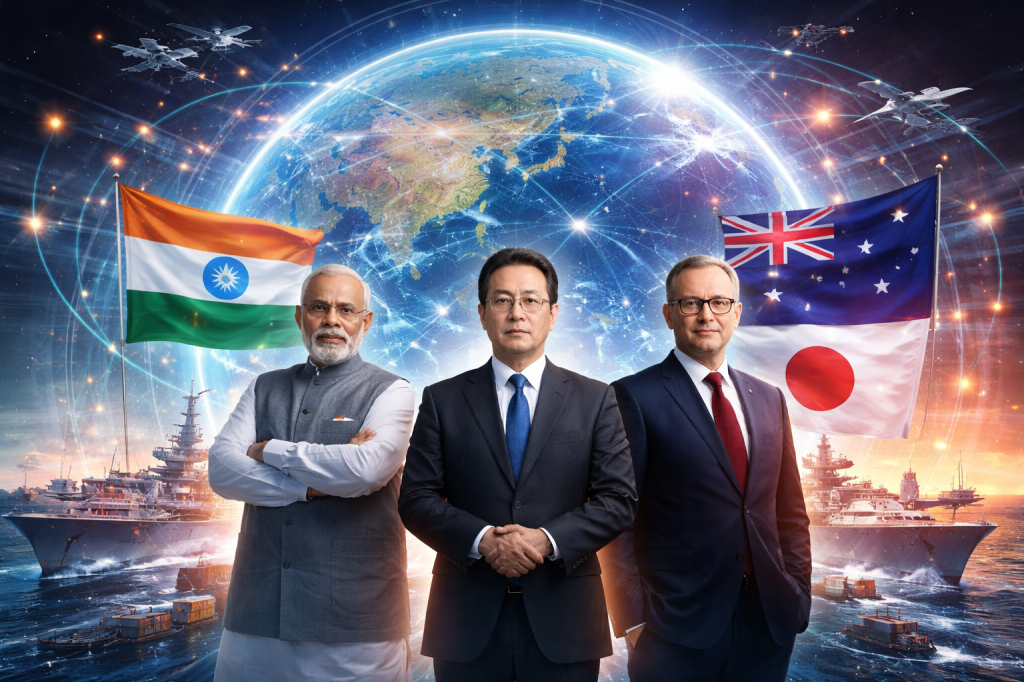
The idea of “middle powers” has evolved significantly from its early usage in post-World War II diplomacy, where countries like India, Japan, and Australia were often seen as secondary actors navigating between superpowers. Historically, middle powers derived influence not from sheer economic or military dominance, but from their ability to build coalitions, uphold multilateral norms, and act as stabilizers in a bipolar or unipolar world. During the Cold War, India’s non-aligned positioning, Japan’s economic diplomacy, and Australia’s alliance-driven security posture reflected distinct pathways to influence. However, the 21st century—particularly the post-globalization phase—has fundamentally altered this role, pushing middle powers from passive balancers to proactive system shapers.
From Multilateralism to Minilateralism: Adaptive Strategic Behaviour
As traditional institutions struggle with legitimacy and effectiveness, middle powers are increasingly bypassing rigid multilateral platforms and moving toward flexible, issue-based coalitions. The rise of arrangements like the Quadrilateral Security Dialogue reflects this shift, where India, Japan, and Australia collaborate alongside the United States to address security, technology, and supply chain resilience. This transition from multilateralism to “minilateralism” is not accidental—it is a strategic response to institutional paralysis in organizations such as the WTO or UN system. Middle powers are leveraging agility over scale, choosing coalitions where outcomes are achievable rather than consensus-driven stagnation.
Economic Statecraft and Supply Chain Realignments
The economic role of middle powers has gained unprecedented importance in a world marked by supply chain disruptions, trade fragmentation, and technological decoupling. India’s push for manufacturing resilience, Japan’s strategic investments in critical technologies, and Australia’s role in critical minerals supply chains illustrate how these countries are repositioning themselves within global value chains. The “China+1” strategy, widely adopted by multinational corporations, has further amplified their importance—not merely as alternative production bases but as strategic nodes in a diversified global system. However, this opportunity comes with constraints: infrastructure gaps in India, demographic challenges in Japan, and export dependency in Australia continue to limit their ability to fully capitalize on these shifts.
Security Architecture: Between Autonomy and Alignment
Security dynamics have placed middle powers in a delicate balancing act between strategic autonomy and alliance commitments. India continues to emphasize strategic independence, even while engaging with Western-led frameworks, whereas Japan has gradually expanded its defense posture beyond its post-war pacifist constraints. Australia, traditionally aligned with the United States, is recalibrating its role in the Indo-Pacific amid rising regional tensions. These varying approaches reflect a common dilemma: how to maintain sovereignty in decision-making while participating in collective security arrangements in an increasingly polarized world.
Normative Power and the Battle for Global Standards
One of the most underappreciated roles of middle powers lies in shaping global norms—whether in digital governance, climate action, or trade standards. India’s digital public infrastructure model, Japan’s advocacy for high-quality infrastructure, and Australia’s regulatory frameworks in sectors like mining and environment represent different facets of normative influence. In a world where technological standards and regulatory regimes are becoming instruments of power, middle powers have the potential to act as bridges between competing systems, particularly between Western and emerging economies. Yet, their success depends on coherence and coordination, which often remains fragmented.
The Constraints: Capacity, Cohesion, and Contradictions
Despite their growing relevance, middle powers face inherent limitations. Economic disparities, domestic political pressures, and limited military capabilities constrain their global ambitions. Moreover, their interests do not always align—India’s developmental priorities differ from Japan’s aging economy concerns or Australia’s resource-driven model. This lack of cohesion often weakens their collective bargaining power, preventing the emergence of a unified middle-power bloc capable of counterbalancing major powers effectively.
From Strategic Hedging to Strategic Leadership
Looking ahead, the role of middle powers is likely to become even more critical as the global system transitions toward multipolarity. The future will not be defined by a single hegemon but by a network of influential actors shaping specific domains—technology, trade, climate, and security. Middle powers will increasingly act as “connectors” in this network, bridging divides, stabilizing regions, and enabling cooperation where great powers fail. However, this requires a shift from reactive hedging strategies to proactive leadership—investing in domestic capabilities, strengthening regional partnerships, and articulating clear global visions.
The Silent Architects of a New Order
In a world marked by uncertainty, fragmentation, and contested leadership, middle powers are emerging as silent architects of the new global order. Their strength lies not in dominance but in adaptability, coalition-building, and credibility. The real question is not whether middle powers will shape the future, but whether they can overcome their internal constraints to do so collectively and coherently. If they succeed, the next phase of global governance may well be defined not by superpowers alone, but by the strategic agency of those once considered “middle.”
#MiddlePowers #MultipolarWorld #Minilateralism #StrategicAutonomy #SupplyChains #EconomicStatecraft #IndoPacific #GlobalGovernance #DigitalSovereignty #Geopolitics
 "Connecting communities, empowering nations: Unifying the Regional and Global Economy ."
Leave a comment