A Structural Moment, Not a Market Panic
The recent depreciation of the Indian rupee must not be misread as a speculative overreaction; it is, in essence, a reflection of a deeper structural shift in the global monetary landscape. Historically, episodes of currency stress in emerging economies—whether during the Asian Financial Crisis of 1997, the taper tantrum of 2013, or the post-pandemic tightening cycle—have often been linked to the overwhelming strength of the US dollar. Today’s situation echoes that pattern, but with a more complex geopolitical overlay. The strengthening of the dollar is not merely cyclical; it is being reinforced by geopolitical tensions, energy market disruptions, and capital flight toward perceived safe havens. In such a context, the rupee’s depreciation is part of a broader global realignment rather than an isolated domestic weakness.
Balance of Payments Pressure: The Real Fault Line
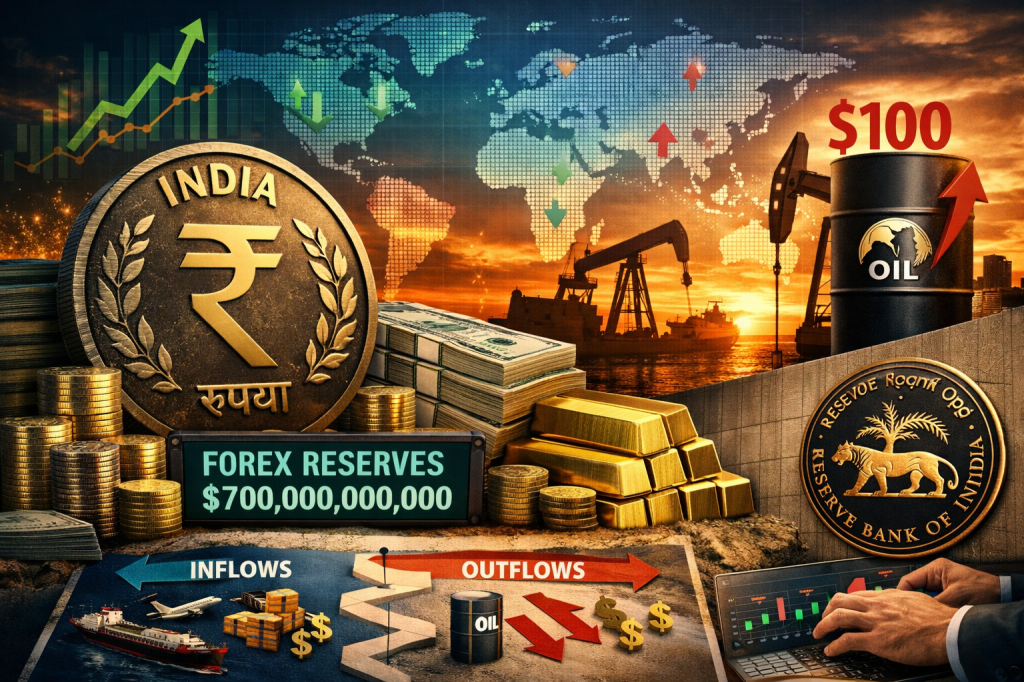
At the heart of the rupee’s movement lies the balance of payments equation—where the inflow and outflow of dollars determine currency stability. India’s vulnerability emerges from two simultaneous pressures. First, a sustained rise in crude oil prices—especially if they remain elevated near or above $100 per barrel—significantly expands the import bill, given India’s heavy dependence on energy imports. Second, geopolitical disruptions in the Middle East, a key export destination for India, threaten to weaken export inflows. This dual squeeze—higher dollar outflows and uncertain inflows—creates a natural depreciation bias. Unlike past episodes driven by capital market volatility, this is a trade and energy-driven imbalance, making it more persistent and structurally embedded.
The Dollar’s Dominance and the Limits of Resistance
What makes the current episode particularly challenging is the near-universal strengthening of the US dollar. Almost all global currencies have depreciated to varying degrees, highlighting a systemic shift rather than country-specific fragility. For India, attempting to aggressively defend the rupee in such an environment risks misallocating valuable foreign exchange reserves. The lesson from history is clear: currencies cannot sustainably resist global macro forces. Attempts to artificially stabilize exchange rates often lead to rapid depletion of reserves without addressing the underlying imbalance.
Policy Response: Between Intervention and Restraint
In this context, the most prudent policy response lies in calibrated restraint rather than aggressive defense. With foreign exchange reserves nearing $700 billion, India is in a relatively strong starting position. However, this strength should not be mistaken as a license for continuous intervention. The strategic approach would be to allow the rupee to adjust gradually to new equilibrium levels, intervening only to prevent disorderly market conditions or excessive volatility. This “keep the powder dry” strategy recognizes that reserves are a strategic buffer, not a tool for resisting fundamental economic shifts.
Inflation Anchoring: The Silent Advantage
One of the most critical enabling factors for such a policy stance is the relative stability of inflation in India. Unlike past episodes where currency depreciation quickly translated into runaway inflation, the current macroeconomic environment provides some breathing room. Anchored inflation expectations allow policymakers to tolerate a weaker currency without triggering panic in domestic markets. In fact, a controlled depreciation can act as a shock absorber, helping the economy adjust to external pressures without resorting to disruptive policy tightening.
Depreciation as Adjustment, Not Weakness
There is a tendency to interpret currency depreciation as a sign of economic weakness. However, from a macroeconomic perspective, depreciation often plays a corrective role. A weaker rupee can enhance export competitiveness, partially offsetting the negative impact of higher import costs. It also discourages non-essential imports, thereby helping rebalance the external account. In this sense, depreciation becomes a mechanism of adjustment rather than a symptom of crisis. The key lies in ensuring that the adjustment remains orderly and does not spiral into instability.
The Energy-Currency Nexus: A Long-Term Constraint
Looking ahead, the deeper challenge for India is the structural link between energy dependence and currency vulnerability. As long as India remains heavily reliant on imported crude oil, its currency will remain sensitive to global energy price shocks. This underscores the importance of accelerating the transition toward renewable energy, diversifying energy sources, and strengthening domestic production capacities. Currency stability, in the long run, is as much about energy policy as it is about monetary management.
Futuristic Outlook: From Defense to Resilience
The future of currency management in India—and indeed across emerging economies—will increasingly shift from defense to resilience. The objective will not be to maintain a fixed or artificially stable exchange rate but to build an economic structure that can absorb shocks without destabilizing growth. This includes deeper financial markets, diversified export baskets, reduced import dependencies, and stronger institutional credibility. The rupee’s trajectory, therefore, will not just reflect monetary policy choices but the broader evolution of India’s economic architecture.
Conclusion: Strategic Patience in a Volatile World
In a world marked by geopolitical uncertainty and financial realignment, the temptation to over-manage the currency must be resisted. The current depreciation of the rupee is not a failure of policy but a reflection of global realities interacting with domestic fundamentals. The appropriate response is not aggressive intervention but strategic patience—allowing the currency to find its level while preserving the strength of reserves for truly destabilizing scenarios. In doing so, India positions itself not as a defender of an exchange rate, but as a manager of long-term economic resilience.
#RupeeDepreciation
#DollarStrength
#BalanceOfPayments
#ForexReserves
#RBIIntervention
#OilPriceShock
#CurrencyAdjustment
#InflationAnchoring
#ExternalVulnerability
#EconomicResilience
 "Connecting communities, empowering nations: Unifying the Regional and Global Economy ."
Leave a comment