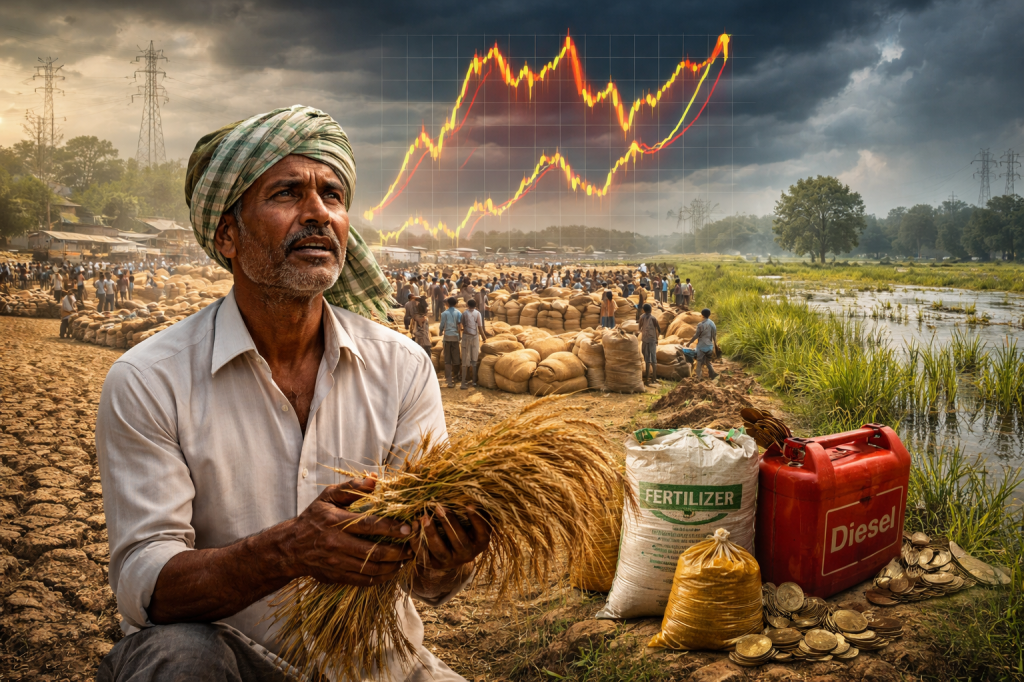
The Historical Illusion of Price-Led Prosperity
For decades, agricultural policy—both in India and globally—has operated under a simplistic assumption: higher food prices would naturally translate into higher farmer incomes. This belief was rooted in classical economic thinking where producers benefit from price increases. However, the reality of agriculture has always been structurally different. Even during the Green Revolution era, while productivity surged, income distribution remained uneven due to fragmented landholdings, state-controlled pricing mechanisms, and weak bargaining power of farmers. What we are witnessing today is not a new crisis, but the deepening of an old structural fault line—where price movements and income realities are increasingly decoupled.
The New Phase: Volatility without Transmission
Agriculture is now entering a more complex phase—“price instability without income stability.” Food prices are rising globally and domestically, driven by supply disruptions, geopolitical tensions, and climate variability. Yet, this inflation is not being transmitted effectively to the farmer. The value chain between farm gate and final consumer has expanded, with intermediaries, logistics costs, processing margins, and speculative trading absorbing much of the price increase. The farmer remains at the weakest node of this chain, often a price taker rather than a price maker.
Climate Variability as a Structural Shock Multiplier
Climate change has fundamentally altered the risk profile of agriculture. Erratic rainfall, unseasonal heatwaves, and increasing frequency of floods are not just affecting output but also amplifying price volatility. A localized crop failure now has ripple effects across markets, pushing prices up. However, farmers facing these shocks often experience yield losses that outweigh any gains from higher prices. In essence, climate variability is creating a paradox—reduced production for the farmer but increased prices for the consumer, widening the disconnect between production risk and income realization.
Input Cost Inflation: The Silent Income Erosion
One of the most critical yet under-discussed aspects of this paradox is the rising cost of inputs. Fertilizers, seeds, pesticides, diesel, and electricity have all witnessed significant cost escalations. Even when output prices rise, the net income of farmers is squeezed due to this input inflation. In many cases, the cost of cultivation grows faster than the price of produce, leading to declining margins. This phenomenon transforms price gains into an illusion, masking the underlying deterioration in farm profitability.
Export Controls and Policy Uncertainty
Government interventions, particularly export bans and stock limits, further complicate the income landscape. While such measures are often justified in the interest of domestic food security and inflation control, they introduce a high degree of policy uncertainty. Farmers, who respond to price signals by increasing production, suddenly find markets restricted when exports are curtailed. This disrupts price realization and discourages long-term investment in agriculture. The absence of a predictable policy regime undermines the very incentives needed for agricultural transformation.
The Structural Constraint: Weak Market Power at the Farm Gate
At the heart of this crisis lies the issue of market power. Most farmers, especially smallholders, operate individually in highly fragmented markets. They lack access to storage, processing, and direct market linkages. As a result, they are forced to sell immediately after harvest when prices are typically at their lowest. The inability to hold produce, negotiate prices, or access diversified markets ensures that they remain price takers. Meanwhile, aggregators, traders, and retailers—who control scale and information—capture a disproportionate share of value.
The Emerging Paradox: Inflation without Prosperity
The broader economic implication of this phenomenon is deeply concerning. Food inflation is rising, contributing to macroeconomic instability and eroding consumer purchasing power. Yet, farmers—the primary producers—are not experiencing corresponding income growth. This creates a dual distortion: urban consumers face higher costs, while rural producers remain economically vulnerable. It challenges the conventional policy narrative that inflation in agriculture is beneficial for farmers.
Towards a New Agricultural Framework: From Price to Power
The future of agriculture cannot be anchored merely in price movements; it must be rooted in enhancing farmer power within the value chain. This requires a shift from price-centric policies to power-centric reforms. Strengthening Farmer Producer Organizations (FPOs), enabling digital market access, investing in decentralized storage and processing infrastructure, and promoting contract farming with safeguards can help rebalance the equation. Equally important is the need for stable and predictable trade policies that align farmer incentives with global opportunities.
A Futuristic Outlook: Data, Decentralization, and Differentiation
Looking ahead, the agriculture sector will increasingly be shaped by data-driven decision-making, decentralized value chains, and product differentiation. Precision farming, climate-resilient crops, and AI-based advisory systems can reduce production risks. At the same time, moving up the value chain—through branding, processing, and direct-to-consumer models—can enhance income realization. However, these transitions will require institutional support, capacity building, and a reimagining of the role of the state as a facilitator rather than a controller.
Breaking the Paradox
The current phase of “price instability without income stability” is a warning signal. It reflects a deeper structural imbalance that cannot be addressed through short-term price interventions alone. The real challenge is to ensure that farmers are not just participants in the market, but empowered stakeholders with the ability to influence outcomes. Unless this shift is achieved, agriculture will continue to operate in a paradox—feeding the economy, yet failing to sustain those who feed it.
#AgricultureCrisis #FarmersIncome #PriceVolatility #ClimateImpact #RuralEconomy #FoodInflation #AgriReforms #MarketPower #FPOs #FutureOfFarming
 "Connecting communities, empowering nations: Unifying the Regional and Global Economy ."
Leave a comment