India’s industrial journey has historically been built on clusters that thrived on proximity, labour availability, and relatively affordable energy. From steel belts in eastern India to textile dyeing hubs in the south and ceramic clusters in the west, energy-intensive clusters became the backbone of manufacturing-led growth. However, the recent energy crisis has fundamentally altered this equilibrium. What was once a silent input—energy—is now emerging as the most strategic determinant of competitiveness, survival, and future investment flows. The crisis has not created the problem; it has exposed a structural fragility that was long embedded in India’s industrial ecosystem.
The Structural Shift: From Cheap Energy to Uncertain Energy Economics
For decades, India’s industrial model operated on an implicit assumption of energy availability at manageable costs, even if quality was inconsistent. Coal-based power, cross-subsidized tariffs, and intermittent policy support created a fragile but workable equilibrium. Today, that equilibrium is breaking down. Rising peak power demand, volatility in coal and gas markets, and the increasing cost of imported fuels have made energy both unpredictable and expensive. Clusters dependent on gas, LPG, or continuous heat processes are already facing disruptions, while electricity tariffs across states are diverging sharply. This signals a transition from a cost-based industrial advantage to a risk-based industrial environment, where uncertainty in energy supply is becoming a core business risk.
Global Pressures and the Carbon Constraint: Competitiveness Redefined
The global industrial landscape is undergoing a profound transformation where carbon intensity is no longer an environmental concern alone but a trade variable. Export-oriented clusters in India—whether in textiles, steel, or chemicals—are increasingly exposed to sustainability-linked compliance regimes and buyer-driven decarbonisation demands. In this evolving framework, energy-intensive clusters are not just competing on cost, but on the embedded energy and emissions within their products. The emerging reality is stark: clusters that fail to transition to cleaner and more efficient energy systems will not only face higher costs but also shrinking market access. Thus, energy transition is no longer optional—it is a condition for survival in global value chains.
Cluster Transformation: From Industrial Estates to Energy Ecosystems
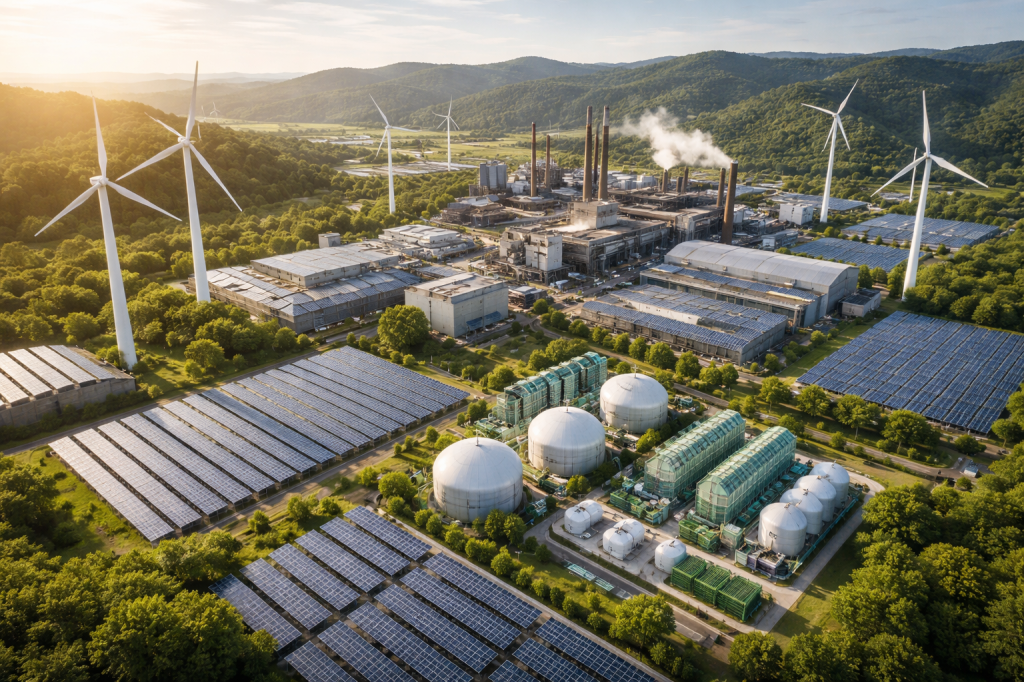
The future of energy-intensive clusters lies in their transformation into integrated energy ecosystems rather than standalone production zones. The traditional model of individual firms managing their own energy needs is giving way to a collective approach. Cluster-level solutions—such as shared renewable energy systems, group captive power models, decentralized grids, and common utilities—are emerging as viable pathways. This shift is particularly critical for MSME-dominated clusters, where individual firms lack the capital and technological capacity to transition independently. The cluster, therefore, becomes the unit of transition, enabling economies of scale in energy procurement, infrastructure investment, and technological adoption.
Technology and Transition Pathways: Efficiency Before Innovation
While the narrative around green hydrogen and advanced decarbonisation technologies is gaining traction, the immediate future of most Indian clusters lies in incremental but impactful interventions. Energy efficiency, process optimisation, waste heat recovery, and partial electrification will drive the first phase of transition. Renewable energy integration—supported by storage solutions—will follow as grid stability improves. Advanced solutions such as hydrogen will play a role in hard-to-abate sectors, but their adoption will be selective and gradual. The transition, therefore, is not a leap but a layered evolution, where technological ambition must align with economic feasibility.
The Emerging Divide: Competitive Clusters vs. Declining Clusters
One of the most critical outcomes of the current energy transition will be the emergence of a sharp divide among industrial clusters. Regions with better infrastructure, policy clarity, grid reliability, and access to renewable energy will attract new investments and upgrade existing capacities. In contrast, clusters that remain dependent on volatile and inefficient energy systems may face gradual decline. This divergence is not just economic but spatial, potentially reshaping India’s industrial geography. The relocation of industries toward energy-secure regions could redefine traditional cluster dominance and create new industrial corridors centered around energy resilience.
The MSME Challenge: Transition Without Disruption
At the heart of India’s cluster economy lies the MSME sector, which faces the dual challenge of adapting to the energy transition while maintaining cost competitiveness. For these enterprises, the transition cannot be capital-intensive or technologically complex. It must be supported through shared infrastructure, innovative financing models, and policy incentives that reduce the burden of upfront investment. Without such support, the transition risks becoming exclusionary, leading to closures, job losses, and social disruption. A just transition framework—combining skilling, financial access, and institutional support—will be essential to ensure that MSMEs remain integral to the future industrial landscape.
Energy as Strategy: The New Industrial Logic
The most profound change emerging from the current crisis is the redefinition of energy from an operational input to a strategic variable. Industrial decisions—location, technology choice, product mix, and export orientation—will increasingly be shaped by energy considerations. Clusters that integrate energy planning into their core strategy will gain a decisive advantage. This includes not only securing reliable supply but also optimizing energy use, reducing emissions, and aligning with global sustainability standards. In this new paradigm, energy efficiency and sustainability are not costs; they are investments in long-term competitiveness.
Futuristic Outlook: Reinventing India’s Industrial Core
Looking ahead, energy-intensive clusters in India are unlikely to diminish in importance. Instead, they will be re-engineered as low-carbon, high-efficiency industrial ecosystems. The transition will be uneven, complex, and at times disruptive, but it is inevitable. Over the next decade, successful clusters will be those that combine technological adaptation, institutional innovation, and strategic energy management. They will operate not just as production centers but as integrated systems where energy, water, materials, and digital intelligence converge.
The recent energy crisis, therefore, should not be seen merely as a short-term disruption but as a structural inflection point. It is forcing India to confront the limitations of its traditional industrial model and to reimagine its clusters for a future defined by uncertainty, sustainability, and global competition. The question is no longer whether energy-intensive clusters have a future, but whether they can evolve fast enough to claim it.
#EnergyTransition
#IndustrialClusters
#EnergySecurity
#Decarbonisation
#MSMECompetitiveness
#RenewableIntegration
#GreenManufacturing
#ClusterTransformation
#CarbonEconomy
#SustainableIndustry
 "Connecting communities, empowering nations: Unifying the Regional and Global Economy ."
Leave a comment