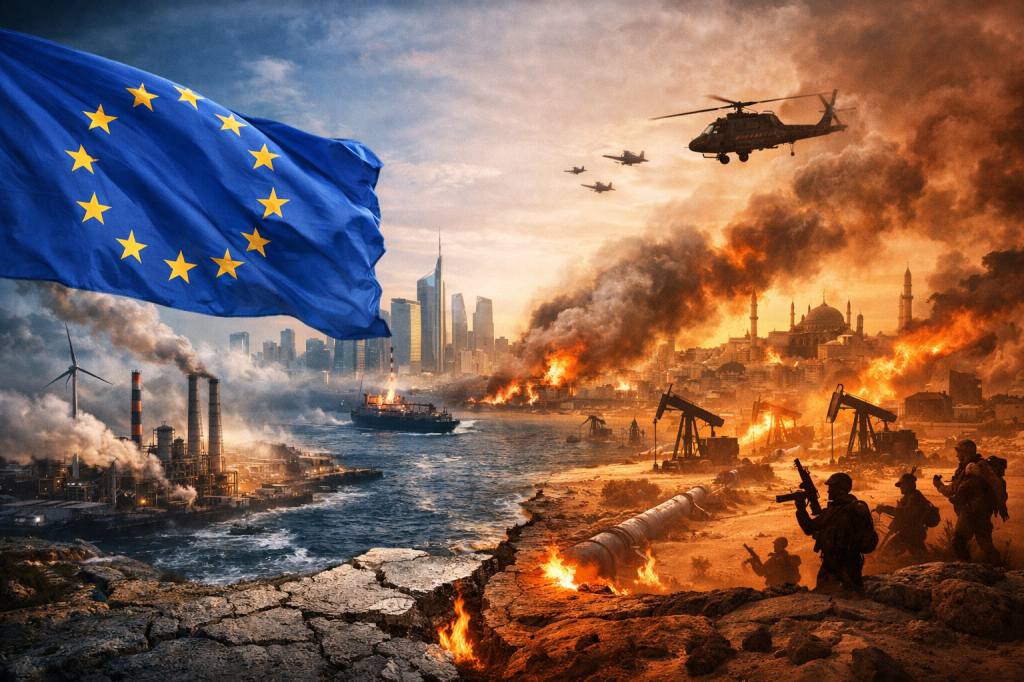
Historical Energy Dependence and Structural Vulnerability
Europe’s economic architecture has long been shaped by its external energy dependencies. Historically reliant on Russian gas, the shock of the Ukraine conflict forced the European Union (EU) to diversify towards liquefied natural gas (LNG) and Middle Eastern oil supplies. However, this shift did not eliminate vulnerability—it merely reconfigured it. The Middle East, accounting for nearly one-third of global oil supply, remains central to Europe’s energy security calculus. Any instability in this region reintroduces systemic risk into an already fragile energy transition pathway. The EU’s push toward renewables, while strategically sound, has not yet achieved the scale required to insulate it from geopolitical shocks.
Energy Prices, Inflation, and Monetary Tightening
The most immediate transmission channel of Middle East crises into the EU economy is through energy prices. Disruptions in oil supply or shipping routes—especially through chokepoints like the Strait of Hormuz or the Red Sea—lead to price spikes. For the EU, which imports over 55% of its energy, even marginal increases translate into significant inflationary pressures. Energy-driven inflation not only erodes household purchasing power but also forces central banks into prolonged monetary tightening. This creates a paradox: while inflation demands higher interest rates, growth stagnation requires stimulus. The result is a prolonged phase of stagflationary risk, particularly in energy-intensive economies such as Germany and Italy.
Supply Chains, Trade Routes, and Logistics Costs
Beyond energy, the crisis disrupts global supply chains, particularly maritime trade. The Red Sea route, a critical artery connecting Europe to Asia via the Suez Canal, handles approximately 12–15% of global trade. Any escalation in conflict leads to rerouting of ships around the Cape of Good Hope, increasing transit time by 10–15 days and raising freight costs by 30–40%. For European industries already grappling with competitiveness issues, this further inflates input costs and delays production cycles. Sectors such as automotive, chemicals, and retail bear the brunt, exacerbating Europe’s declining share in global manufacturing.
Fiscal Stress and Defence Reorientation
The geopolitical instability compels EU nations to increase defence spending, diverting fiscal resources from welfare and development priorities. Countries like Germany, which had historically maintained conservative defence budgets, are now committing substantial funds to military modernization. This shift places additional strain on already stretched public finances, especially in Southern European economies with high debt-to-GDP ratios. The long-term implication is a reallocation of fiscal priorities—from social welfare to security—potentially altering the European social contract.
Migration Pressures and Social Cohesion
Middle East crises also trigger humanitarian consequences, leading to increased migration flows toward Europe. Past experiences, such as the Syrian refugee crisis, have demonstrated how sudden influxes can strain public services and intensify political polarization. Rising migration often fuels populist narratives, challenging the EU’s internal cohesion and complicating consensus-driven policymaking. The economic cost of integration, coupled with sociopolitical tensions, adds another layer of complexity to Europe’s response framework.
Strategic Autonomy vs. Global Interdependence
A critical debate emerging within the EU is the balance between strategic autonomy and global interdependence. The Middle East crisis underscores the risks of excessive reliance on external regions for critical resources. Consequently, the EU is accelerating efforts in energy diversification, including green hydrogen partnerships with North Africa and increased investment in renewables. However, these strategies require time, capital, and technological breakthroughs. In the interim, Europe remains exposed, highlighting the gap between policy ambition and ground reality.
Industrial Competitiveness Under Threat
Higher energy and logistics costs directly impact Europe’s industrial competitiveness. Energy-intensive industries such as steel, fertilizers, and chemicals face rising production costs, prompting some firms to relocate to regions with cheaper energy, such as the United States or Southeast Asia. This deindustrialization risk is not merely economic but strategic, as it weakens Europe’s position in global value chains. The Middle East crisis thus acts as a catalyst, accelerating structural shifts already underway.
Financial Markets and Investment Uncertainty
Geopolitical instability increases volatility in financial markets, affecting investor confidence. European equity markets often react sharply to Middle East tensions, particularly in sectors linked to energy and transportation. Moreover, uncertainty discourages long-term investments, especially in infrastructure and manufacturing. The risk premium associated with Europe increases, making capital more expensive and slowing economic recovery.
The Green Transition Dilemma
Ironically, while the crisis reinforces the urgency of transitioning to renewable energy, it also complicates the process. High energy prices can incentivize renewable investments, but they also increase the cost of transitioning infrastructure. Additionally, short-term reliance on fossil fuels to stabilize energy supply may delay long-term climate goals. This creates a policy dilemma: balancing immediate energy security with long-term sustainability.
A Fragmented Future: Europe’s Strategic Choices
Looking ahead, the implications of Middle East crises for the EU are not merely cyclical but structural. Europe stands at a crossroads where it must decide between reactive crisis management and proactive strategic transformation. The ability to build resilient energy systems, diversify trade routes, and maintain social cohesion will determine its future trajectory. Failure to address these challenges could lead to a gradual erosion of Europe’s economic and geopolitical influence.
In essence, the Middle East crisis is not an external shock for Europe—it is a mirror reflecting its internal vulnerabilities. The real question is not whether Europe can withstand the crisis, but whether it can use this moment to fundamentally reimagine its economic and strategic foundations.
#EnergySecurity #EUeconomy #MiddleEastCrisis #SupplyChainDisruption #InflationShock #Geopolitics #IndustrialCompetitiveness #StrategicAutonomy #MigrationCrisis #GreenTransition
 "Connecting communities, empowering nations: Unifying the Regional and Global Economy ."
Leave a comment