Historical Roots of Price Powerlessness
The inability of farmers to decide the price of their produce is not a recent dysfunction—it is structurally embedded in the evolution of agrarian economies. From colonial-era revenue extraction systems to post-independence procurement frameworks, agriculture has historically been treated as a sector to stabilize food security rather than maximize farmer profitability. Policies such as Minimum Support Price (MSP) were designed as safety nets, not as instruments of price discovery. Over time, this created a paradox: while farmers produce the most essential goods, they remain “price takers” in a system where prices are administratively influenced, politically sensitive, and market-distorted.
Fragmentation and the Economics of Weak Bargaining
At the heart of the problem lies extreme fragmentation. India has over 85% small and marginal farmers, each producing limited surplus. In economic terms, this leads to a classic case of “perfect competition on the supply side” but “oligopsony on the demand side.” Thousands of sellers compete against a handful of traders, aggregators, processors, and retailers. The result is predictable: bargaining power collapses. Unlike industrial producers who can withhold supply or coordinate pricing, farmers are forced into distress selling, especially immediately after harvest when liquidity pressures peak.
Perishability: The Silent Destroyer of Price Power
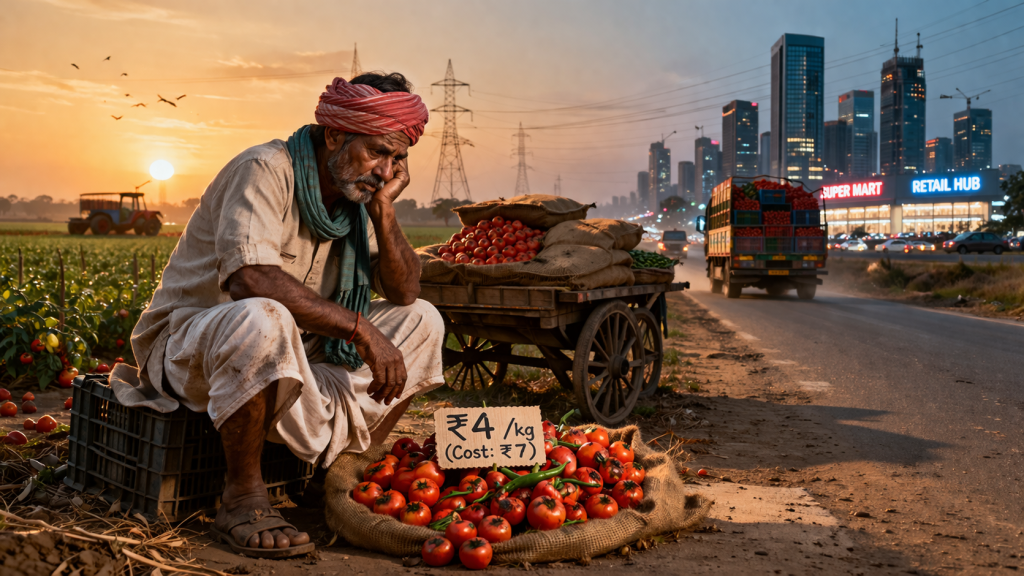
Agricultural commodities are inherently perishable. A tomato farmer cannot “store and wait” for better prices the way a steel producer can. The absence of adequate cold storage and warehousing infrastructure converts time into a liability. Within days—sometimes hours—produce loses value. This creates a forced supply surge during harvest seasons, leading to price crashes. In many cases, farmers receive prices below cost of production, while the same produce later sells at multiples in urban retail markets. The farmer’s inability to control time translates directly into an inability to control price.
Information Asymmetry and Market Opacity
Price discovery mechanisms in agriculture remain opaque and fragmented. While digital platforms and e-NAM initiatives attempt to integrate markets, ground reality still reflects asymmetry. Traders often have better information about demand trends, inter-market arbitrage opportunities, and storage capacities. Farmers, on the other hand, operate with localized and delayed information. This asymmetry allows intermediaries to capture disproportionate margins. In economic terms, the farmer is not just a price taker but an “information-disadvantaged price taker.”
Policy Distortions: Protection Without Empowerment
Government interventions, though well-intentioned, often distort price signals. MSP covers only a limited set of crops and benefits a fraction of farmers, primarily in certain states. Subsidies on inputs such as fertilizers, electricity, and irrigation reduce cost visibility but do not enhance price realization. Export bans, stock limits, and sudden policy reversals—often driven by inflation concerns—further weaken farmers’ pricing power. When global prices rise, farmers are restricted from benefiting fully; when prices fall, safety nets are insufficient. This asymmetry reinforces dependency rather than empowerment.
Supply Gluts and the Absence of Demand Alignment
Agricultural production decisions in India are often supply-driven rather than demand-driven. Crop choices are influenced by tradition, input subsidies, and assured procurement rather than market demand. This leads to cyclical gluts—onions, tomatoes, pulses—where oversupply crashes prices. Without robust agro-processing and value addition ecosystems, excess produce cannot be absorbed efficiently. The result is a structural mismatch: farmers produce more of what the system incentivizes, not what the market demands.
The Value Chain Capture: Where Farmers Lose Margins
A critical examination of the agricultural value chain reveals that farmers capture the smallest share of the final consumer price—often as low as 25–40% for perishable goods. The remaining value is absorbed by intermediaries, logistics providers, processors, and retailers. While each layer adds some value, the disproportionate distribution reflects systemic inefficiencies and power imbalances. In contrast, in developed agricultural markets, farmer cooperatives and integrated supply chains enable producers to capture a higher share of value.
Global Comparison: Why Farmers Elsewhere Fare Better
In countries like the Netherlands or the United States, farmers exercise greater price influence not because markets are free, but because institutions are strong. Farmer Producer Organizations (FPOs), cooperatives, contract farming frameworks, and futures markets enable aggregation, risk management, and forward pricing. In India, while FPOs are being promoted, their scale, governance, and market integration remain limited. Without collective strength, individual farmers remain atomized and powerless.
The Political Economy of Cheap Food
One of the most critical but often under-discussed aspects is the political economy of food pricing. Governments prioritize keeping food inflation low to maintain urban consumption stability. This implicitly suppresses farm-gate prices. In effect, farmers subsidize the rest of the economy through low prices. This “invisible taxation” of agriculture ensures that the burden of food affordability is disproportionately borne by producers rather than shared across the system.
A Futuristic Outlook: Will Farmers Ever Become Price Makers?
Looking ahead, the possibility of farmers becoming price makers depends on structural transformation rather than incremental reforms. Digital agriculture platforms, AI-driven demand forecasting, blockchain-based traceability, and direct-to-consumer (D2C) models have the potential to reduce intermediaries and enhance transparency. However, technology alone cannot solve institutional weaknesses. The real shift must come from aggregation (strong FPOs), infrastructure (storage, logistics), and policy stability (predictable trade and pricing policies).
If these reforms are not implemented at scale, the future may see an even deeper paradox: rising agricultural output coexisting with declining farmer incomes. Climate change will further complicate this dynamic by increasing production volatility, thereby amplifying price uncertainty.
Conclusion: From Producers to Price Takers—A Structural Trap
The inability of farmers to decide prices is not a failure of individuals but a consequence of systemic design. It is a combination of fragmentation, perishability, policy distortions, weak institutions, and political priorities. Until farmers transition from isolated producers to organized economic agents with control over time, information, and market access, price discovery will remain beyond their reach. The real question is not why farmers cannot decide prices—but whether the system is designed to ever allow them to.
#FarmersCrisis #PriceDiscovery #AgriculturalEconomics #MarketFailure #SupplyChainInefficiency #Perishability #MSP #RuralDistress #ValueChainInequality #AgriReforms
 "Connecting communities, empowering nations: Unifying the Regional and Global Economy ."
Leave a comment