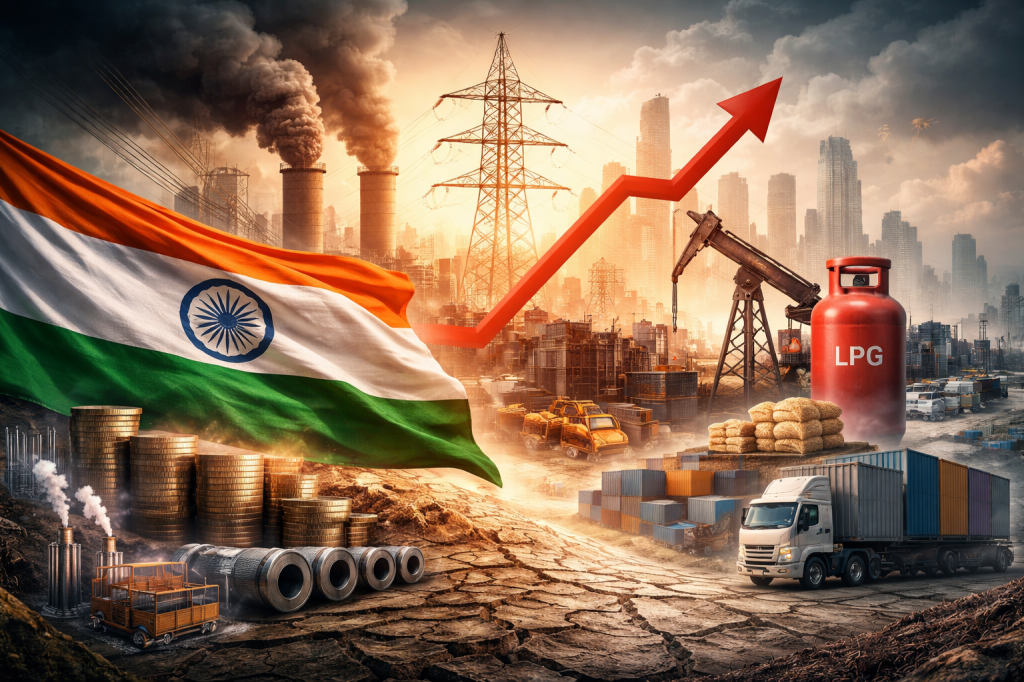
India’s economic journey has always been energy-constrained, but the nature of that constraint has fundamentally changed. In earlier decades, the crisis was visible—blackouts, coal shortages, and load shedding defined the limits of growth. Today, the crisis is more subtle but far more dangerous. Electricity availability has improved, peak demand has touched over 240 GW, and reported shortages are minimal. Yet beneath this surface stability lies a deeper structural stress: rising import dependence, escalating energy costs, cooling-driven demand spikes, and fiscal pressures. India is no longer struggling to produce power—it is struggling to afford its growth model.
The Illusion of Energy Adequacy
On paper, India appears energy-secure. Transmission networks have expanded, renewable capacity has increased, and power deficits have narrowed to near-zero levels. But this “adequacy” masks a critical economic vulnerability. Over 85–90% of crude oil is imported, nearly half of natural gas demand is externally sourced, and even coal imports continue despite domestic abundance. This means that India’s growth engine is externally powered.
The macroeconomic risk becomes clear when global prices rise. A sustained oil price of $100 per barrel can push India’s current account deficit close to 2% of GDP, increase inflation significantly, and force additional government expenditure of nearly ₹3–4 lakh crore. At $120–130 per barrel, growth itself begins to slow toward the 6% range. In a ₹350+ lakh crore economy, energy is no longer an input—it is a macroeconomic shock multiplier.
Manufacturing at Risk: The Weakest Link in India’s Growth Story
India’s manufacturing sector, valued at over ₹45 lakh crore in nominal terms, is the most energy-sensitive segment of the economy. It consumes nearly 42% of total electricity. In sectors like steel, cement, textiles, and chemicals, energy costs can account for 25–40% of total production cost.
A 10–15% increase in energy prices can wipe out margins for MSMEs entirely. Unlike large firms, MSMEs cannot hedge fuel costs, invest in captive solar, or relocate production. The result is not just cost escalation—it is structural erosion. Capacity utilization drops, exports become uncompetitive, and employment contracts silently.
This is where the energy crisis becomes a development crisis. India’s ambition to become a global manufacturing hub under “China+1” is critically dependent on stable and affordable energy. Without it, the opportunity shifts to countries offering better cost predictability.
Logistics and Trade: The Invisible Transmission Channel
The second-largest economic impact lies in transport, logistics, and trade—together contributing over ₹56 lakh crore to India’s economy. Logistics alone accounts for nearly ₹24 lakh crore (about 8% of GDP).
Every increase in fuel prices directly raises freight costs, aviation fuel expenses, shipping charges, and last-mile delivery costs. This is not confined to transport companies—it flows into food prices, e-commerce costs, export competitiveness, and even construction activity.
Energy inflation here behaves like a tax on the entire economy. It is invisible, widespread, and difficult to reverse.
Agriculture: Low GDP Share, High Economic Sensitivity
Agriculture contributes around ₹54 lakh crore to GVA, but its real importance lies in employment and inflation. The sector consumes about 17% of electricity, primarily through irrigation, and is heavily dependent on diesel for mechanization and logistics.
Energy shocks increase fertilizer costs, irrigation expenses, and transport costs, all of which translate into higher food prices. The government attempts to cushion this through subsidies—such as over ₹1 lakh crore annually on fertilizers—but this creates fiscal stress.
Thus, while agriculture may appear moderately impacted in GDP terms, it becomes a high-impact sector in terms of inflation, rural distress, and political economy.
Households and Consumption: The Silent Erosion of Demand
Private consumption constitutes over 56% of India’s GDP, making it the single largest driver of growth. Energy inflation directly erodes this base.
Even when retail fuel prices are controlled, households pay indirectly through higher transport fares, rising food prices, increased electricity bills, and costlier services. The cumulative effect is a reduction in disposable income.
This is where the energy crisis becomes dangerous—it weakens demand at the bottom of the pyramid while policy continues to focus on supply-side expansion. Growth without consumption sustainability is inherently fragile.
The New Energy Shock: Cooling Demand Explosion
A structural shift is underway that is often underestimated—cooling demand. Air-conditioner sales have surged, and cooling alone contributed around 60 GW to peak load in 2024. By 2030, this could rise to nearly 140 GW, potentially accounting for one-third of peak electricity demand.
This is not just a climate issue; it is an economic one. Rising temperatures, urbanization, and income growth are combining to create a new category of energy demand that is both seasonal and highly concentrated.
India may soon face a paradox: sufficient installed capacity annually, but severe peak-time stress driven by cooling loads. This will increase infrastructure costs, require massive grid investments, and push tariffs upward.
Digital Economy: The Hidden Energy Consumer
India’s services sector has long been considered low-energy, but this assumption is rapidly becoming outdated. Data center capacity has quadrupled from around 375 MW in 2020 to nearly 1,500 MW in 2025, and is expected to grow further with AI adoption.
Digital infrastructure—cloud computing, fintech, AI models—requires continuous and reliable power, often with high cooling requirements. This transforms the services sector into a significant energy consumer.
If energy costs rise, India’s competitiveness as a digital hub could weaken, particularly against countries offering cheaper and greener electricity.
Power Sector: Operationally Improved, Structurally Fragile
India’s power sector has improved in efficiency—AT&C losses have declined to around 15%, and the gap between cost and revenue has narrowed significantly. Investments under schemes like RDSS are substantial.
However, the sector remains financially vulnerable. Political constraints prevent full cost pass-through to consumers, forcing DISCOMs to absorb shocks. This creates a cycle of delayed payments, reduced investment, and long-term instability.
The risk is not immediate collapse, but gradual weakening—a system that functions, but under increasing financial stress.
Ranking the Economic Impact: A Hard Reality Check
If one were to rank sectors by the size and intensity of impact under a sustained energy crisis, the order becomes clear. Manufacturing and MSMEs face the highest direct impact due to cost sensitivity and global competition. Transport and logistics follow closely, acting as the transmission channel for inflation across the economy. Households come next, as consumption erosion affects overall demand. Agriculture ranks lower in GDP terms but higher in inflationary and social impact. The power sector itself is a latent risk, while the digital economy is an emerging vulnerability that could escalate rapidly.
Growth Will Be Energy-Determined
India’s aspiration to become a $30 trillion economy is fundamentally an energy story. The question is no longer whether India can produce enough electricity, but whether it can do so at a cost, reliability, and sustainability level that supports large-scale industrialization and mass consumption.
If energy remains expensive and externally dependent, India risks entering a phase of “constrained growth”—where ambition exceeds infrastructure capability. If managed strategically, however, energy could become a competitive advantage through decentralized grids, renewable integration, storage innovation, and energy-efficient industrial ecosystems.
Energy Is the New Economic Policy
India’s energy crisis is not a sectoral issue—it is a systemic one. It cuts across manufacturing competitiveness, inflation management, fiscal stability, and global trade positioning. The shift from visible shortages to invisible economic stress makes it more dangerous.
The real policy question is whether India continues to treat energy as a utility or redefines it as the central pillar of economic strategy. Because in the coming decade, the difference between growth and stagnation may not be decided by capital or labour—but by energy.
#EnergyEconomics #IndiaGrowth #EnergyCrisis #ManufacturingIndia #OilDependence #InflationImpact #LogisticsCost #DigitalEconomy #ClimateEnergy #ViksitBharat
 "Connecting communities, empowering nations: Unifying the Regional and Global Economy ."
Leave a comment