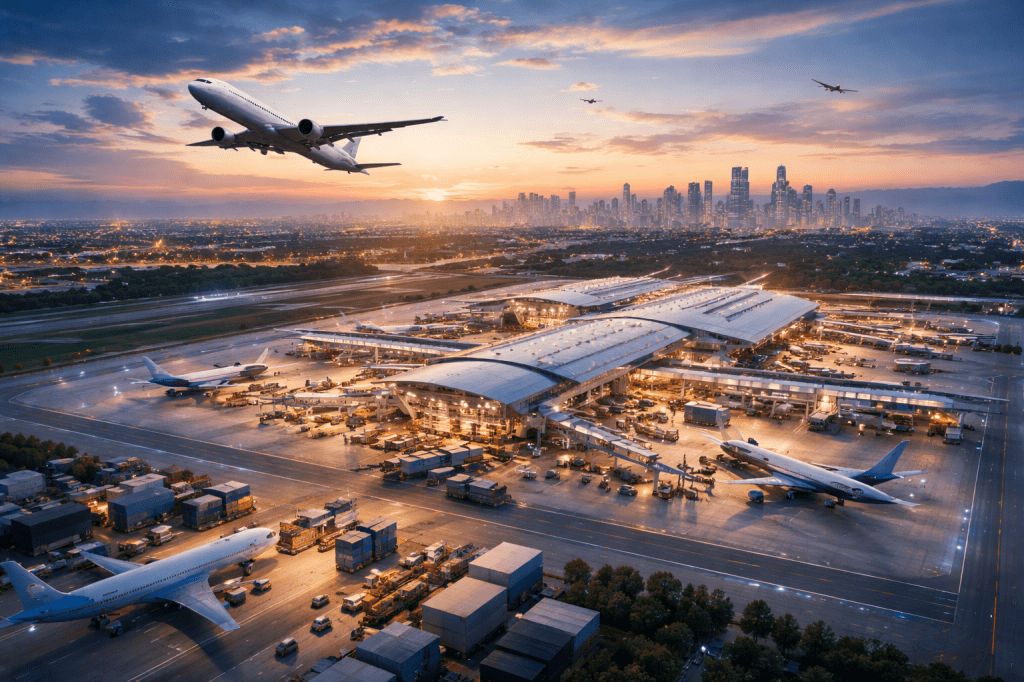
From State Monopoly to Market Expansion: A Historical Lift-Off with Structural Limits
India’s aviation story began as a tightly controlled, state-led system, where air travel was a luxury and connectivity was limited to a narrow elite segment. The liberalization phase of the 1990s unlocked private participation, transforming aviation into a competitive industry. Over the last two decades, India has emerged as one of the fastest-growing aviation markets in the world, with passenger traffic crossing pre-pandemic levels and new airports being developed at an unprecedented pace. However, this expansion has largely been volume-driven rather than value-driven. The historical trajectory shows a recurring pattern—rapid entry of airlines, aggressive price competition, and eventual financial distress. From Kingfisher to Jet Airways, the sector has repeatedly demonstrated that growth in numbers does not necessarily translate into sustainable profitability.
Passenger Growth vs Profitability Paradox: The Illusion of Scale
India today stands among the top aviation markets globally in terms of passenger traffic, yet its airline industry remains structurally fragile. The core issue lies in a distorted business model—high operating costs combined with one of the lowest fare structures in the world. Aviation turbine fuel (ATF) in India is heavily taxed, airport charges remain high, and currency volatility adds pressure due to leasing costs denominated in dollars. As a result, airlines operate on razor-thin margins, where even minor shocks—fuel price fluctuations, geopolitical tensions, or currency depreciation—can destabilize operations. The paradox is stark: more passengers, more flights, more airports, but not necessarily more profits. This raises a fundamental question—has India built a scale economy without building a viable economic model?
Infrastructure Expansion: Capacity Creation Without Demand Mapping
The government’s aggressive push toward airport infrastructure—targeting over 200 operational airports—reflects a strong belief in aviation as a growth driver. Projects like Jewar Airport symbolize this ambition, aiming to position India as a global aviation hub. However, infrastructure expansion has often preceded demand maturity. Many regional airports operate below capacity, and even major hubs face uneven utilization across time bands. The underlying concern is whether India is building airports based on projected demand or aspirational growth narratives. Without synchronized development of regional economies, industrial clusters, and income levels, airport infrastructure risks becoming underutilized capital assets rather than engines of growth.
The Missing Link: Aviation and Industrial Ecosystems
Globally, successful aviation hubs are deeply integrated with industrial and logistics ecosystems. Airports like Dubai, Singapore, and Frankfurt thrive not merely on passenger traffic but on cargo, trade facilitation, and value chain integration. In India, this linkage remains weak. Aviation has been treated as a standalone sector rather than as part of a broader economic architecture. The absence of strong air cargo ecosystems, limited cold chain integration, and weak last-mile connectivity reduce the multiplier impact of aviation investments. If airports like Jewar are to succeed, they must evolve into logistics and export hubs, supporting MSMEs, e-commerce, and global supply chains. Without this integration, aviation growth will remain superficial and consumption-driven rather than production-linked.
Low-Cost Model Trap: Democratisation or Distortion?
The rise of low-cost carriers has democratized air travel in India, making it accessible to a wider population. However, this model has also created structural distortions. Airlines compete primarily on price, leading to compromised service quality, limited differentiation, and financial instability. The absence of a balanced mix of full-service and low-cost models restricts the industry’s ability to capture higher value segments. Moreover, excessive price sensitivity among consumers discourages long-term investments in service excellence and innovation. The sector risks being trapped in a “low-cost equilibrium,” where affordability comes at the expense of sustainability.
Cargo, Not Cabins: The Untapped Economic Multiplier
The future of Indian aviation may not lie in passenger cabins but in cargo holds. India’s share in global air cargo remains disproportionately low relative to its economic size. With the rise of e-commerce, global value chains, and time-sensitive exports, air cargo has the potential to become a major growth driver. Yet, policy focus and investments have historically prioritized passenger infrastructure over cargo ecosystems. Developing integrated air cargo hubs, streamlining customs processes, and linking airports with industrial corridors could transform aviation into a critical enabler of export-led growth. This shift from passenger-centric to logistics-centric aviation is essential for long-term sustainability.
Sustainability vs Expansion: A Contradiction in Motion
India’s aviation expansion is unfolding at a time when global discourse is increasingly focused on climate change and sustainability. While new airports are being designed as “green” or “net-zero,” the fundamental reality remains that aviation is a carbon-intensive industry. The contradiction between rapid expansion and environmental commitments will become more pronounced in the coming years. Carbon taxes, sustainable aviation fuel (SAF) mandates, and global regulatory pressures could significantly alter the cost structure of the industry. India must prepare for this transition by investing in green technologies, alternative fuels, and efficiency improvements, rather than relying solely on infrastructure expansion.
Futuristic Outlook: From Mobility to Economic Architecture
Looking ahead, the aviation industry in India must transition from being a mode of transport to becoming a core component of economic architecture. This requires a shift in thinking—from building airports to building ecosystems, from passenger growth to value creation, and from short-term expansion to long-term sustainability. The integration of aviation with digital platforms, AI-driven logistics, multimodal transport networks, and industrial clusters will define the next phase of growth. If executed strategically, aviation can become a catalyst for India’s ambition of becoming a global manufacturing and trade hub. If not, it risks remaining an overbuilt, under-optimized sector.
Growth is Not Enough—Direction Matters
India’s aviation industry stands at a critical inflection point. The past has been about expansion, the present is about consolidation, and the future must be about integration and sustainability. The key challenge is not whether India can build more airports or carry more passengers—it is whether the industry can create real economic value. Without addressing structural inefficiencies, aligning with industrial ecosystems, and preparing for global sustainability norms, the sector’s growth story may remain incomplete. In aviation, as in economics, altitude without direction does not guarantee progress.
#AviationEconomics #AirportInfrastructure #AirCargoLogistics #LowCostCarrierTrap #ATFCostIndia #MSMEExports #SupplyChainIntegration #SustainableAviation #RegionalConnectivity #EconomicEcosystems
 "Connecting communities, empowering nations: Unifying the Regional and Global Economy ."
Leave a comment