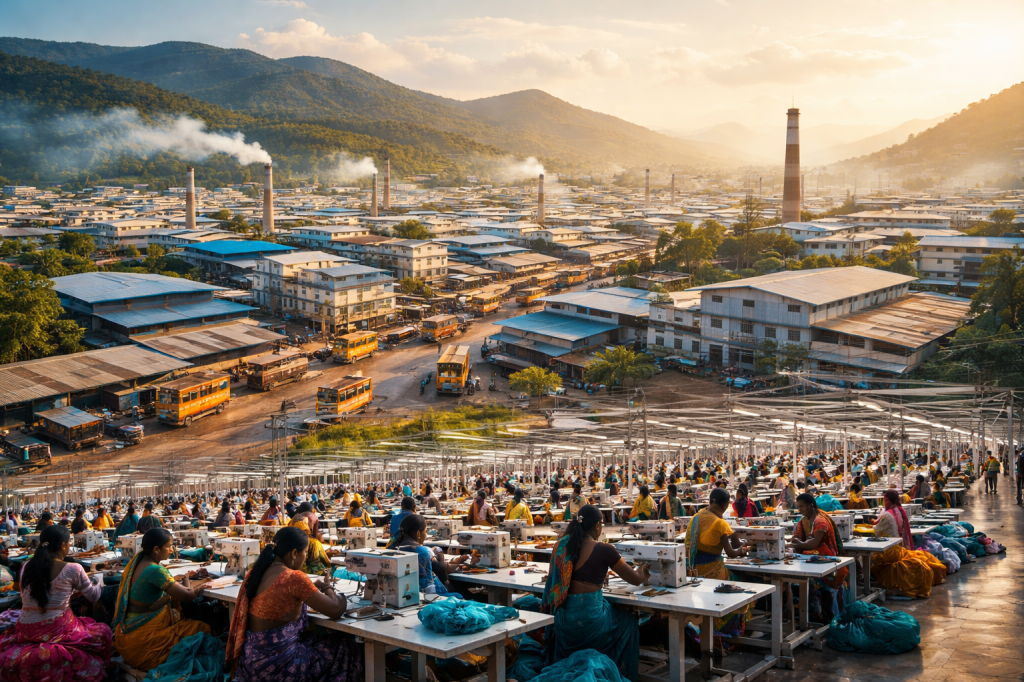
Introduction: The Forgotten Backbone of Industrial India
India’s legacy industrial clusters—spread across textiles, handicrafts, engineering, leather, and food processing—have historically been the backbone of employment, exports, and regional development. Yet, in a rapidly evolving global economy shaped by supply chain realignments, sustainability pressures, and technological disruption, many of these clusters are struggling to remain relevant. The question is no longer whether they can survive, but whether they can transform into globally competitive ecosystems.
A critical insight emerging from recent discussions is that cluster development must move beyond fragmented policy interventions and instead focus on clearly defined outcomes, measurable impact, and replicable models grounded in real success stories.
Defining the Right Outcomes: Competitiveness and Jobs
The improvement of legacy clusters must begin with clarity on outcomes. Two interconnected goals stand out as non-negotiable:
Global Competitiveness:
Clusters must integrate into global value chains, not just operate as domestic supply bases. Competitiveness today is defined by compliance, quality, speed, traceability, and sustainability. Without global integration, claims of competitiveness remain superficial.
Employment Generation:
Clusters must deliver measurable job creation. Not just preservation of existing employment, but incremental, quality jobs—especially for women and youth. This is crucial in a country where industrial employment has not kept pace with population growth.
The real test of cluster transformation lies in whether these two outcomes are achieved simultaneously.
Learning from Success: The Power of Replicable Models
India does not need to reinvent cluster development from scratch. There are proven models that demonstrate how legacy clusters can evolve into globally integrated ecosystems. The key lies in extracting principles rather than copying structures blindly.
What distinguishes successful clusters is not just infrastructure or incentives, but a deeper alignment between industry needs, institutional support, and long-term vision. A structured toolkit based on such models can help standardize approaches while allowing contextual flexibility across regions and sectors.
Core Principles: What Actually Works
Demand-Driven Development:
The most successful cluster transformations are led by industry demand—not government supply. Businesses define the problem, articulate the need, and co-invest in solutions. This ensures relevance, ownership, and sustainability.
Stakeholder Convergence:
Cluster success depends on coordinated action across multiple stakeholders—government departments, financial institutions, industry bodies, and knowledge partners. Fragmented schemes rarely deliver results; convergence around a shared business plan does.
These two principles—demand-driven strategy and institutional convergence—form the foundation of any meaningful cluster revitalization effort.
Structural Challenges: Why Legacy Clusters Struggle
Despite their historical strengths, most legacy clusters face deep-rooted structural constraints:
Outdated Infrastructure: Congested spaces, lack of standardized facilities, and absence of modern industrial ecosystems limit scalability.
Environmental Pressures: Increasing global emphasis on sustainability exposes gaps in waste management, water usage, and compliance.
Labour and Social Gaps: Informal employment, lack of worker housing, and limited social security reduce workforce stability.
Market Disconnect: Many clusters remain disconnected from global buyers, branding platforms, and evolving consumer preferences.
Skill Deficits: Traditional skills are not always aligned with modern production technologies or global quality standards.
These are not isolated issues—they are interconnected constraints that require systemic solutions.
Practical Solutions: Building the Ecosystem
Modern Industrial Infrastructure:
Development of industrial parks with standardized facilities allows firms to scale efficiently. Governance through industry-led entities ensures accountability and responsiveness.
Sustainable Resource Management:
Water recycling, effluent treatment, and shared environmental infrastructure are no longer optional—they are prerequisites for global market access.
Worker-Centric Development:
Affordable and safe housing, especially for women workers, enhances labour participation and retention. Clusters must evolve as social ecosystems, not just production hubs.
Market Access Platforms:
Regular exhibitions, buyer-seller meets, and branding initiatives help clusters connect with global markets and reduce dependence on intermediaries.
Skill Ecosystems:
Partnerships with training institutions aligned to industry needs ensure a steady pipeline of skilled labour. Skill development must be continuous, not episodic.
Access to Finance:
Cluster-based financing models, including banking consortia and blended finance, can unlock capital for both infrastructure and enterprise growth.
The Bigger Insight: Clusters as Systems, Not Locations
One of the most critical shifts required in policy thinking is to view clusters not as geographical concentrations of firms, but as integrated economic systems. These systems combine production, infrastructure, labour, finance, environment, and markets into a cohesive whole.
Without this systemic approach, interventions remain piecemeal—and outcomes remain limited.
The Way Forward: A Toolkit for Transformation
A structured, adaptable toolkit for cluster development can serve as a national framework. Such a toolkit should:
Define measurable outcomes (exports, jobs, productivity)
Embed demand-driven planning processes
Institutionalize stakeholder convergence
Provide templates for infrastructure, governance, and financing
Integrate sustainability and compliance as core elements
This approach reduces duplication of effort and accelerates learning across clusters.
From Legacy to Leadership
India stands at a critical juncture where global supply chains are being reconfigured and new opportunities are emerging. Legacy clusters, if transformed effectively, can become engines of export growth, employment generation, and regional development.
However, transformation requires honesty. Not all clusters will survive in their current form. Those that fail to integrate, upgrade, and adapt may fade. But those that embrace demand-driven strategies, build collaborative ecosystems, and align with global standards can move from survival to leadership.
The future of India’s industrial growth may well depend on whether its legacy clusters can reinvent themselves—not as relics of the past, but as competitive nodes in a rapidly changing global economy.
#LegacyClusters #IndustrialTransformation #GlobalValueChains #MSMEGrowth #ClusterDevelopment #SustainableIndustry #EmploymentGeneration #MakeInIndia #ExportCompetitiveness #EconomicReforms
 "Connecting communities, empowering nations: Unifying the Regional and Global Economy ."
Leave a comment