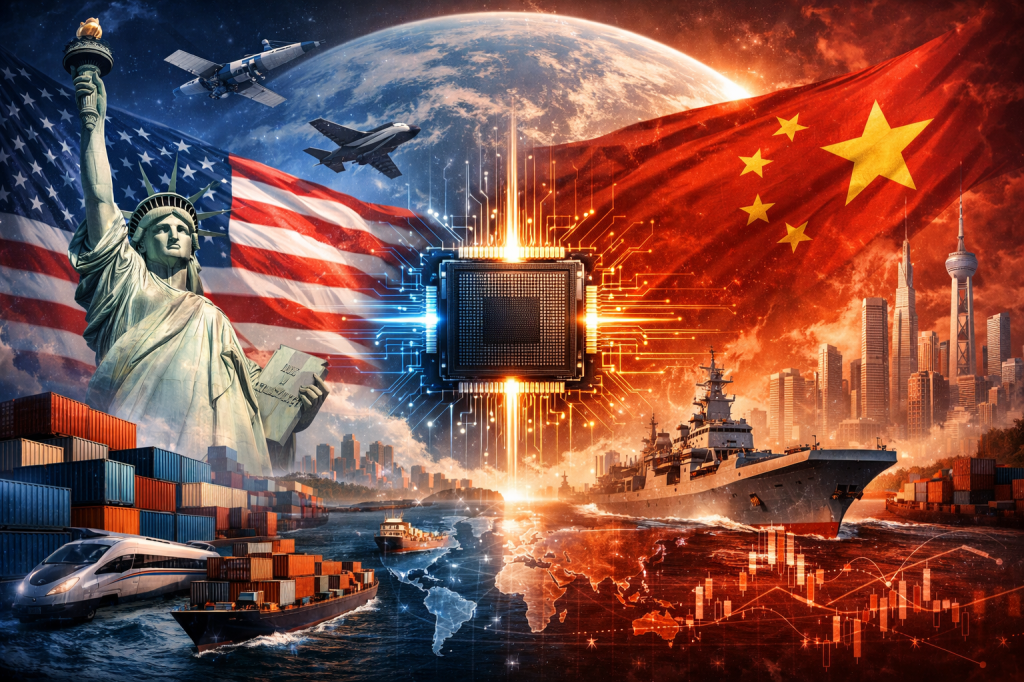
Historical Roots of a Strategic Rivalry
The strategic competition between the United States and China is not merely a geopolitical contest between two powerful nations; it represents a profound restructuring of the global economic and political order. Historically, global power transitions have often been accompanied by periods of instability. From the rivalry between Britain and Germany before World War I to the Cold War between the United States and the Soviet Union, history suggests that the rise of a new power often triggers strategic anxiety within the established hegemon. The contemporary tension between Washington and Beijing reflects a similar pattern, but with a critical difference: the two economies are deeply intertwined through trade, finance, and technology.
China’s rise has been one of the most remarkable economic transformations in modern history. In 1980, China’s share of global GDP was less than 2 percent. Today, it accounts for roughly 18 percent of global output measured by purchasing power parity. The United States remains the world’s largest economy in nominal terms and continues to dominate advanced technologies, financial markets, and military capabilities. However, the rapid industrialization and technological advancement of China have significantly altered the balance of economic power.
Economic Interdependence and Strategic Distrust
One of the paradoxes of the US–China relationship is that while both countries are strategic competitors, they remain economically interdependent. China has long been a manufacturing hub for global supply chains, exporting electronics, machinery, and consumer goods to the United States and other developed economies. At the same time, China holds significant reserves in US Treasury securities and relies on access to global markets for sustaining growth.
However, this interdependence has gradually transformed into strategic vulnerability in the eyes of policymakers. The United States has increasingly perceived China’s economic rise as a challenge to its technological leadership and industrial base. Concerns about intellectual property, industrial subsidies, and state-led industrial policy have intensified debates about fair competition. As a result, trade tensions escalated in the late 2010s, leading to tariffs, export controls, and restrictions on technology transfer.
The competition has now moved beyond tariffs into deeper structural areas such as semiconductor supply chains, artificial intelligence, quantum computing, and advanced manufacturing. The United States has introduced restrictions on advanced chip exports and pressured allies to limit technology transfers to Chinese firms. China, in response, has accelerated its domestic innovation programs and invested heavily in semiconductor self-sufficiency.
Technology as the Core Battlefield
Technology has emerged as the central arena of strategic competition between the two powers. The control over advanced computing capabilities, artificial intelligence infrastructure, and digital platforms increasingly determines economic productivity and military advantage. Companies involved in semiconductor manufacturing, cloud computing, and telecommunications infrastructure are now at the heart of geopolitical tensions.
The competition over semiconductor supply chains illustrates this transformation clearly. Advanced chip manufacturing depends on a complex ecosystem involving design firms, manufacturing facilities, specialized equipment suppliers, and rare earth materials. The United States, along with its allies, still controls many critical nodes of this ecosystem. At the same time, China is investing billions of dollars to develop domestic alternatives and reduce technological dependence.
This technological rivalry has broader implications for global innovation. Instead of a unified global technology ecosystem, the world may gradually move toward parallel technological systems. One ecosystem may revolve around US-led standards and alliances, while another may develop around Chinese platforms and infrastructure. Such fragmentation could increase costs for businesses and slow down global technological diffusion.
Supply Chains and the Politics of Economic Security
Another dimension of the US–China competition is the restructuring of global supply chains. For decades, globalization encouraged companies to prioritize efficiency and cost reduction. Manufacturing activities were concentrated in regions offering lower production costs and large labor pools, particularly in East Asia.
Today, however, economic security has become a central policy concern. Governments are increasingly emphasizing supply chain resilience, strategic autonomy, and domestic manufacturing capacity. The COVID-19 pandemic and geopolitical tensions exposed vulnerabilities in highly concentrated supply chains, especially in sectors such as pharmaceuticals, semiconductors, and critical minerals.
As a result, many countries are pursuing strategies such as “China+1,” encouraging companies to diversify manufacturing locations to countries like Vietnam, India, and Mexico. While these strategies aim to reduce dependence on a single production hub, they also reflect a broader shift toward a more fragmented global economic system.
Military and Strategic Dimensions
Beyond economics and technology, the rivalry between the United States and China also has significant military and strategic implications. The Indo-Pacific region has become the focal point of this competition. Issues related to the South China Sea, Taiwan, and regional security alliances increasingly influence strategic calculations on both sides.
The United States has strengthened partnerships with regional allies through frameworks such as the Quad and AUKUS, aiming to maintain a balance of power in the Indo-Pacific. China, on the other hand, has expanded its naval capabilities and invested in infrastructure projects across Asia, Africa, and Europe through initiatives like the Belt and Road Initiative.
These developments highlight a broader contest for influence in shaping regional order. While the United States emphasizes alliance networks and security partnerships, China focuses on infrastructure connectivity and economic engagement.
The Global South and the Emerging Multipolar Order
The rivalry between Washington and Beijing also affects countries across the Global South. Many developing economies benefit from Chinese infrastructure financing while simultaneously maintaining strong economic and security ties with the United States and its allies. Rather than choosing sides, these countries often pursue strategic autonomy by engaging with both powers.
India, for example, participates in US-led security dialogues while maintaining economic interactions with China and other emerging economies. Similarly, Southeast Asian countries continue to balance relations between competing powers to maximize economic opportunities and minimize strategic risks.
This balancing behavior suggests that the future global order may not be strictly bipolar. Instead, it could evolve into a complex multipolar system where multiple regional powers influence global governance and economic networks.
The Future Trajectory of Strategic Competition
Looking ahead, the competition between the United States and China is likely to shape global economic and political dynamics for decades. The contest is not only about military power or economic size; it is about technological leadership, institutional influence, and the ability to shape global rules.
One possible scenario is the emergence of a divided technological and economic system, where global supply chains split into competing blocs. Another possibility is a managed competition in which both countries establish mechanisms to prevent escalation while continuing to compete in strategic sectors.
The ultimate outcome will depend on how both powers manage the delicate balance between cooperation and rivalry. Global challenges such as climate change, financial stability, and public health require collaboration between major powers. Yet strategic distrust and geopolitical tensions continue to complicate such cooperation.
A Critical Reflection on Power Transitions
The strategic competition between the United States and China represents more than a bilateral rivalry; it reflects the broader transformation of the global system from a unipolar moment dominated by the United States to a more contested and uncertain order. Historically, power transitions have been turbulent, but they have also reshaped international institutions and economic structures.
The challenge for the coming decades will be whether this competition can be managed without descending into destructive confrontation. If the rivalry evolves into a framework of competitive coexistence, it may stimulate innovation and economic transformation. However, if strategic mistrust continues to deepen, the world could face a prolonged period of geopolitical fragmentation, technological decoupling, and economic instability.
In this unfolding contest, the stakes extend far beyond the two powers involved. The structure of global governance, the openness of international trade, and the future trajectory of technological development will all be shaped by how this rivalry evolves.
#USChinaRivalry #Geopolitics #GlobalEconomy #TechnologyWar #SupplyChains #SemiconductorRace #IndoPacific #GlobalPowerShift #MultipolarWorld #StrategicCompetition
 "Connecting communities, empowering nations: Unifying the Regional and Global Economy ."
Leave a comment