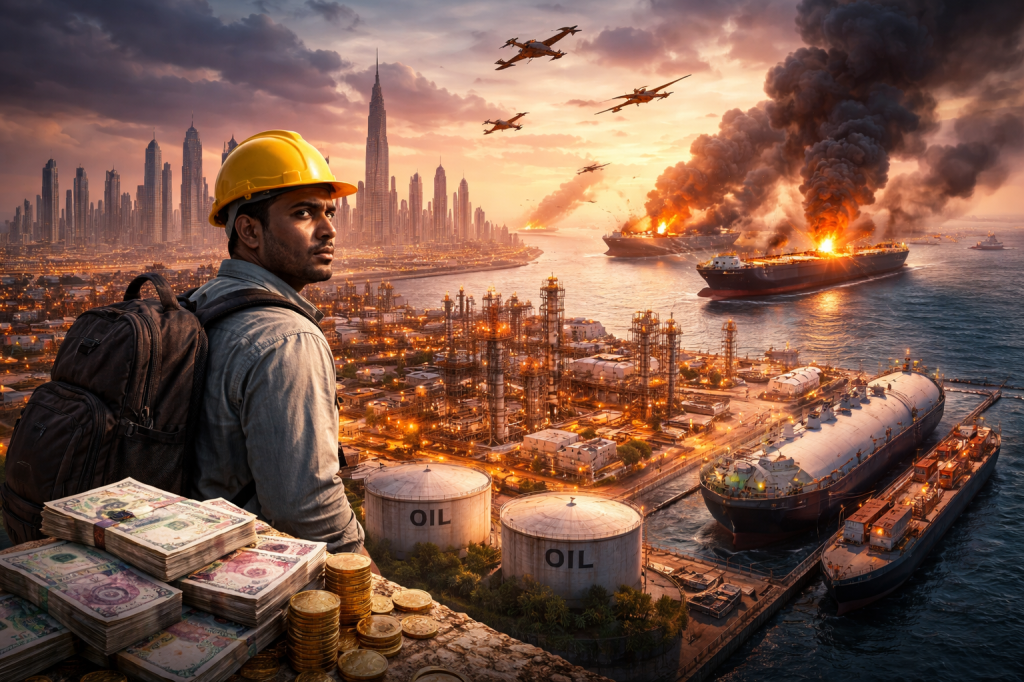
A Region That Quietly Powers India’s Economy
For decades, the Middle East has functioned as one of the most critical external pillars of India’s economic system. The relationship is not limited to diplomacy or historical connections; it is deeply embedded in India’s energy security, migration flows, trade corridors, and financial stability. Nearly every major macroeconomic indicator of India—energy prices, remittance inflows, shipping routes, and export markets—intersects with West Asia.
A large-scale war in the Middle East therefore does not remain a distant geopolitical conflict for India. Instead, it travels quickly through multiple economic channels, affecting the cost of living, industrial competitiveness, and even the stability of India’s balance of payments. In a world where global supply chains are increasingly fragile, the Middle East remains one of the few regions where energy, labour mobility, and trade flows converge simultaneously for India.
Energy Dependence: The First Shock Wave
The most immediate impact of a Middle East conflict on India comes through energy markets. India is the world’s third-largest consumer of crude oil, and more than 85 percent of its oil demand is met through imports. A substantial portion of these imports originates from countries in the Gulf region such as Saudi Arabia, Iraq, the United Arab Emirates, and Kuwait.
Even more strategically important is the Strait of Hormuz, one of the world’s most sensitive maritime chokepoints. Roughly one-fifth of global oil trade passes through this narrow corridor. Any military escalation or disruption in this area immediately pushes global oil prices upward. For India, this translates directly into higher import bills.
The implications go far beyond petrol prices. Crude oil is a foundational input for multiple sectors including transportation, fertilizers, plastics, chemicals, aviation, and power generation. A sustained increase in oil prices quickly feeds into inflation, fiscal pressure on fuel subsidies, and a widening current account deficit.
In essence, an energy shock from the Middle East acts like a tax on the entire Indian economy.
LNG and Gas Vulnerability
While crude oil attracts most attention, natural gas represents another strategic vulnerability. A large share of India’s liquefied natural gas imports comes from Qatar and other Gulf producers. Gas is increasingly important for India’s power sector, fertilizer production, and city gas distribution networks.
If geopolitical tensions interrupt LNG shipping routes or increase insurance costs for tankers, the price of gas can surge sharply. Such increases affect fertilizer subsidies, electricity tariffs, and industrial energy costs, thereby placing additional strain on government finances and consumer spending.
The Indian Diaspora: A Silent Economic Engine
Beyond energy, India’s most powerful connection to the Middle East is its people. Nearly ten million Indians live and work in Gulf countries, making the region home to one of the largest overseas Indian communities in the world.
These workers are employed across sectors such as construction, infrastructure development, aviation, hospitality, healthcare, retail, and logistics. Their economic contribution to India is enormous because they send large portions of their income back home.
India has consistently been the largest recipient of remittances globally, receiving more than $120 billion annually in recent years. A significant share of these funds originates from Gulf economies.
If a regional war slows construction projects, reduces government spending, or disrupts economic activity in Gulf states, Indian workers could face job losses, delayed payments, or visa restrictions. Even a modest decline in remittances would have ripple effects across several Indian states such as Kerala, Uttar Pradesh, Bihar, and Telangana where Gulf migration forms a crucial pillar of household income.
Remittances are not just personal transfers—they support education, healthcare, housing construction, and small business investments in India’s domestic economy.
Trade and the Emerging FTA Architecture
In recent years, India has significantly expanded its economic engagement with the Middle East through trade agreements and strategic partnerships. The Comprehensive Economic Partnership Agreement (CEPA) with the United Arab Emirates has already boosted bilateral trade dramatically, while negotiations with the Gulf Cooperation Council aim to create a broader regional framework.
These agreements are designed to expand Indian exports in sectors such as gems and jewellery, textiles, engineering goods, food products, pharmaceuticals, and services.
However, war introduces multiple barriers to this trade architecture. Shipping costs rise, insurance premiums increase, ports become congested, and regional demand may weaken. Governments in conflict zones also tend to prioritize security and fiscal stability rather than trade liberalization.
Thus, a prolonged conflict could slow the momentum of India’s new Middle East trade strategy.
Shipping Routes and Supply Chain Disruptions
Another critical dimension is maritime logistics. Much of India’s trade with Europe and the Mediterranean region passes through the Red Sea and Suez Canal corridor. Conflicts in West Asia can disrupt these routes, forcing shipping companies to take longer paths around Africa.
This rerouting increases freight costs, delivery times, and inventory expenses. Exporters in sectors such as textiles, auto components, chemicals, and engineering goods—many of which operate on thin margins—are particularly vulnerable.
For India’s export-oriented industries, logistical uncertainty can reduce competitiveness in global markets.
Inflation, Fiscal Stress, and the Rupee
The macroeconomic consequences of Middle East instability extend into India’s financial system. Rising energy prices increase India’s import bill, putting pressure on the current account deficit. A wider deficit often leads to depreciation of the Indian rupee.
Currency depreciation can further increase the cost of imports, creating a feedback loop of inflationary pressure. The Reserve Bank of India may then face the difficult task of balancing inflation control with economic growth, especially if global financial markets become volatile during the conflict.
At the same time, the government may have to expand fiscal support to cushion consumers from high fuel prices.
A Strategic Paradox for India
Despite these vulnerabilities, India also holds certain strategic advantages. Over the past decade, it has diversified its crude import sources and strengthened relationships with multiple energy suppliers. Strategic petroleum reserves provide a limited buffer against short-term shocks.
Moreover, Gulf economies themselves depend heavily on Indian workers and Indian markets, creating mutual economic interdependence.
Nevertheless, the fundamental paradox remains: the more India integrates economically with the Middle East—through energy trade, labour migration, and new trade agreements—the greater its exposure to regional instability.
The Long-Term Lesson
A prolonged Middle East war would not simply represent a temporary geopolitical disturbance for India. It would reveal deeper structural dependencies within India’s growth model.
The long-term solution lies in energy diversification, renewable expansion, stronger domestic manufacturing, and wider export markets beyond traditional regions. At the same time, India must continue strengthening diplomatic ties across West Asia to ensure stability in a region that remains indispensable to its economic future.
The Middle East may lie thousands of kilometres from India’s borders, but its economic tremors reach deeply into India’s daily life—from the price of fuel to the livelihoods of millions of Indian families.
In an interconnected world, distant wars can quickly become domestic economic challenges.
#IndiaEconomy
#MiddleEastConflict
#EnergySecurity
#IndianDiaspora
#Remittances
#GlobalTrade
#StraitOfHormuz
#SupplyChains
#OilPrices
#Geopolitics
 "Connecting communities, empowering nations: Unifying the Regional and Global Economy ."
Leave a comment