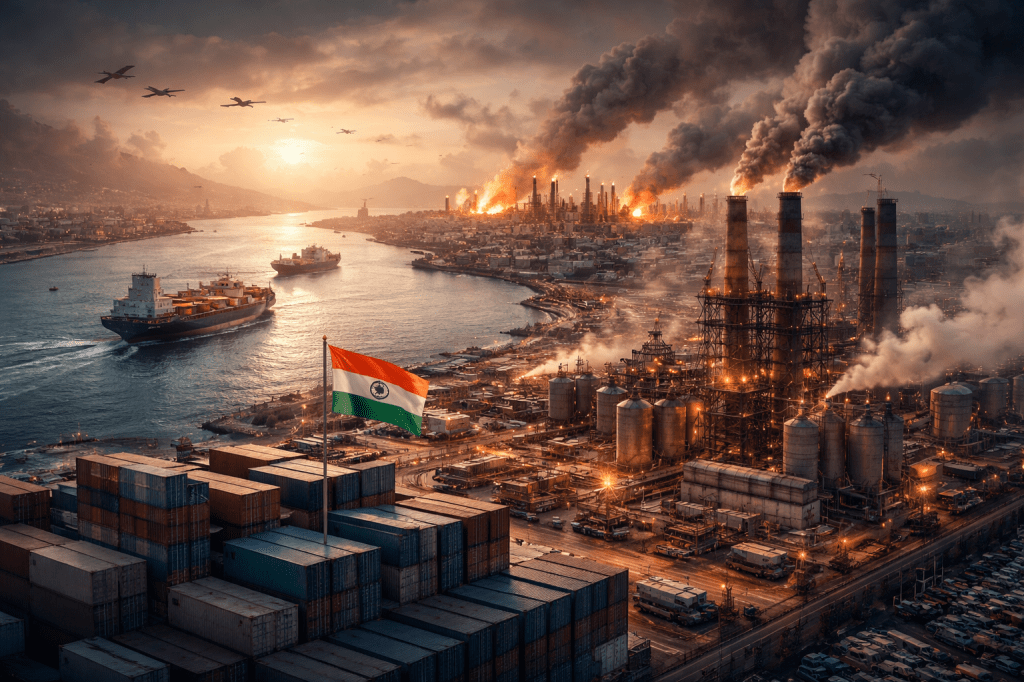
A Crisis Far Away That Quickly Reaches Indian Factories
Geography often creates the illusion that conflicts remain local. Yet in the interconnected world economy, disturbances in one region quickly ripple through global production networks. The Middle East—or West Asia as it is often called in Indian policy discourse—remains one of the most strategically sensitive regions for the global economy. It supplies a large share of the world’s oil and gas, hosts critical maritime chokepoints such as the Strait of Hormuz and the Red Sea corridor, and acts as an important market for Asian exports.
For India, whose industrial expansion increasingly depends on stable energy supplies, predictable shipping routes, and strong export markets, any escalation in this region directly influences manufacturing competitiveness. The impact unfolds in layers. The first layer hits factories directly through energy prices and logistics disruptions. The second layer spreads through supply chains, exports, and financing conditions. The third layer begins to reshape long-term industrial strategy, investment patterns, and technology choices.
Understanding these primary, secondary, and further impacts helps explain why a geopolitical crisis thousands of kilometers away can reshape the trajectory of Indian manufacturing.
Primary Impacts: The Immediate Shock to Production
Energy Price Volatility
The most immediate consequence of Middle East instability is volatility in oil and gas prices. India imports the majority of its crude oil requirements, and many industrial processes—from steel and cement to chemicals and ceramics—are directly or indirectly linked to energy prices.
When geopolitical tensions raise oil prices, the first impact appears in the cost structure of manufacturing firms. Transportation costs increase, captive power generation becomes more expensive, and logistics charges rise across supply chains. For energy-intensive industries such as aluminium, fertilizers, petrochemicals, ceramics, and glass, even small changes in fuel costs can significantly affect margins.
Disruption of Gas and Petrochemical Inputs
The Middle East is also a major supplier of LNG and petrochemical feedstocks used by Indian industry. If supply disruptions occur due to geopolitical tensions or maritime risks, gas-dependent industries may face shortages or sudden price increases.
Industries such as ceramics, fertilizers, chemicals, and synthetic textiles rely heavily on gas-based inputs. In several industrial clusters, gas supply disruptions can lead to temporary production cuts or even plant shutdowns.
Shipping and Logistics Disruptions
Another direct impact occurs through maritime routes. The Red Sea and Suez Canal route connects Asia with Europe and the Mediterranean. If ships are forced to reroute around Africa due to security concerns, transit time increases significantly.
For Indian manufacturers, this means longer shipping cycles, delayed deliveries, and higher freight costs. Export-oriented industries—especially engineering goods, auto components, textiles, and electronics—may struggle to meet delivery schedules.
Secondary Impacts: The Ripple Across the Industrial Ecosystem
Manufacturing Cost Inflation
Once energy and logistics costs rise, the second layer of impact spreads through industrial supply chains. Manufacturing inflation begins to increase as firms face higher costs for transport, raw materials, packaging, and electricity.
This inflationary pressure reduces price competitiveness in international markets. Export-oriented sectors such as textiles, engineering goods, and chemicals may face tighter margins, particularly when global demand remains uncertain.
Stress on MSME Clusters
India’s manufacturing sector relies heavily on micro, small, and medium enterprises operating within industrial clusters. These firms typically have limited financial buffers and little ability to hedge energy or currency risks.
When input costs rise suddenly, MSMEs often struggle to absorb the shock. Delayed shipments, increased working capital requirements, and volatile export demand can quickly translate into cash flow pressure.
Industrial clusters such as ceramics, auto components, textiles, and light engineering are particularly sensitive to these disruptions.
Export Demand and Market Uncertainty
The Middle East is not only an energy supplier but also an important export destination for Indian goods. Engineering products, food processing equipment, construction materials, and consumer goods are widely exported to Gulf economies.
When conflict or instability affects regional economic activity, demand for imported goods may weaken. This can reduce export orders for Indian manufacturers, especially in sectors linked to infrastructure, construction, and consumer markets in the Gulf.
Further Impacts: Structural Transformation of Indian Manufacturing
Shift Toward Energy Diversification
Repeated energy shocks reinforce the strategic importance of reducing dependence on imported fossil fuels. For Indian manufacturing, this may accelerate investment in renewable energy, green hydrogen, and energy-efficient industrial processes.
Factories increasingly recognize that energy security is becoming a central determinant of long-term competitiveness.
Supply Chain Resilience and Diversification
The crisis also strengthens the case for diversified supply chains. Companies may begin to source critical inputs from multiple countries or increase domestic production of intermediate goods.
This trend aligns with broader global shifts toward resilient supply chains, where companies prioritize stability alongside cost efficiency.
Acceleration of Industrial Policy
Geopolitical disruptions often trigger stronger industrial policy responses. Governments begin to prioritize domestic capabilities in strategic sectors such as energy equipment, semiconductors, advanced materials, and logistics infrastructure.
For India, the crisis may reinforce ongoing policy initiatives aimed at strengthening domestic manufacturing ecosystems, including cluster development, infrastructure corridors, and technology upgrading.
Technology and Automation
Longer-term disruptions can also accelerate technological change. Manufacturers facing volatile input costs and uncertain supply chains often turn to automation, digital supply-chain management, and predictive analytics to increase efficiency and reduce risk.
The factory of the future therefore becomes not only more automated but also more resilient and data-driven.
The Strategic Lesson for India
The Middle East crisis highlights a deeper transformation in the global economic system. Manufacturing competitiveness today depends not only on labour costs or production capacity but also on energy security, logistics resilience, and geopolitical stability.
For India, this moment presents both risks and opportunities. In the short term, rising energy prices and disrupted shipping routes can create inflationary pressure and stress for manufacturing clusters. In the longer term, however, these disruptions may encourage India to strengthen domestic supply chains, accelerate industrial modernization, and build more resilient manufacturing ecosystems.
The real challenge is therefore strategic: whether India can convert external shocks into catalysts for structural transformation. If energy diversification, supply chain resilience, and industrial innovation become central priorities, the country’s manufacturing sector may emerge stronger and more competitive in the decades ahead.
#IndianManufacturing
#GeopoliticsAndTrade
#EnergySecurity
#SupplyChainResilience
#IndustrialPolicy
#GlobalTrade
#ManufacturingEconomics
#EconomicSecurity
#IndustrialTransformation
#GeoEconomics
 "Connecting communities, empowering nations: Unifying the Regional and Global Economy ."
Leave a comment