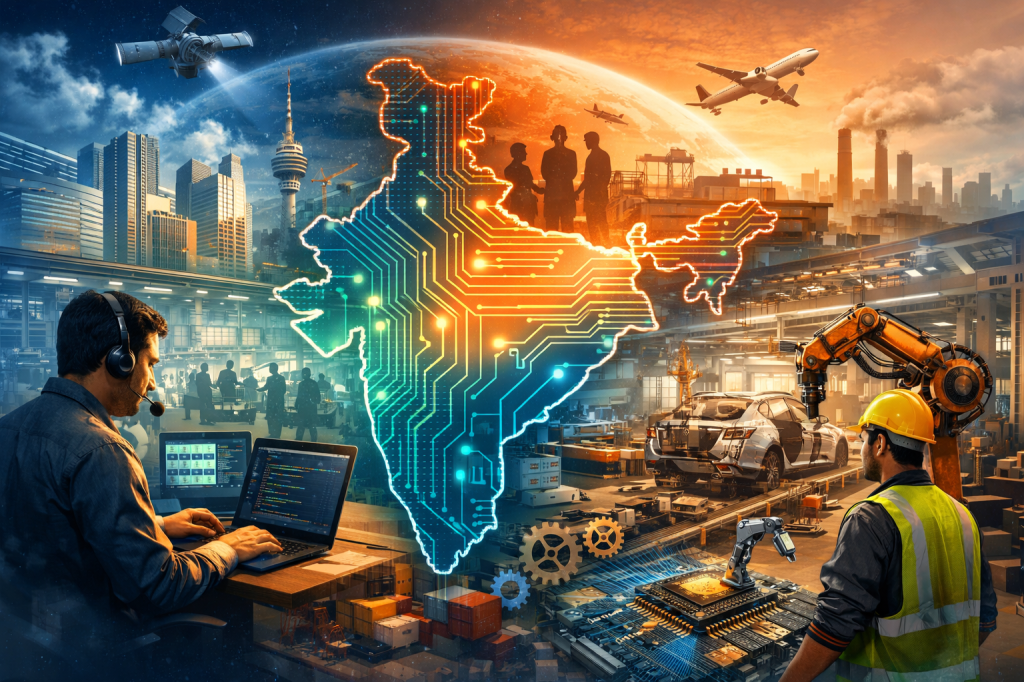
India’s development trajectory has long puzzled economists because it diverged from the traditional pattern followed by most industrialized nations. Historically, countries moved through a sequence of structural transformation—first agriculture, then manufacturing, and finally services. Nations such as Japan, South Korea, and China followed this path, using manufacturing as the engine of mass employment, export growth, and industrial capability. India, however, experienced a different evolution. Since the economic reforms of the early 1990s, the country has witnessed an unusually rapid expansion of the services sector, which today contributes more than half of the country’s GDP. While this transformation enabled India to integrate into the global digital economy and created globally competitive firms in information technology, finance, consulting, and telecommunications, it also produced an important policy debate: can a large developing country sustain inclusive growth primarily through services, or must manufacturing play a stronger role in the next phase of development?
Historical Roots of India’s Services Expansion
The rise of India’s services sector was not accidental but the result of several structural advantages. A large English-speaking workforce, strong educational institutions in engineering and management, and the rapid expansion of global outsourcing created fertile ground for the growth of technology and knowledge-based services. The global digital revolution coincided with India’s economic liberalization, allowing Indian firms to become major providers of software development, IT services, and business process outsourcing. Over time, this sector became a major source of export revenue and helped position India as one of the world’s leading digital economies.
Yet the services boom also reflected deeper structural realities. Compared to heavy industrialization, services required lower initial capital investment and faced fewer infrastructure bottlenecks. In a country where logistics networks, industrial land policies, and regulatory systems were still evolving, services offered a faster path to growth. As a result, India effectively moved from a largely agrarian economy toward a service-dominated one without passing through the intensive manufacturing phase that characterized the development of East Asian economies.
The Employment Dilemma
While services have contributed significantly to economic growth, their ability to generate employment on the scale required by India’s demographic structure remains limited. High-value services—such as software engineering, financial analytics, and digital consulting—demand specialized skills and higher levels of education. Consequently, these sectors employ only a relatively small segment of the workforce compared to the size of India’s labor force.
This imbalance has created a structural challenge. Millions of young people enter the labor market every year, many from rural and semi-urban backgrounds where opportunities for high-skill employment remain limited. Without a strong manufacturing base capable of absorbing medium-skill workers, large segments of the population risk remaining in informal or low-productivity occupations. Historically, manufacturing has played a crucial role in enabling workers to transition from agriculture to more productive employment. The absence of this transition at scale raises important questions about the sustainability of a services-dominated growth model.
Manufacturing as a Catalyst of Structural Transformation
Across modern economic history, manufacturing has served as the backbone of industrial transformation. It creates large-scale employment opportunities, stimulates the development of supply chains, and fosters technological learning across industries. Factories generate demand for logistics services, engineering firms, raw material suppliers, and a wide network of supporting enterprises. In this way, manufacturing ecosystems often become the foundation for broader industrial clusters.
For developing economies, manufacturing also plays a crucial role in export competitiveness. Products such as electronics, machinery, automobiles, and consumer goods can be produced at scale and exported to global markets, generating foreign exchange and strengthening industrial capabilities. Countries that successfully leveraged manufacturing—particularly in East Asia—used export-oriented industrial strategies to build globally competitive industries while simultaneously improving domestic productivity.
Why India’s Manufacturing Growth Lagged
India’s relatively modest manufacturing expansion can be traced to several structural factors. For many decades, industrial policies were shaped by complex regulatory frameworks, licensing systems, and restrictions on scale expansion. Even after economic reforms, challenges such as logistics inefficiencies, infrastructure gaps, fragmented supply chains, and difficulties in land acquisition continued to affect industrial competitiveness. Additionally, rigidities in labor regulations and the absence of large integrated industrial ecosystems slowed the growth of large-scale manufacturing.
Another important factor was the timing of globalization itself. By the time India liberalized its economy, global manufacturing supply chains were already heavily concentrated in East Asia, particularly in China. The extraordinary scale achieved by Chinese manufacturing during the 1990s and 2000s created formidable competition, making it difficult for late entrants to capture similar market shares in labor-intensive industries.
The Emerging Window of Opportunity
The global economic landscape is now undergoing significant transformation. Rising geopolitical tensions, trade disputes, and supply chain disruptions have encouraged multinational corporations to diversify their production bases. The concentration of manufacturing in a limited number of countries is increasingly viewed as a strategic vulnerability by governments and businesses alike. As a result, companies are exploring alternative manufacturing locations that offer scale, stability, and access to large domestic markets.
This shift has opened a potential opportunity for India. With its large labor force, expanding infrastructure, and growing domestic demand, India is increasingly being considered as a potential hub for global manufacturing diversification. Policy initiatives aimed at encouraging domestic production, improving logistics networks, and integrating Indian firms into global value chains are gradually reshaping the industrial landscape. Whether these initiatives can translate into large-scale manufacturing growth will depend on sustained policy reforms and the development of robust industrial ecosystems.
The Convergence of Manufacturing and Services
However, the future of industrial development may not simply replicate the manufacturing models of the past. Modern manufacturing increasingly relies on advanced digital technologies, including artificial intelligence, data analytics, robotics, and predictive maintenance systems. Production systems are becoming more integrated with digital services, blurring the traditional distinction between manufacturing and services.
In this emerging environment, India’s strength in digital technologies may actually complement a renewed focus on manufacturing. Software capabilities can support advanced manufacturing processes, supply-chain optimization, and industrial automation. This convergence suggests that India’s next growth phase may not involve abandoning the services sector but rather integrating it more deeply with industrial production.
Toward a Hybrid Growth Strategy
Given these structural dynamics, the most realistic development strategy for India may involve a hybrid growth model. Services will continue to play a vital role in sectors such as finance, digital technology, healthcare, and education. At the same time, manufacturing must expand significantly to create employment opportunities, deepen industrial capabilities, and strengthen export competitiveness.
Such a strategy would require strengthening industrial clusters, improving supply-chain connectivity, investing in skill development, and supporting small and medium enterprises that form the backbone of manufacturing ecosystems. Equally important will be investments in research, innovation, and technology adoption to ensure that Indian industries remain competitive in an increasingly digital and sustainability-driven global economy.
Looking Toward the Future
The debate between manufacturing-led and services-led growth ultimately reflects a deeper question about India’s development trajectory. Services have delivered impressive economic gains and established India as a major participant in the global knowledge economy. Yet the scale of India’s demographic transformation demands broader employment opportunities and stronger industrial capacity.
The coming decades may therefore witness a gradual rebalancing of India’s growth model. Manufacturing will likely become more prominent, not as a replacement for services but as a complementary pillar of economic development. If India successfully combines technological innovation with large-scale industrial expansion, it could pioneer a distinctive development pathway—one that integrates digital capabilities with manufacturing ecosystems to create a resilient and inclusive economy.
In that sense, the future of India’s growth may not lie in choosing between services and manufacturing, but in building a dynamic economic system where both reinforce each other, enabling the country to navigate the complexities of the twenty-first-century global economy.
#ManufacturingLedGrowth
#IndiaEconomicTransformation
#IndustrialPolicy
#StructuralTransformation
#EmploymentGeneration
#GlobalValueChains
#IndustrialClusters
#DigitalManufacturing
#SupplyChainResilience
#FutureOfIndianEconomy
 "Connecting communities, empowering nations: Unifying the Regional and Global Economy ."
Leave a comment