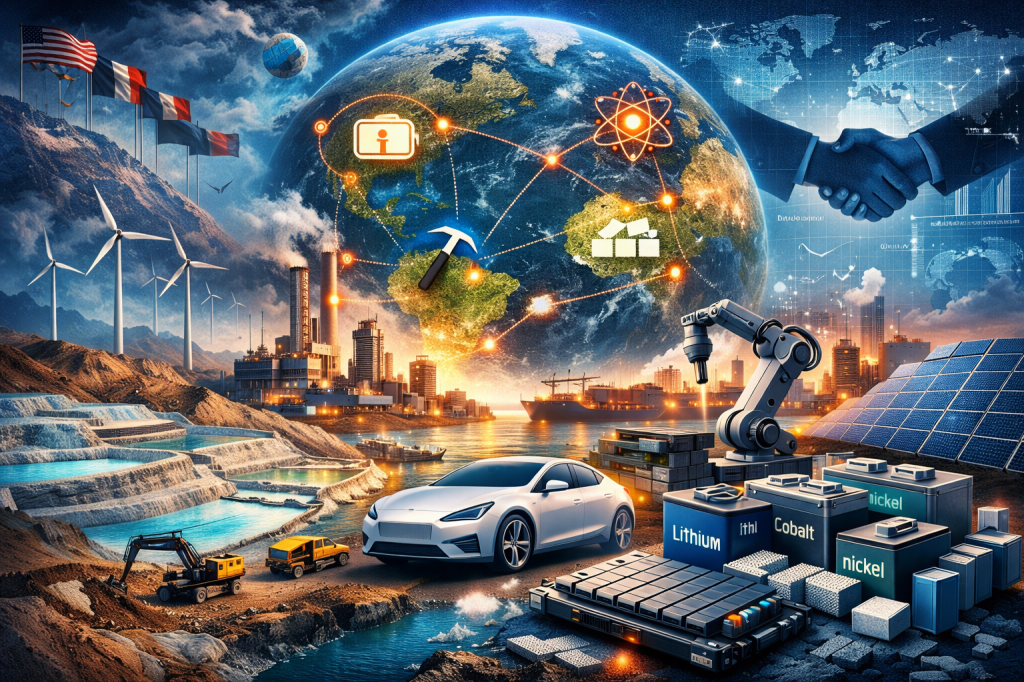
A New Industrial Age Powered by Minerals
The global transition toward electric mobility, renewable energy, and digital technologies is triggering a new kind of industrial competition—one that is less visible than trade wars or tariff disputes but potentially far more consequential. At the center of this transformation lies a strategic race for critical minerals such as lithium, cobalt, nickel, graphite, and rare earth elements. These minerals form the backbone of modern clean technologies including electric vehicle (EV) batteries, wind turbines, solar panels, semiconductors, and advanced electronics. In many ways, the 21st century’s industrial competitiveness may depend less on traditional manufacturing capacity and more on secure access to these strategic raw materials. Just as oil shaped geopolitical alignments during the 20th century, critical minerals are increasingly shaping the geopolitical landscape of the green and digital economy.
From Oil Geopolitics to Mineral Geopolitics
Resource competition has always played a central role in shaping global economic systems. During the industrial revolutions of the 19th and 20th centuries, coal and later oil defined the power structures of global economies. Nations that controlled energy resources or trade routes gained enormous strategic advantages. Today, a similar transformation is unfolding with minerals required for clean technologies. Lithium is essential for lithium-ion batteries powering electric vehicles, cobalt improves battery stability and energy density, while rare earth elements are indispensable for high-performance magnets used in electric motors and wind turbines. Unlike oil, however, the geographic distribution of these minerals is highly concentrated. For example, lithium reserves are heavily located in the “Lithium Triangle” of South America—primarily Chile, Argentina, and Bolivia—while cobalt production is dominated by the Democratic Republic of Congo. Rare earth processing is overwhelmingly concentrated in China, which currently controls a major share of global refining capacity. This concentration creates a structural vulnerability for countries seeking to build resilient green technology industries.
Industrial Policy and the Strategic Control of Supply Chains
Recognizing these vulnerabilities, major economies are increasingly integrating critical minerals into their industrial strategies. Governments are actively designing policies to secure supply chains through strategic partnerships, domestic mining initiatives, and investment incentives. The United States has introduced policies encouraging domestic battery supply chains and partnerships with allied countries. The European Union has launched initiatives to diversify mineral sourcing and develop recycling capabilities within Europe. China, on the other hand, has spent decades building dominance across the entire mineral value chain—from mining investments in Africa and Latin America to large-scale refining and battery manufacturing capacity. These efforts illustrate a broader shift toward resource nationalism and strategic industrial planning, where countries aim not only to secure raw materials but also to control high-value downstream industries such as battery production and electric vehicle manufacturing.
Trade Alliances and the New Resource Diplomacy
The global race for minerals is also reshaping diplomatic alliances and trade relationships. Countries rich in mineral resources are gaining strategic importance as partners in the energy transition. Governments are negotiating long-term supply agreements, establishing mineral security partnerships, and creating collaborative mining and processing initiatives. For example, alliances between advanced economies and mineral-rich developing nations are emerging as part of broader economic cooperation frameworks. However, these partnerships are not without complexity. Many resource-rich countries are seeking greater value addition within their own economies rather than remaining mere exporters of raw materials. This has led to policies requiring local processing, export restrictions, and technology transfer agreements, which could reshape the traditional global commodity trade structure.
Supply Chain Security in a Fragmenting Global Economy
The pursuit of supply chain security is becoming a central feature of industrial policy. The COVID-19 pandemic and subsequent geopolitical tensions revealed how vulnerable global supply chains can be when concentrated in a few regions. In response, governments and corporations are exploring strategies such as “friend-shoring,” diversification of suppliers, and investment in alternative technologies. For the electric vehicle industry alone, demand for lithium is expected to grow several times over the next two decades, while demand for rare earth elements used in magnets and electronics could increase dramatically as renewable energy infrastructure expands. Such rapid growth raises concerns about supply bottlenecks, price volatility, and geopolitical competition over resource access.
Technology, Recycling, and the Search for Alternatives
While securing raw material supplies is crucial, innovation is also emerging as a strategic response to mineral dependency. Researchers and companies are exploring new battery chemistries that reduce or eliminate reliance on scarce minerals such as cobalt. Sodium-ion batteries, solid-state batteries, and alternative magnet technologies are being developed as potential substitutes. At the same time, recycling and circular economy models are gaining importance as a long-term strategy to recover valuable minerals from used batteries and electronic waste. If scaled effectively, recycling could reduce dependence on newly mined resources while addressing environmental and sustainability concerns associated with mining activities.
The Environmental and Social Paradox of the Green Transition
The race for critical minerals also exposes an important paradox in the global energy transition. While green technologies aim to reduce carbon emissions and environmental damage, the mining and processing of minerals can create significant ecological and social challenges. Large-scale mining operations often involve water-intensive extraction processes, habitat disruption, and complex labor conditions. Countries hosting these resources are increasingly demanding higher environmental standards, local economic benefits, and responsible supply chain practices. As a result, the future of critical mineral supply chains will depend not only on geological availability but also on governance frameworks, sustainability standards, and community acceptance.
India and the Strategic Opportunity
For emerging economies like India, the global race for critical minerals presents both risks and opportunities. India’s ambition to become a major hub for electric vehicles, renewable energy technologies, and advanced manufacturing requires reliable access to these minerals. At present, India remains largely dependent on imports for lithium, cobalt, and several rare earth elements. To address this challenge, the country has begun exploring overseas mining partnerships, investing in mineral exploration, and strengthening domestic processing capabilities. India is also promoting battery manufacturing through industrial policies and incentive schemes designed to build an integrated ecosystem from raw materials to finished products. However, achieving long-term resilience will require strategic international partnerships, technological innovation, and a robust recycling ecosystem.
The Emerging Global Order of Resource Power
Looking ahead, the competition for critical minerals could fundamentally reshape global economic structures. Instead of traditional energy geopolitics centered on oil and gas, the next phase of industrial competition may revolve around mineral ecosystems, battery supply chains, and advanced material technologies. Countries that successfully combine resource access, technological innovation, and industrial capacity will likely dominate the next generation of green industries. Conversely, nations that remain dependent on external suppliers for critical materials may face strategic vulnerabilities in an increasingly fragmented global economy.
A Future Defined by Materials
The transition toward electric mobility and green technology is often portrayed as a purely technological revolution. Yet beneath the surface, it is also a profound transformation in the world’s material foundations. Lithium mines in South America, cobalt deposits in Africa, and rare earth processing plants in Asia are becoming the unseen pillars of the global clean energy economy. The race for these resources is not merely about securing raw materials; it is about shaping the industrial architecture of the future. In this hidden battle for minerals, the winners may not simply be those who build the most advanced technologies, but those who control the materials that make those technologies possible.
#CriticalMinerals #ElectricVehicles #GreenTechnology #EnergyTransition #RareEarths #BatterySupplyChain #IndustrialPolicy #ResourceSecurity #GlobalSupplyChains #FutureManufacturing
 "Connecting communities, empowering nations: Unifying the Regional and Global Economy ."
Leave a comment