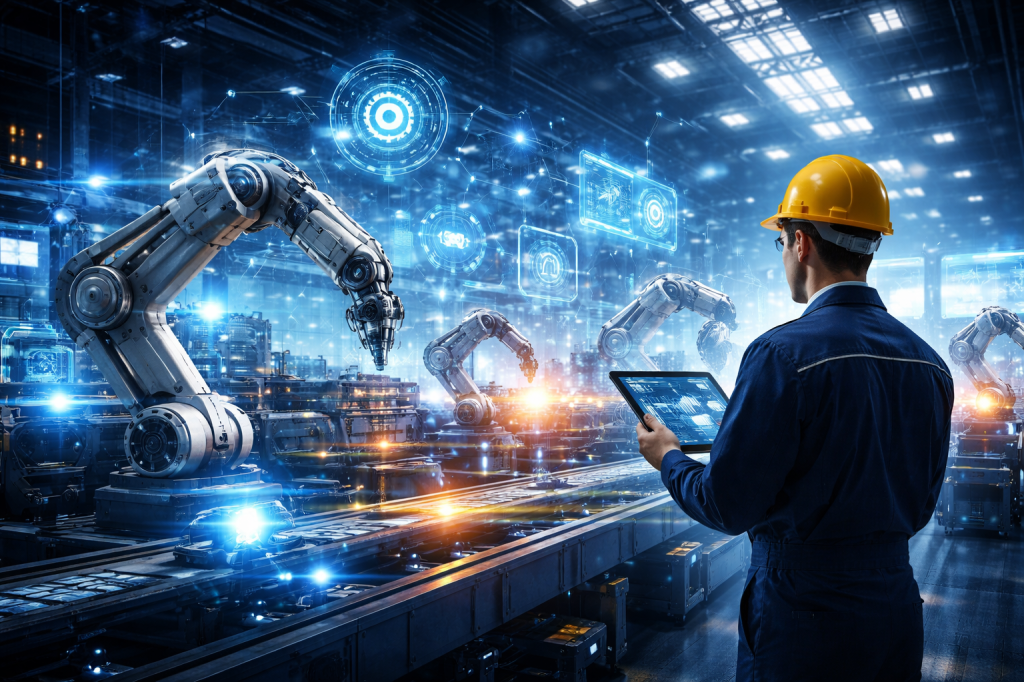
The Evolution of Manufacturing: From Labour Advantage to Intelligence Advantage
For more than two centuries, manufacturing competitiveness has evolved through distinct phases. The early industrial revolution was powered by mechanisation and steam engines, the twentieth century by mass production and global supply chains, and the late twentieth century by labour-cost arbitrage that shifted manufacturing from advanced economies to developing nations. Countries such as China, Vietnam, and India built their industrial base largely on cost advantages, large labour pools, and export-oriented industrialisation. However, the next phase of industrial transformation is being shaped not by cheaper labour but by smarter production systems. Artificial intelligence, automation, and data-driven manufacturing are rapidly transforming factory floors into interconnected digital ecosystems where machines, software, and humans collaborate to optimise productivity.
The shift from labour-intensive manufacturing to intelligent production systems is gradually redefining what competitiveness means in the global industrial economy. In this emerging paradigm, productivity gains come not only from scale and efficiency but also from predictive analytics, automated decision-making, and real-time data flows across production networks. Manufacturing is increasingly moving away from traditional assembly lines toward digitally orchestrated production systems capable of adapting dynamically to market changes, supply disruptions, and technological shifts.
Predictive Manufacturing and the Rise of Data-Driven Production
One of the most transformative applications of artificial intelligence in manufacturing is predictive manufacturing. Historically, production systems operated on reactive models—machines were repaired after failure and production schedules were adjusted only after disruptions occurred. AI-enabled systems are changing this paradigm by analysing massive datasets generated by sensors embedded in machines, production lines, and logistics networks.
Through predictive analytics, manufacturers can anticipate equipment failures, forecast demand fluctuations, and optimise production schedules before disruptions occur. This shift significantly reduces downtime, improves asset utilisation, and lowers operational costs. Studies suggest that predictive maintenance alone can reduce equipment downtime by up to 30–40 percent while extending machine life by several years. In highly competitive industries such as electronics, automotive, and semiconductor manufacturing, these productivity gains can translate into billions of dollars in savings annually.
However, predictive manufacturing also raises important structural questions. The competitive advantage may increasingly shift toward companies and countries that possess advanced digital infrastructure, large datasets, and the ability to deploy AI at scale. This could potentially concentrate industrial power among technologically advanced economies and corporations.
Digital Twins and the Simulation Economy
Another emerging frontier in advanced manufacturing is the concept of digital twins. A digital twin is a virtual replica of a physical manufacturing system, product, or supply chain that allows companies to simulate real-world processes in a digital environment. Through these simulations, manufacturers can test design changes, optimise production flows, and anticipate operational challenges without disrupting actual production.
Digital twins are increasingly used in sectors such as aerospace, automotive, and high-precision engineering. By integrating artificial intelligence with digital simulations, companies can experiment with thousands of production scenarios, identifying optimal configurations for efficiency, energy consumption, and cost. In many advanced manufacturing facilities, engineers can simulate entire production cycles before physical machines even begin operating.
The broader implication of digital twin technology is the emergence of what could be called a “simulation economy,” where industrial competitiveness depends not only on physical production capabilities but also on computational modelling and digital experimentation. Countries investing heavily in high-performance computing, industrial software, and digital infrastructure may therefore gain significant advantages in the future of manufacturing.
Robotics and the Changing Nature of Work
Automation through robotics has been transforming manufacturing for decades, but the new generation of intelligent robots—often referred to as collaborative robots or “cobots”—is expanding the boundaries of automation. Unlike traditional industrial robots that operate in isolated environments, cobots can work alongside humans, performing repetitive, dangerous, or highly precise tasks.
Global robot density in manufacturing has increased dramatically over the past decade. In highly automated economies such as South Korea, Japan, and Germany, robot density exceeds 300 robots per 10,000 manufacturing workers. This rapid growth reflects the increasing integration of robotics into production processes ranging from electronics assembly to logistics and warehouse operations.
While robotics significantly enhances productivity, it also raises complex questions about employment, skills, and social adjustment. Rather than eliminating jobs entirely, automation is reshaping job roles. Workers are increasingly required to operate, maintain, and program automated systems, shifting labour demand toward technical and digital skills. For emerging manufacturing hubs, the challenge is therefore not simply to create industrial jobs but to build a workforce capable of operating within highly automated environments.
Data-Driven Supply Chains and the Rise of Intelligent Networks
Manufacturing competitiveness today extends beyond factory walls. Supply chains themselves are becoming intelligent networks driven by data analytics, artificial intelligence, and real-time information flows. The disruptions experienced during global crises—from pandemic lockdowns to geopolitical tensions—have highlighted the vulnerabilities of traditional supply chains that rely on linear production models.
AI-enabled supply chains allow companies to monitor global logistics flows, forecast demand patterns, and dynamically adjust sourcing strategies. Algorithms can identify alternative suppliers, optimise shipping routes, and predict inventory shortages weeks before they occur. As a result, supply chains are evolving from static production pipelines into adaptive digital ecosystems.
In this emerging model, competitiveness depends on the ability to integrate manufacturing operations with digital supply-chain intelligence. Companies that can seamlessly connect production data with logistics, procurement, and market analytics will gain significant advantages in speed, flexibility, and resilience.
Will AI Strengthen Emerging Manufacturing Hubs or Deepen the Global Divide?
The global implications of AI-driven manufacturing are still unfolding. On one hand, emerging manufacturing economies such as India and Vietnam have strong potential to benefit from this transformation. Both countries possess large engineering talent pools, growing digital infrastructure, and expanding industrial bases. The integration of artificial intelligence into manufacturing could enable them to leapfrog traditional industrial stages and build highly competitive technology-enabled production ecosystems.
India, in particular, has been actively promoting digital manufacturing through initiatives such as smart manufacturing programs, semiconductor investments, and AI-focused innovation ecosystems. Vietnam, meanwhile, has attracted large-scale foreign investment in electronics manufacturing and is increasingly integrating advanced automation technologies into its industrial parks.
However, there is also a contrasting scenario. If access to advanced AI technologies, robotics, and digital infrastructure remains concentrated in a few technologically advanced economies, the productivity gap between nations could widen significantly. Advanced economies may increasingly rely on “reshoring” strategies supported by automation, reducing their dependence on low-cost labour in developing countries. In such a scenario, manufacturing competitiveness would shift from labour costs to technological capability and innovation capacity.
The Rise of Smart Industrial Ecosystems
The future of manufacturing may ultimately move beyond individual factories toward interconnected industrial ecosystems. In these ecosystems, production facilities, suppliers, logistics networks, research institutions, and digital platforms operate within integrated data environments. Artificial intelligence coordinates production flows, optimises resource allocation, and enables real-time collaboration across industrial networks.
Industrial clusters—long recognised as engines of manufacturing competitiveness—may evolve into smart ecosystems where digital platforms enhance cooperation among firms. For example, clusters could share AI-based forecasting tools, digital supply-chain platforms, and common technology infrastructure. Such shared digital resources would allow small and medium enterprises to access advanced technologies that would otherwise remain beyond their reach.
This transformation could be particularly significant for countries like India, where manufacturing clusters form the backbone of industrial production. Integrating artificial intelligence into cluster-based ecosystems could significantly enhance productivity, export competitiveness, and technological upgrading across thousands of small and medium enterprises.
A New Industrial Paradigm
The transformation of manufacturing through artificial intelligence and automation represents more than a technological upgrade; it signals the emergence of a new industrial paradigm. In this paradigm, competitiveness will be determined by a combination of digital capability, technological integration, human capital, and policy vision. Countries that invest in AI infrastructure, digital skills, and innovation ecosystems will shape the next phase of global industrial leadership.
Yet the transition to intelligent manufacturing systems must be managed carefully. Policymakers must ensure that automation-driven productivity gains are balanced with inclusive employment strategies, workforce reskilling programs, and technology diffusion across smaller enterprises. Without such efforts, the benefits of AI-driven manufacturing could remain concentrated among a limited number of companies and countries.
The future factory may no longer resemble the assembly lines that defined twentieth-century industrialisation. Instead, it will function as a dynamic digital ecosystem where machines predict failures, algorithms optimise production, robots collaborate with humans, and supply chains respond instantly to market signals. In this emerging world, the true measure of manufacturing competitiveness will no longer be the number of workers on factory floors but the intelligence embedded within the industrial system itself.
#SmartManufacturing
#AIinManufacturing
#IndustrialAutomation
#DigitalTwins
#PredictiveManufacturing
#RoboticsRevolution
#SupplyChainIntelligence
#Industry40
#ManufacturingCompetitiveness
#FutureOfIndustry
 "Connecting communities, empowering nations: Unifying the Regional and Global Economy ."
Leave a comment