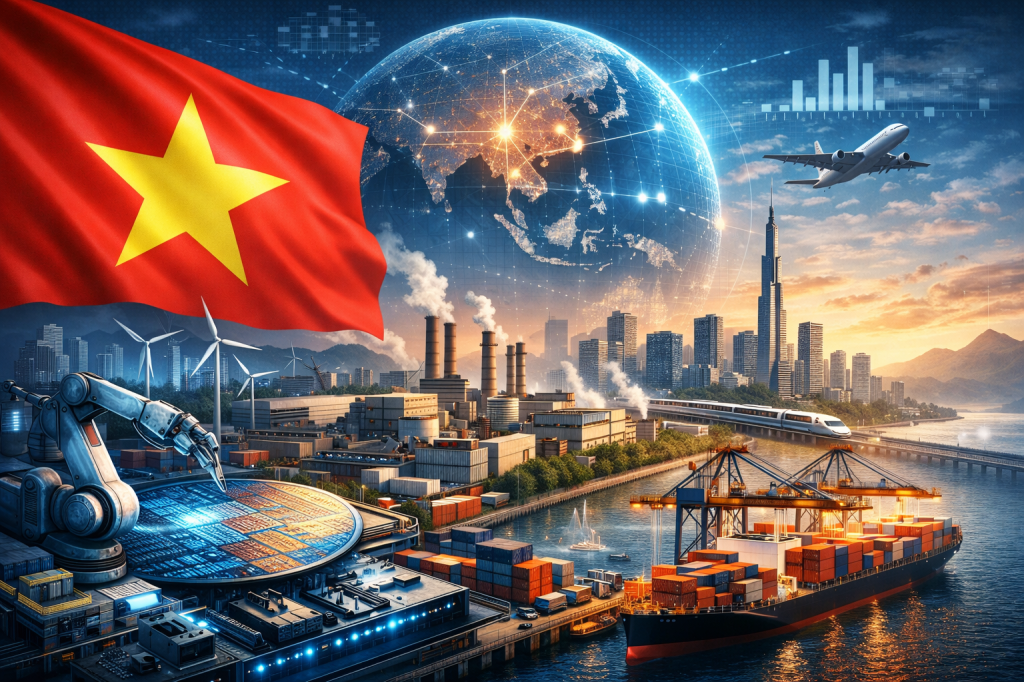
In the evolving landscape of global production networks, Vietnam’s emergence as a top manufacturing hub in Asia by 2026 marks one of the most significant structural transformations outside China in the past two decades. This transition did not happen overnight—it is the outcome of historical reforms, policy continuity, infrastructure deepening, and global supply chain realignments. In mid-2025, when global manufacturing output showed only modest growth, Vietnam stood out as a rare outperformer, signalling not just cyclical strength but a deeper repositioning within the global value chain.
Historical Pathways and Policy Evolution
Vietnam’s manufacturing story is rooted in the Đổi Mới reforms of 1986, which slowly opened the economy to market principles, FDI, and export-oriented industrialization. Over time, consistent political stability, streamlined investment regulations, bilateral and multilateral trade agreements, and an improving logistics ecosystem shaped a foundation that many competitors in the region struggled to replicate. Unlike the rapid but volatile industrial rise of some ASEAN neighbours in the early 2000s, Vietnam built its momentum in phases—first textiles and footwear, then assembling electronics, and finally attracting high-value manufacturing in semiconductors, renewable energy components, and advanced machinery post-2020.
Infrastructure and Investment Momentum
By 2025–26, Vietnam accelerated its infrastructure push with new industrial parks, deep-sea ports (like Lach Huyen), expanded power corridors, and logistics upgrades, allowing businesses to scale operations more smoothly. While global manufacturing grew only marginally amid inflationary pressure, geopolitical tensions, and energy cost volatility, Vietnam benefited from strategic FDI diversification, particularly as firms sought a “China+1” hedge. Companies from Japan, South Korea, the U.S., and Europe expanded production footprints, leveraging Vietnam’s improving freight connectivity and competitive labor pool.
Vietnam in the Global Supply Chain Realignment
The modest global manufacturing recovery of mid-2025 revealed an interesting trend: countries with agility, cost leadership, and stable policy environments captured disproportionate gains. Vietnam’s rise must be viewed against this backdrop. As traditional manufacturing bases like China faced rising wages, demographic changes, and geo-economic scrutiny, global producers recalibrated their risk exposure. Vietnam, with its young workforce, low attrition, expanding skill training programs, and business-friendly reforms, became the natural beneficiary.
Technology Upgradation and Digital Manufacturing
Looking ahead to 2030, Vietnam is not merely competing on low-cost advantages. Government incentives for AI-driven production lines, 4.0 manufacturing ecosystems, smart factories, and green technology adoption are expanding. The country’s rapid digitalization—accelerated during the pandemic—has cultivated a new generation of tech-enabled MSMEs that integrate seamlessly into global production networks. Yet, the biggest challenge remains absorptive capacity: while FDI inflows bring technology, Vietnam must continue upgrading domestic supplier capabilities to avoid dependency on foreign intermediaries.
Competitive Pressures and Critical Risks
Despite its strong footing, Vietnam’s future growth trajectory will face critical pressures. Wage growth is rising as the middle class expands, potentially eroding the cost advantage that initially attracted many global manufacturers. Energy reliability and clean energy supply remain emerging concerns as global buyers push for ESG compliance. Competition from India, Indonesia, and Mexico—each courting global manufacturers aggressively—could fragment Vietnam’s dominance. Additionally, excessive concentration of assembly-based manufacturing may limit long-term value capture unless domestic innovation ecosystems deepen.
The Road Ahead: Will Vietnam Sustain Its Momentum?
The next decade will determine whether Vietnam transitions from a manufacturing destination to a manufacturing powerhouse. Success will rest on structural choices: deepening skill formation, expanding local supply chains, diversifying export markets, enhancing automation, and synchronizing industrial policy with global sustainability standards. If executed effectively, Vietnam could evolve from being the “factory of Asia’s next decade” to a central node in the world’s reconfigured production map.
#VietnamManufacturing
#GlobalSupplyChains
#ChinaPlusOne
#IndustrialInfrastructure
#FDIInflow
#SmartManufacturing
#ASEANGrowth
#ESGCompliance
#AdvancedManufacturing
#SupplyChainResilience
 "Connecting communities, empowering nations: Unifying the Regional and Global Economy ."
Leave a comment