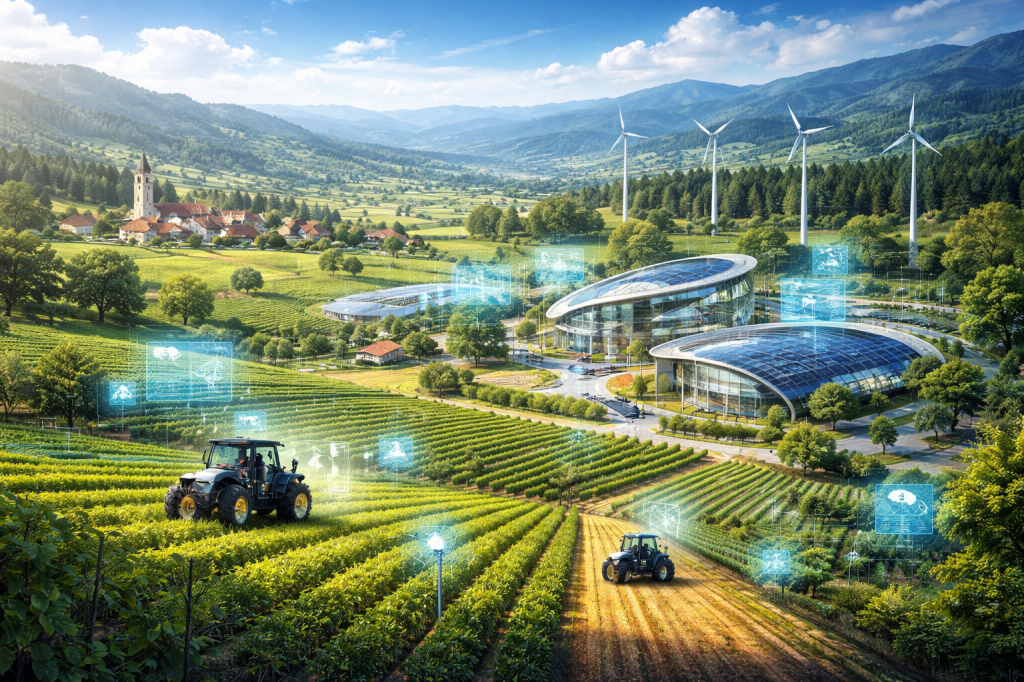
The evolution of Digital Innovation in Rural Industrial Clusters has become a defining feature of Europe’s emerging development narrative, and the Innovation Technology Cluster (ITC) of Slovenia stands at the centre of this transformation. To understand its significance, we must trace the arc from Europe’s post-industrial rural decline to today’s digitally empowered agrifood ecosystems. Slovenia, a country shaped by smallholder agriculture, mountainous terrain, and distributed rural settlements, faced the classic European challenge: how to make rural industry competitive without disrupting ecological integrity or local traditions. The ITC Cluster emerged as a response to this historical gap, positioning Digital Transformation, Agrifood Modernisation, and Rural Resilience as integrated pillars of the next stage of industrial policy.
With its emphasis on Data-Driven Agriculture, Digital Twin Models, and Industry 4.0 adoption for rural SMEs, the ITC Cluster has pioneered a model in which rural sectors are no longer seen as laggards but as testing grounds for innovation. This shift is rooted in Europe’s broader policy direction—linking the Green Deal, Farm-to-Fork Strategy, and Digital Europe Programme—to create clusters that serve as “innovation bridges” between farmers, SMEs, universities, and technology companies. In practice, this means deploying next-generation tools such as IoT-enabled soil monitoring, AI-based crop forecasting, precision fertilisation, and blockchain-based traceability across rural value chains. The result is increased productivity, higher export readiness, and stronger climate resilience—aligned with data showing that digitally enabled farmers in the EU report up to 20–30% increases in yield predictability and 15% reduction in input costs.
Yet the ITC Cluster model is not merely about technology; it is about community-centric economic development. Under the heading Sustainability and Human-Centred Innovation, the cluster integrates circular economy principles, green packaging, energy-efficient manufacturing, and regenerative farming practices, demonstrating that environmental stewardship can coexist with rural industrial growth. Slovenia’s success lies in embedding this digital agenda in its cooperative culture—transforming isolated rural entrepreneurs into connected ecosystems capable of meeting global standards.
The next critical heading, Building Industry Resilience, is tied to Europe’s shifting geopolitical and climate landscape. The ITC Cluster views resilience not only as the strengthening of supply chains but as the ability of rural industries to adapt to shocks—whether from extreme weather, market volatility, or global disruptions. Digital platforms for market access, shared logistics networks, and cross-cluster partnerships across Europe allow small rural firms to compete like large enterprises. Historical experience from the Balkan economic transitions shows that regions lacking such networks faced stagnation, while digitally integrated clusters accelerated upward mobility.
Looking ahead, Futuristic Pathways for Rural Clusters indicate a move toward AI-orchestrated production networks, autonomous farm equipment, bio-digital innovations, and climate-smart industrial estates. Europe anticipates that by 2035, rural digitalisation could contribute an additional €180–€210 billion to the EU economy, and Slovenia’s ITC Cluster is positioned as a leading example of this shift. The future will belong to rural clusters that move from traditional supply chains to intelligent value webs, where data flows as seamlessly as physical goods.
The ITC Cluster model offers valuable lessons for countries like India, where rural industrialisation is critical to achieving balanced growth. The biggest takeaway is that digital innovation must not be an urban privilege; it must penetrate the last mile of the industrial ecosystem. Europe’s example shows that when technology is paired with local culture, decentralised governance, and long-term environmental vision, rural clusters can become engines of competitiveness rather than symbols of backwardness.
#DigitalTransformation #RuralClusters #AgrifoodInnovation #Industry4_0 #Sustainability #ClusterDevelopment #AIinAgriculture #EuropeanDigitalStrategy #SmartRuralEconomy #ClimateResilience
 "Connecting communities, empowering nations: Unifying the Regional and Global Economy ."
Leave a comment