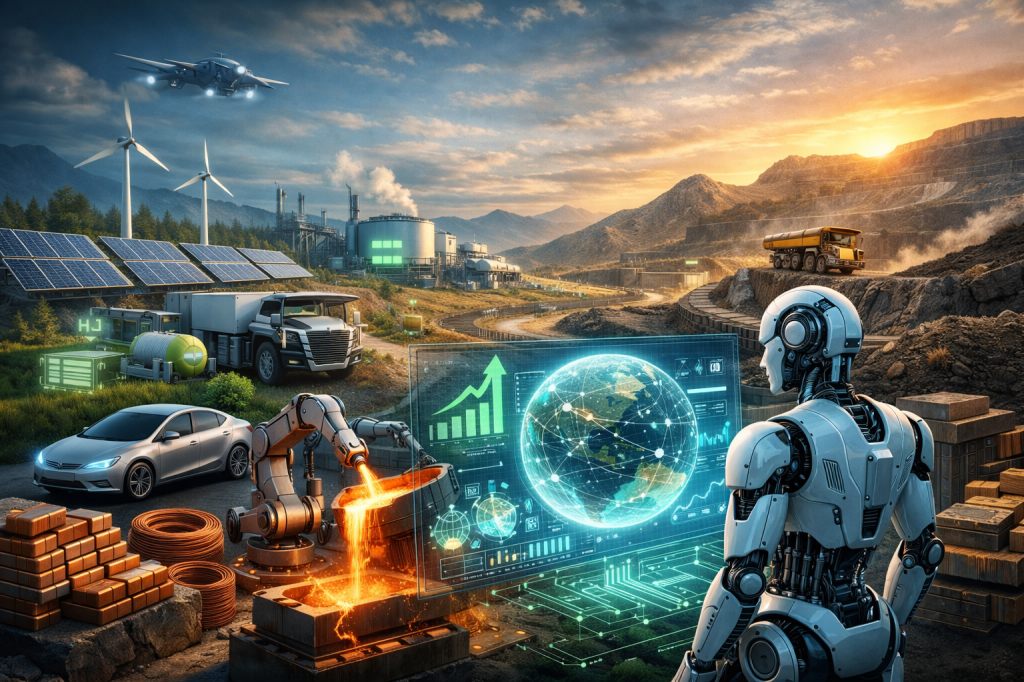
The world metals sector in 2026 stands at one of the most defining crossroads in its 150-year industrial history. What once grew on the shoulders of abundant ore, low-cost extraction, and predictable global trade now faces a complex web of operational strain, tariff-driven uncertainties, and a deep structural oversupply in several segments. Yet, paradoxically, the same system under pressure also holds the seeds of the next wave of industrial growth—driven by green energy transitions, artificial intelligence, and a strategic re-ordering of mineral supply chains. The landscape in 2026 is therefore neither a downturn nor a boom; it is a moment of transition where legacy constraints collide with technology-enabled possibilities.
Rising Operational Complexity in a Historically Resource-Rich Sector
The sector’s foremost challenge is operational complexity—something that has intensified over decades. Declining ore grades, once a distant worry in the 1990s, have now become a measurable drag on productivity—copper ore grades have fallen nearly 40% since 1991, forcing miners to dig deeper, move more earth, and absorb higher energy costs. Historically, mining thrived on surface-level deposits, predictable geology, and manual-intensive operations. But 2026 reflects a dramatic shift: mines are deeper, weather disruptions more frequent, and geological unpredictability higher. This is pushing operational costs up at a time when global metal prices remain volatile.
The shortage of skilled workers—especially in geotechnology, AI systems, and green metallurgy—adds another layer of friction. Rising energy and labor costs compress margins further in an environment where global basic metals growth remains at a modest 0.7%. Capital constraints also appear as companies borrow heavily to deploy green technologies, digital systems, and carbon-reduction equipment—often straining balance sheets already weakened by slow market expansion.
Trade Barriers, Overcapacity, and the Geopolitics of Metal Supply
Since the early 2000s, global metals markets have shifted from relatively smooth flows to a politically sensitive arena shaped by tariffs, retaliatory duties, export controls, and industrial policy. The 2026 environment is intensely shaped by these forces. U.S. tariff policies, China’s ongoing overcapacity—especially in steel and aluminum—and unpredictable trade measures have saturated markets, distorted prices, and created new supply-chain risk zones.
Geopolitics now sits at the center of metals strategy. China controls nearly 60% of the global rare earths capacity, creating systemic vulnerabilities for countries attempting to accelerate clean energy or semiconductor industries. Meanwhile, the U.S.–China strategic rivalry fuels a new form of industrial nationalism where metals are no longer seen as commodities alone but as instruments of technological power and national security. This resembles earlier Cold War resource strategies, but with far greater interconnectedness and economic consequences.
Green Energy Transition: From Pressure Point to Growth Engine
Even as the sector grapples with oversupply and complexity, the energy transition opens unprecedented opportunities. Copper demand is surging, with a projected 150,000-tonne shortfall, driven by electric vehicles, high-density renewable grids, and AI-intensive data centers that require enormous volumes of copper, aluminum, and specialty steels. Aluminum producers benefit from lightweight mobility and solar infrastructure demand, while green steel—once experimental—is becoming a procurement priority in regions enforcing carbon border taxes.
This demand shift marks a historical turning point: metals once valued for volume and low cost are now valued for carbon transparency, traceability, and energy efficiency. Policies such as the EU Carbon Border Adjustment Mechanism (CBAM) accelerate this trend, pressuring producers to decarbonize or lose market access. Low-carbon producers in the Middle East, Africa, and parts of Asia find new competitive openings as global buyers increasingly reward sustainability over scale.
Technology Adoption: The New Frontier of Competitive Advantage
AI, automation, geospatial analytics, and digital twins are transforming how mines operate. What used to be a labor-intensive sector is becoming a technology-infused ecosystem where efficiency depends on algorithmic prediction, real-time sensing, and integrated resource modeling. This signals a profound historical reversal: technological innovation was once optional in metals; in 2026, it is existential.
AI improves exploration accuracy, cuts energy consumption, and stabilizes supply chains by forecasting weather or geological disruptions. Tailings reprocessing—historically considered waste—is now a profitable avenue as digital tools uncover residual metals that earlier extraction methods missed. Capital investments increasingly tilt toward copper and critical minerals, reflecting a long-term strategic bet that these materials will define the next industrial wave.
The Road Ahead: Balancing Risks and Unlocking Value
The metals industry of 2026 is not collapsing under risk—it is evolving through it. Operational complexity, tariff pressures, and oversupply remain real constraints, but the sector’s future will be shaped by how effectively companies reposition themselves around green metals, technological innovation, low-carbon production, and geopolitical diversification.
The next decade will reward producers who:
• decarbonize rapidly
• embrace AI-driven productivity
• secure long-term procurement contracts
• diversify away from single-country dependence
• invest in copper and critical minerals
• build resilience against political and climate volatility
The sector is entering a phase where historical advantages no longer guarantee future relevance. Instead, competitiveness will arise from adaptability—an ability to turn structural constraints into strategic breakthroughs.#GreenMetals
#CriticalMinerals
#EnergyTransition
#OperationalComplexity
#CopperShortage
#LowCarbonSteel
#AIinMining
#GeopoliticsSupplyChain
#TradeBarriers
#SustainableManufacturing
 "Connecting communities, empowering nations: Unifying the Regional and Global Economy ."
Leave a comment