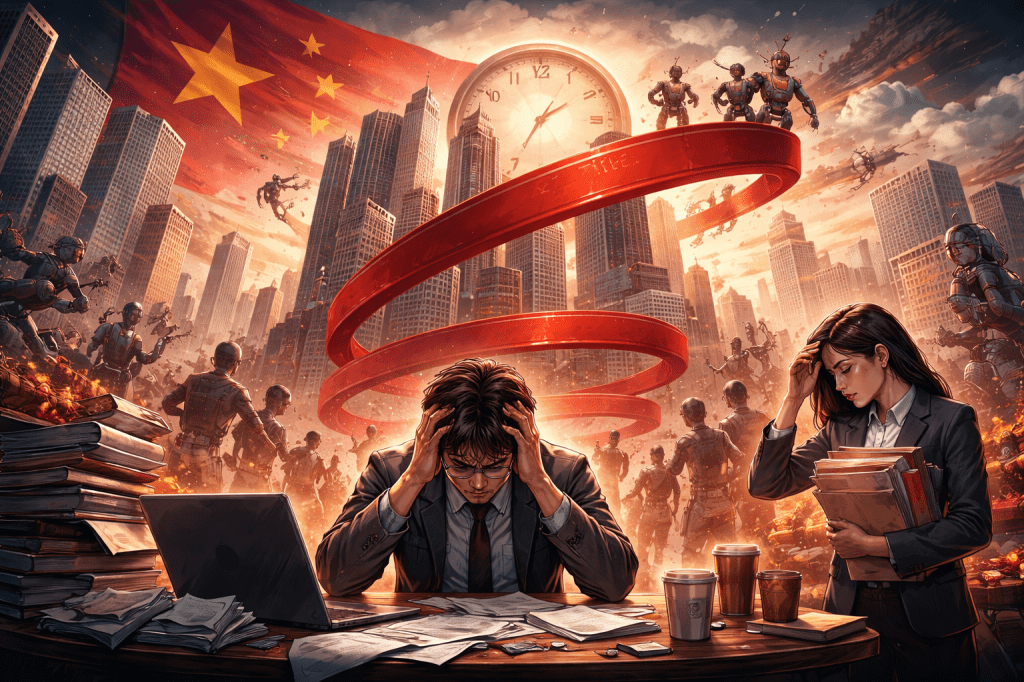
The problem of involution in China—often described through the popular term —captures a cycle of excessive competition without proportional gains in productivity, innovation, or well-being. Historically, the concept traces back to anthropologist Clifford Geertz’s description of “agricultural involution” in Java, where labour intensity rose but output stagnated. In China, the idea re-emerged in the last decade as citizens, especially students and white-collar workers, began to critique a system that demands infinitely more effort yet delivers diminishing returns. Underlying this is China’s rapid transition from a low-income to upper-middle-income economy, where competition has moved from land and labour to degrees, credentials, and urban opportunities—yet the economic ladder no longer expands at the same pace as social aspirations.
Education, Urbanisation, and the Hyper-Competition Cycle
The roots of involution lie partly in China’s rigid education and examination-driven mobility system. As millions chase the same elite universities and top-tier city jobs, the result is not higher skill productivity but inflated credentialism. Families spend a disproportionate share of income on tutoring and extracurricular activities, a trend visible even after the 2021 crackdown on private tutoring. China’s urbanisation model—where Tier-1 cities concentrate the highest-paying jobs—further intensifies this competition, generating a winner-takes-all environment that pressures youth into what the government itself labels as “internal friction.”
Labour Markets and the Rise of 996 Work Culture
The involution problem is perhaps most visible in China’s corporate culture. The infamous “996”—working 9 a.m. to 9 p.m., six days a week—became a status symbol of dedication in the tech boom years. But by the mid-2020s, the limits of this model became evident: burnout rose, productivity plateaued, and many young workers began expressing their frustration through the “lying flat” (tang ping) and “let it rot” (bai lan) movements. These social sentiments reflect a deeper macroeconomic challenge—China’s demographic decline has led to a scarcity of young workers, yet instead of redesigning labour systems, many firms squeeze more intensity out of the existing workforce, reinforcing involution.
Industrial Strategy, Innovation Gaps, and the Middle-Income Trap Risk
China’s push into high-tech sectors—AI, semiconductors, green manufacturing—is real and unmatched in scale. However, involution poses a paradox: while investment rises, genuine breakthrough innovation can stagnate when firms focus on incremental improvements driven by internal competition rather than disruptive thinking. This pattern mirrors the middle-income trap seen historically in countries like Brazil or Thailand, where rising costs outpaced the shift toward innovation-led growth. If China cannot transform its labour and innovation ecosystem, involution may slow its transition into a high-income economy.
Demographics, Social Welfare, and the Pressure to “Do More With Less”
The demographic contraction—China’s population began shrinking from 2022—creates structural pressures that magnify involution. Fewer young people must support more elderly dependents, yet they face stagnant wages, shrinking job security, and high housing prices in major cities. The absence of universal social safety nets, particularly in healthcare and pensions for migrant workers, deepens anxiety and pushes families to over-invest in education as a survival strategy. This generational strain fuels a cycle of overwork, over-saving, and under-consumption—ultimately undermining China’s ambition to shift toward a consumption-led economy.
Digital Economy, AI Automation, and the Future of Work
Looking forward, China stands at a crossroads. AI and automation promise to replace routine and repetitive jobs—ironically, the very sectors where involution is most acute. If managed well, technological modernization can release workers from excessive competition and redirect human capital toward creativity and innovation. But if automation is adopted without labour reforms, it may instead amplify underemployment among graduates—already visible in youth unemployment rates that exceeded 20% in 2023 before the government paused publication of the data. The future depends on whether China can use technology to redesign work rather than intensify it.
Toward an Exit from Involution: Policy, Governance, and Social Transformation
Breaking free from involution requires a shift from quantity-driven to quality-driven development. Policies encouraging balanced urbanisation, reforming the hukou system, reducing education inequality, expanding social welfare, and supporting SMEs can reduce structural pressures. Encouraging flexible work, improving labour rights, and rewarding genuine innovation over internal competition are equally vital. Historically, China has demonstrated capacity for large-scale policy transformation—from post-1978 reforms to the digital governance revolution of the 2010s. A similar leap is now needed, one that addresses not only economic incentives but also the social psychology of an entire generation.
The Future of China’s Growth Will Depend on Escaping the Logic of Involution
Involution is not merely a social media phenomenon; it is a structural reflection of China’s evolving development model. The challenge is profound: sustaining growth in a mature economy while ensuring that effort, education, and ambition yield proportional opportunities. If China successfully transitions to an innovation-driven, human-centric growth model, it could set a global example for large economies facing demographic and technological transitions. If not, involution may become the defining barrier stopping China from reaching its long-envisioned high-income future.
#Involution
#Neijuan
#HyperCompetition
#996Culture
#LyingFlat
#MiddleIncomeTrap
#DemographicDecline
#OverEducation
#ProductivityStagnation
#InnovationGap
 "Connecting communities, empowering nations: Unifying the Regional and Global Economy ."
Leave a comment