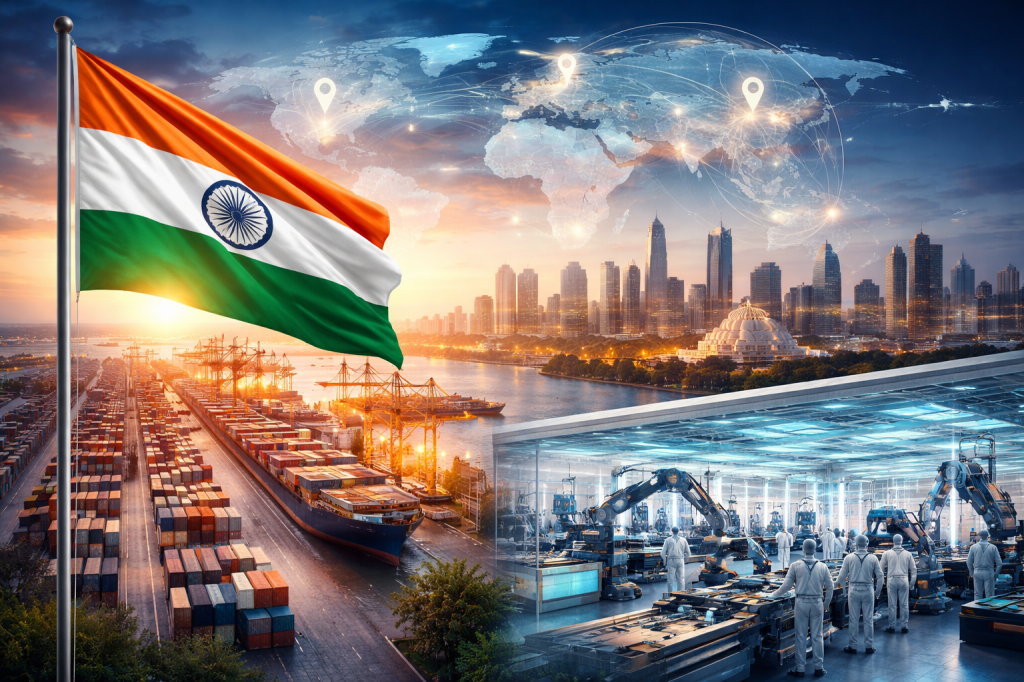
For three decades, global trade expanded under the logic of efficiency. Production concentrated where costs were lowest, logistics were predictable, and geopolitics appeared stable. The rise of global value chains made East Asia—particularly China—the manufacturing anchor of the world. But the shocks of the past decade—trade wars, pandemic disruptions, technology restrictions, and geopolitical fragmentation—have fundamentally altered that architecture.
The conversation has shifted from cost minimisation to risk diversification. Corporations are no longer asking where production is cheapest; they are asking where it is safest, scalable, and politically aligned. The “China+1” strategy is not about replacing China but about hedging exposure. And in this recalibration, India has emerged as a serious contender.
China+1 and India’s Emerging Opportunity
India stands at a rare strategic moment. As multinational firms diversify supply chains, sectors such as electronics, pharmaceuticals, textiles, and engineering goods are witnessing renewed global interest. The expansion of electronics assembly, pharmaceutical ingredient manufacturing, and specialty chemicals indicates a gradual but meaningful repositioning of production networks.
Electronics manufacturing, for example, has grown sharply in recent years, supported by policy incentives and rising domestic demand. Pharmaceutical exports continue to strengthen India’s role as a major supplier of generics. Textiles and engineering goods—traditional strengths—are benefiting from buyers seeking alternatives to over-concentrated sourcing hubs.
But opportunity should not be mistaken for inevitability. Global investors are not reallocating capital out of goodwill; they are reallocating based on measurable reliability. India must compete not only on wages but on predictability, compliance, and time-to-market.
The Competitive Field: No Automatic Advantage
India’s strategic window is real—but it is contested.
Countries such as Vietnam, Mexico, Indonesia, and Eastern Europe are aggressively positioning themselves within the same diversification narrative.
Vietnam offers policy speed and export discipline. Mexico leverages proximity to the US market under regional trade frameworks. Indonesia combines resource depth with industrial ambition. Eastern Europe provides logistical integration with the European Union.
These competitors often move faster on land acquisition, environmental clearances, and export facilitation. In a world where supply chain decisions are increasingly time-sensitive, delays become strategic disadvantages.
India’s scale—its large domestic market and demographic depth—is an undeniable strength. Yet scale without efficiency risks becoming inertia.
Infrastructure, Logistics, and the Cost of Time
Historically, India’s trade performance has been constrained not by ambition but by friction. Port congestion, logistics costs, power reliability, and regulatory complexity have increased transaction costs. While improvements are visible in digital customs processes, highway expansion, and freight corridors, the global benchmark is rising even faster.
In trade realignment, infrastructure is not merely a physical asset; it is a signal. Investors interpret turnaround time at ports, average customs clearance duration, and electricity stability as indicators of systemic capability.
If India reduces logistics costs significantly and improves last-mile connectivity, it can transform comparative advantage into competitive advantage. If not, it risks remaining a secondary diversification choice rather than a primary manufacturing hub.
Regulatory Clarity and Policy Credibility
Trade realignment is occurring in a world shaped by carbon regulations, technology controls, and compliance-driven procurement standards. Multinational corporations increasingly evaluate suppliers on ESG standards, traceability, and geopolitical alignment.
India’s policy architecture must therefore evolve from reactive incentives to predictable frameworks. Frequent regulatory shifts, retrospective taxation memories, or procedural ambiguity can undermine investor confidence.
In the next decade, credibility may matter more than subsidies. Investors can tolerate moderate costs if policy consistency is strong. They struggle with uncertainty even when costs are low.
Sectoral Shifts: Electronics, Pharma, Textiles, Engineering
Electronics manufacturing represents perhaps the most symbolic test of India’s trade ambitions. Moving from assembly to component ecosystems will determine whether India captures value-added segments or remains confined to low-margin activities.
Pharmaceuticals offer a mature export base, but supply chain resilience in active pharmaceutical ingredients (APIs) remains critical. Textiles face global competition not only on cost but on sustainability compliance. Engineering goods must climb the value ladder through design capability and quality certification.
The common thread across these sectors is productivity. Without sustained gains in skill development, technology adoption, and energy efficiency, trade realignment will plateau.
Windows That Close
India has experienced strategic windows before. The liberalisation reforms of the 1990s unlocked export momentum. The IT services boom leveraged human capital at the right global moment. Each wave demonstrated that when structural reform aligns with global demand shifts, transformation accelerates.
Today’s trade realignment is comparable in scale. Yet unlike earlier eras, the global system is less forgiving. Protectionism, regional blocs, and climate-linked trade mechanisms narrow the margin for error.
India must therefore act with urgency but also with coordination. Industrial policy cannot function in isolation from trade diplomacy, labour reform, energy transition, and digital governance.
The Futuristic Outlook: From Alternative to Anchor
The central question is whether India becomes merely an alternative manufacturing site—or an anchor economy in restructured global value chains.
To achieve leadership, three structural shifts are essential:
Execution speed must match policy intent.
Infrastructure efficiency must approach global best practice.
Regulatory systems must deliver clarity and continuity.
If these conditions align, India’s market depth and demographic scale could convert diversification into durable leadership.
If they do not, India may benefit partially—capturing incremental flows without achieving systemic transformation.
Opportunity Requires Discipline
Trade realignment is not a temporary adjustment; it is a structural reconfiguration of global production. India’s strategic window is open, but windows close when momentum stalls.
The next decade will not reward scale alone—it will reward coordination, productivity, and credibility.
India’s advantage lies in its size and strategic positioning. Its challenge lies in execution. And in the global competition for diversified supply chains, execution speed will determine whether opportunity translates into leadership.
#TradeRealignment
#ChinaPlusOne
#GlobalValueChains
#ManufacturingShift
#SupplyChainDiversification
#InfrastructureEfficiency
#RegulatoryClarity
#IndustrialCompetitiveness
#ExportStrategy
#StrategicWindow
 "Connecting communities, empowering nations: Unifying the Regional and Global Economy ."
Leave a comment