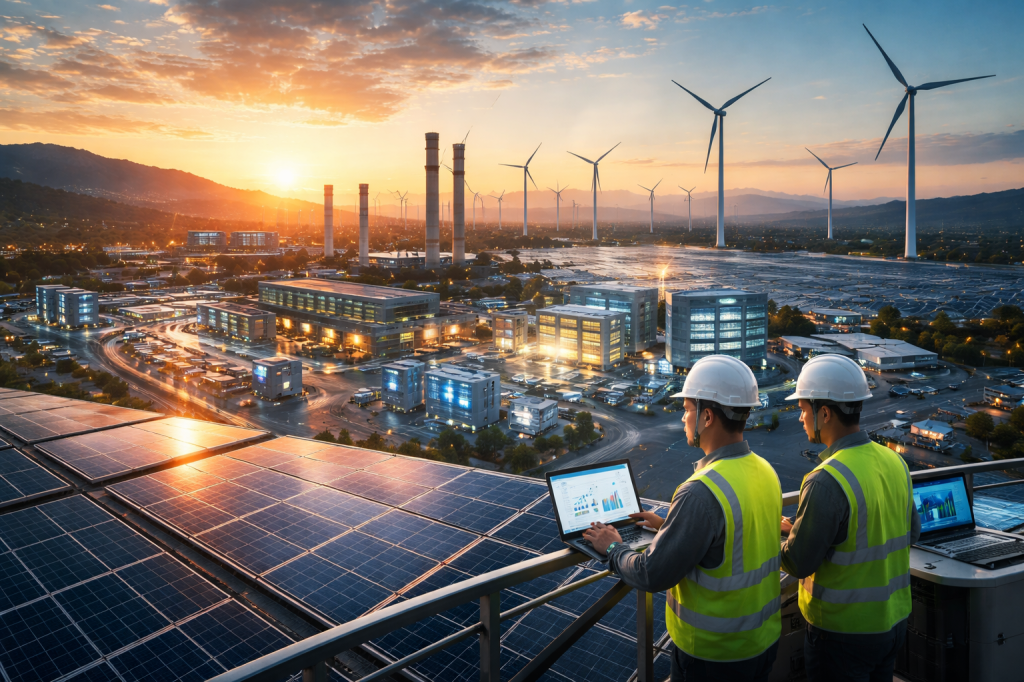
From Industrial Revolution to Energy Reinvention
Every major industrial transformation has been anchored in energy shifts. The coal-powered factories of the 19th century reshaped global trade. Oil and electricity in the 20th century enabled mass production, global logistics, and urbanisation. Today, the global economy stands at the threshold of another systemic change—one defined not by access to fossil fuels, but by carbon intensity, electrification, and renewable integration.
Unlike previous transitions, this one is not purely technological; it is regulatory, geopolitical, and financial. Carbon emissions are no longer treated as externalities—they are embedded into trade frameworks, investment criteria, and corporate valuation metrics. Energy transition is no longer an environmental conversation alone. It is now a competitiveness question.
Carbon as a Trade Variable
For decades, global trade operated primarily on cost efficiency and scale. Today, carbon intensity increasingly influences market access. Procurement contracts demand emission disclosures. Financial institutions price climate risk into lending decisions. Border carbon measures and sustainability-linked supply chains are reshaping industrial geography.
This shift is particularly evident in export-oriented manufacturing. Firms supplying global value chains must now demonstrate traceability, renewable energy use, and measurable decarbonisation pathways. Carbon performance is quietly becoming as important as price and quality.
For advanced economies, this creates an opportunity to consolidate technological leadership in green hydrogen, advanced batteries, smart grids, and energy-efficient industrial systems. For emerging economies, however, the situation is more complex. The cost of upgrading infrastructure, retraining labour, and modernising energy systems is substantial. The risk is marginalisation from regulated global markets if adaptation is delayed.
Cost Burden or Productivity Catalyst?
At first glance, the transition appears expensive. Electrification of industrial heat, renewable power integration, energy storage systems, and carbon capture technologies demand capital investment. Smaller manufacturers often see these requirements as compliance burdens rather than growth enablers.
However, history suggests that energy efficiency improvements often yield productivity gains. During previous oil shocks, firms that invested in energy-saving technologies reduced long-term operating costs and strengthened competitiveness. The same dynamic may apply today.
Electrification reduces fuel volatility exposure. Renewable energy stabilises long-term power costs. Digital energy management systems optimise consumption patterns, lowering waste. Firms that treat decarbonisation as a strategic redesign rather than a regulatory checkbox may unlock efficiency dividends.
The transition becomes costly only when reactive. It becomes advantageous when proactive.
Emerging Economies at a Strategic Crossroads
Emerging economies face a delicate balance. Many still rely on coal-based grids, energy-intensive production methods, and capital-constrained MSMEs. Rapid decarbonisation without financial support risks industrial contraction and employment stress.
Yet the alternative—delayed transition—carries its own economic dangers. As global buyers impose sustainability standards, exporters unable to demonstrate low-carbon compliance may lose access to premium markets. Financing may become more expensive. Insurance costs may rise.
The solution lies not in imitation of advanced economies, but in strategic sequencing. Investment in grid modernisation, distributed renewable systems, energy-efficient MSME clusters, and digital monitoring can create gradual decarbonisation pathways without destabilising growth.
For countries with abundant solar and wind potential, the energy transition could reduce import dependence on fossil fuels, strengthen energy security, and improve trade balances. The challenge is mobilising capital, building institutional capacity, and ensuring just transitions for labour-intensive sectors.
Finance, Technology, and the New Competitive Architecture
Global capital markets are increasingly aligning with climate frameworks. Sustainability-linked bonds, green finance instruments, and ESG-based lending terms are influencing corporate strategies. Firms with credible decarbonisation roadmaps often secure better financing conditions.
Technology is also redefining the pace of change. AI-enabled energy management, predictive maintenance, and smart manufacturing systems integrate decarbonisation with operational efficiency. The next generation of industrial competitiveness may depend less on cheap labour and more on energy-smart production design.
This evolution suggests a structural shift: energy transition is becoming embedded in the core architecture of industrial strategy. It is no longer peripheral.
The Risk of Fragmentation
However, the transition also carries geopolitical implications. Divergent regulatory standards, carbon pricing disparities, and technology access restrictions may fragment global markets. Countries that lack technological access or climate finance may face widening competitiveness gaps.
There is a risk that the energy transition could unintentionally reinforce global inequalities if policy coordination remains weak. International cooperation on technology transfer, transitional finance, and capacity building will determine whether decarbonisation becomes inclusive or exclusionary.
Beyond Compliance
Looking ahead to the next two decades, the question will not be whether industries decarbonise—but how intelligently they integrate the process into productivity systems.
Factories of the future may operate on hybrid renewable grids, powered by electrified processes, monitored by AI-driven optimisation systems, and financed through sustainability-linked instruments. Carbon accounting may become automated and embedded in enterprise software.
In such a scenario, energy transition ceases to be an external cost and becomes a design principle. Firms that embed low-carbon systems early may enjoy stable energy costs, easier trade access, stronger brand positioning, and technological leadership.
Strategic Choice, Not Inevitable Burden
The energy transition is inevitable. Climate risk, regulatory evolution, and technological progress ensure that reversal is improbable. The real strategic choice lies in framing.
If viewed narrowly as a compliance expense, it will strain margins and slow investment. If embraced as an industrial modernisation project, it can drive innovation, productivity, and long-term competitiveness.
History teaches that energy transformations reshape economic hierarchies. The coming decade will determine whether nations and firms treat decarbonisation as an imposed burden—or as the foundation of the next industrial advantage.
The transition itself is unavoidable. Competitive leadership, however, remains optional.
#EnergyTransition
#CarbonIntensity
#IndustrialStrategy
#GreenCompetitiveness
#Electrification
#RenewableIntegration
#Decarbonisation
#SustainableTrade
#ClimateFinance
#IndustrialModernisation
 "Connecting communities, empowering nations: Unifying the Regional and Global Economy ."
Leave a comment