A False Victory: The Illusion of Stability
By early 2026, advanced economies appear to have defeated inflation if one looks only at the headline numbers. Consumer Price Index (CPI) inflation has cooled across the US, Europe, and parts of East Asia, giving an impression of regained macroeconomic stability. But beneath this optical calm lies a structural challenge that refuses to fade. The real battle—in housing, healthcare, education, and the broader service economy—remains far from won. These sectors are embedded with rigidities that monetary policy alone cannot correct.
Where Inflation Still Lives: The Rise of Structural Costs
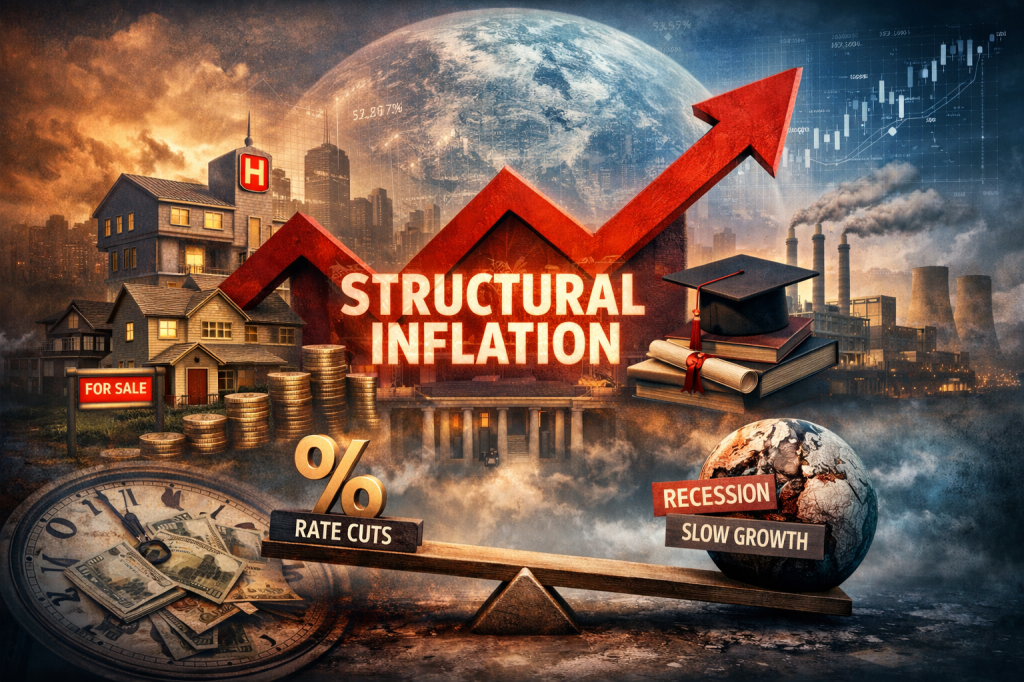
Goods inflation softened rapidly once supply chains normalised and pandemic-era distortions faded. But service-sector inflation has stubbornly held its ground. Housing costs surged due to chronic under-supply and zoning bottlenecks. Healthcare inflates because ageing populations and labour-intensive delivery models push up costs faster than productivity gains can absorb. Education, driven by wage-heavy institutions and rising administrative expenses, has become a slow-burning inflation engine.
These components are immune to traditional monetary tightening. They reflect structural shortages, institutional rigidities, and demographic transitions—not excess liquidity or overstimulated demand.
The Historical Trap: Monetary Policy vs. Structural Inflation
Historically, central banks have excelled at fighting cyclical price rises—from the Volcker shocks of the 1980s to the post-GFC quantitative tightening cycles. But structural inflation has always challenged them. In the 1970s, supply-side shocks overpowered rate hikes. In the 2000s, soaring asset prices coexisted with stable goods inflation. Today, the architecture is similar: a world where central banks control money but governments control the structural forces that money cannot fix.
The post-pandemic era has revived this structural trap. Tightening interest rates cooled goods inflation, but the service sectors—dependent on labour, regulations, and long-term investment—continued to push prices up. Monetary policy is a blunt instrument in a world demanding surgical solutions.
A New Policy Dilemma: Cut Too Soon or Hold Too Long?
Central banks now face a paradox.
Cutting rates risks reigniting inflation, as households unfreeze their spending and firms accelerate investment. But keeping rates high suffocates already-fragile growth, particularly in Europe, where industrial competitiveness is weakening. The US faces a different challenge: strong labour markets keep services inflation elevated even as borrowing costs strain small businesses and mid-income households.
This is the first time since the early 1990s that advanced economies are stuck between inflation fatigue and growth fatigue—each policy response risks worsening the other.
Why the Old Playbook No Longer Works
The global economy has entered a phase where price stability depends more on structural reform than on monetary strength.
Housing inflation needs supply-side reforms in construction, land policy, and incentives.
Healthcare inflation requires productivity-boosting technologies—AI diagnostics, telemedicine, and cost-sharing models.
Education inflation demands rethinking outdated models of credentialism, institutional costs, and employability-focused curricula.
Services inflation in general requires digitisation, automation, and competition where monopolistic or oligopolistic structures dominate.
Monetary policy cannot fix zoning laws, expand hospital capacity, or reform university governance. Yet these are precisely the choke points of modern inflation.
A Future Defined by “Structural Anti-Inflation Policy”
The future of inflation management will not be defined by central banks alone. It will be shaped by governments willing to redesign the structural foundations of their economies. Advanced economies will need:
Supply-side investment in housing and skill development
Technological integration to raise productivity in slow-moving sectors
Regulatory streamlining to reduce cost-push bottlenecks
Targeted fiscal interventions focused on affordability rather than broad consumption
Inflation risk will persist not because central banks fail, but because structural reforms lag behind.
The War Has Shifted—Not Ended
The inflation fight, as defined by traditional metrics, may be largely over—but the inflation problem is very much alive. The world stands at an inflection point where headline stability hides structural stress. Unless nations confront the deep-rooted cost pressures embedded in housing, healthcare, education, and services, the global economy will drift into a long phase of unresolved inflation and muted growth.
Monetary policy won the battle.
But structural reform will decide the war.
#StructuralInflation
#CoreInflation
#ServiceSectorCosts
#MonetaryPolicyLimits
#HousingCrisis
#HealthcareInflation
#EducationCosts
#RateCutDilemma
#SupplySideReforms
#FutureOfInflation
 "Connecting communities, empowering nations: Unifying the Regional and Global Economy ."
Leave a comment