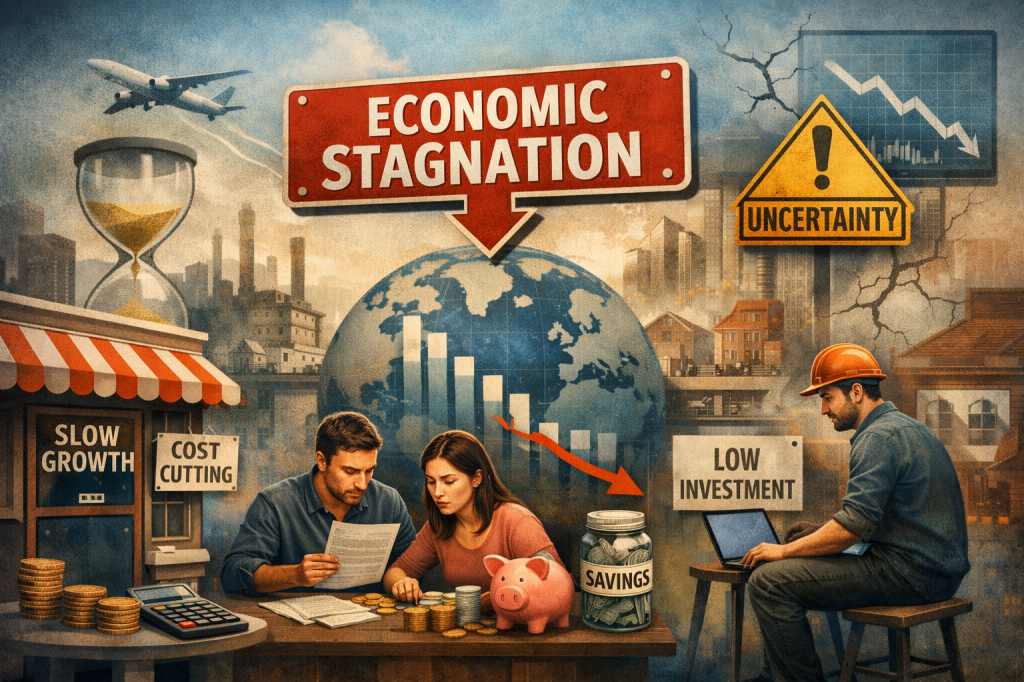
The global economy of the mid-20200s appears relatively stable on the surface—growth has not collapsed, inflation has retreated from its peaks, and financial markets remain largely functional. Yet this stability is deceptive. Underneath the macro indicators lies a quiet but powerful shift in the behaviour of households, small firms, and independent producers—a shift that threatens to redefine the trajectory of global economic growth.
Micro-Level Behavioural Shift: A New Age of Caution
The most underappreciated trend today is not occurring in stock markets or central bank balance sheets, but inside homes, neighbourhood businesses, micro-enterprises, and family-run firms across the world. Since the overlapping shocks of the past decade—pandemic, geopolitical fractures, inflation surges, supply-chain disruptions, rapid technology transitions, and labour market insecurity—people have rewritten their personal economic rulebook.
Across both advanced and emerging economies, savings are being prioritised, not as a choice but as a survival strategy. Households are deliberately reducing discretionary spending and building buffers. Small businesses, especially those in retail, services, and traditional manufacturing sectors, are showing clear debt aversion, preferring self-financing and staying small rather than borrowing to expand. Risk-taking has fallen sharply, creating a culture where the fear of future shocks outcompetes the desire for growth.
Historically, societies shift into such defensive behaviour only after periods of prolonged instability—similar patterns were seen after the 1970s oil shocks and the 2008 global financial crisis. But today’s behavioural shift is deeper and more persistent, partly because the shocks are overlapping rather than episodic.
From Adaptive Behaviour to Macro-Level Drag
This micro-level caution is not irrational pessimism. It is adaptive behaviour shaped by uncertainty that feels structural. When households adjust consumption and savings patterns to protect themselves from volatility, they reinforce a cycle of subdued demand. When entrepreneurs avoid debt and delay expansion, the ripple effects weaken job creation, innovation, and productivity.
Economically, the danger is no longer recession—it is chronic stagnation. Growth does not collapse, but it struggles to accelerate. Businesses remain operational but stagnant. Investment continues but becomes incremental rather than transformative. Policy responses stabilize conditions but fail to restore confidence.
The irony is striking: micro-level caution, perfectly rational for individuals, becomes collectively damaging for the macroeconomy. It shifts economies into a “low-risk, low-growth equilibrium,” where everyone is waiting for certainty that never fully arrives.
A Future of Stability Without Dynamism
If this behavioural reset persists, the world could enter a decade defined by stable but shallow growth—a macro environment that avoids crisis but also lacks momentum. For countries relying on innovation-led growth, this could mean a slowdown in startup formation, lower venture capital flows, and weaker diffusion of cutting-edge technologies. For developing economies, especially those dependent on MSMEs and household consumption (like India), the impact may be more acute: a persistent demand drag will reduce the multiplier effect of public investment and slow the pace of economic transformation.
Looking ahead, policymakers will need to rethink conventional stimulus strategies. Pushing liquidity into the system will not automatically revive risk-taking if households remain psychologically anchored to caution. Similarly, supply-side incentives may not work unless demand signals are strong enough to encourage investment.
The real challenge is rebuilding economic courage at the grassroots—restoring the confidence required for households to spend, small firms to borrow, and entrepreneurs to take risks. Without this, the global economy risks drifting into a future defined not by crisis, but by quiet stagnation.
#MicroEconomyShift
#GlobalStagnation
#RiskAversion
#SavingsSurge
#DemandSlowdown
#EntrepreneurshipDecline
#BehaviouralEconomics
#PostShockEconomy
#CautiousConsumers
#FutureOfGrowth
 "Connecting communities, empowering nations: Unifying the Regional and Global Economy ."
Leave a comment