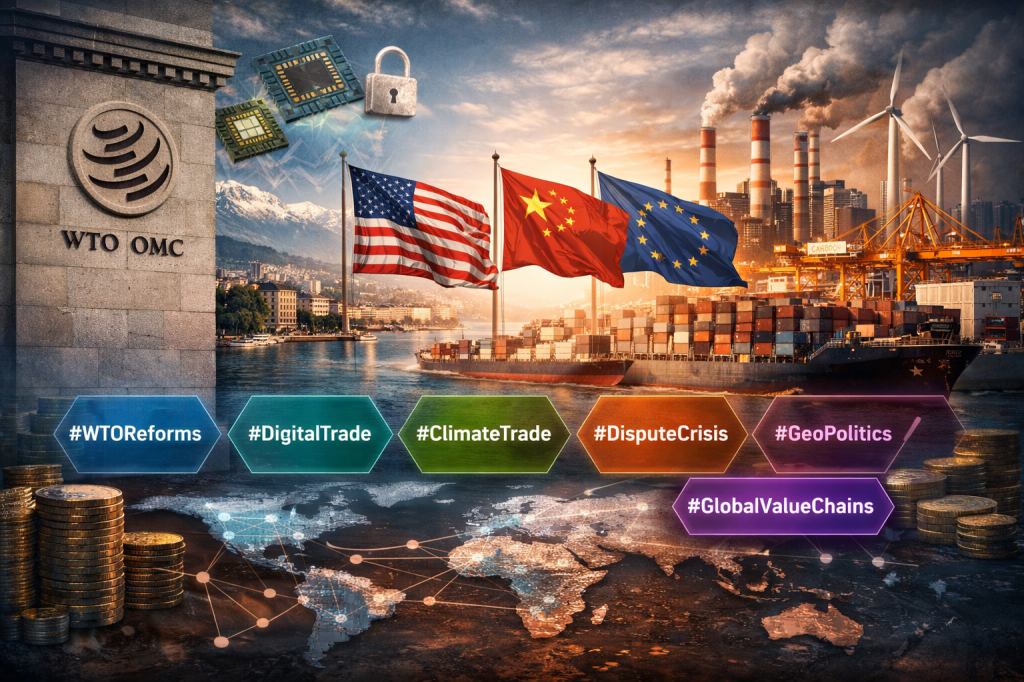
For nearly three decades, the World Trade Organization has been the anchor of the global trading system—promising predictability, fairness, and stability. But the world it was designed for no longer exists. The smooth flows of globalization have given way to geopolitically filtered supply chains, climate-linked trade retaliation, digital sovereignty, industrial subsidies, and security-driven export controls. The WTO today faces its most serious crisis of relevance since its birth in 1995.
Below is a critical exploration of the key challenges facing the WTO—and the deep structural reforms required to prevent the global trade order from sliding into fragmentation.
1. Dispute Settlement Paralysis: When the Referee Goes Silent
One of the WTO’s strongest institutions—its dispute settlement system—has been effectively paralyzed since 2019 when the United States blocked new appointments to the Appellate Body. Without a functioning appeal mechanism, countries can violate rules with few consequences.
This vacuum has fuelled unilateral tariff actions, retaliatory duties, and mini trade wars. Developing economies, which rely the most on a neutral dispute forum, now lack a trustworthy arbiter.
What must change?
The system needs a reformed and time-bound Appellate Body, a fast-track arbitration option, and digital transparency mechanisms. Without this foundation, rules become optional—and trade becomes a power game.
2. Outdated Rules in a Digital-First World
The WTO’s rulebook still belongs to 1995—the pre-AI, pre-cloud, pre-platform era. Digital trade now grows faster than physical goods, yet global rules on data flows, AI-enabled services, digital taxation, and cyber risks remain unclear.
Countries have responded with digital borders:
Data localization norms
Algorithm regulation
Digital taxes
Cybersecurity-based market restrictions
These fragmented rules threaten to break the internet into geopolitical zones.
What must change?
The world needs a Digital Trade 2.0 framework—one that governs cross-border data, ensures consumer trust, harmonizes digital tax norms, and defines AI-enabled trade. Future competitiveness lies in digital flows, not container ships.
3. Geopolitics Over Trade: The Age of “Conditional Integration”
Globalization is no longer about efficiency—it is about security, alliances, and supply-chain resilience. Export controls on semiconductors, rare earths, and dual-use technologies now determine who trades with whom.
The WTO’s current structure cannot discipline national-security exceptions when they are invoked broadly. The result is a fractured global economy where blocs, not rules, shape trade.
What must change?
A geo-economic risk framework is needed to distinguish legitimate security concerns from disguised protectionism. Without boundaries, national-security exceptions could hollow out the rules-based system.
4. Climate Policy as the New Trade War
Climate-linked trade actions—such as the EU’s Carbon Border Adjustment Mechanism (CBAM) and U.S. green subsidies—are becoming a new form of industrial competition.
Developing nations argue that they are penalized despite low historical emissions. Exporters of steel, cement, fertilizers, aluminium, and chemicals risk losing competitiveness in a world where carbon intensity becomes a trade determinant.
What must change?
The WTO needs a Climate-Trade Compact with:
Transparent carbon calculation rules
Fair timelines for developing economies
Green-transition financing
A classification of “green subsidies” that avoids distortion
Climate action cannot become a non-tariff barrier in disguise.
5. Broken Development Framework: S&DT No Longer Fits the World
The Special and Differential Treatment (S&DT) rules divide the world simplistically into “developed” and “developing”. Some countries with high incomes and advanced industrial bases still claim developing status, while LDCs remain overshadowed.
This outdated binary blocks reform and weakens trust.
What must change?
A tiered, metrics-driven development framework—where flexibilities depend on income, export capacity, and institutional strength—is essential. Development must be a spectrum, not a label.
6. Agriculture Deadlock: The WTO’s Original Failure Point
Agriculture remains the most politically sensitive sector and the biggest unresolved agenda:
Developed-country subsidies distort global prices
Developing countries face disputes over public stockholding
Food security programmes clash with subsidy limits
The failure to update the Agreement on Agriculture has weakened the WTO’s credibility in food-related trade—a sector central to 60% of the world’s poor.
What must change?
A permanent solution on public stockholding, recognition of climate-resilient subsidies, and disciplining of OECD farm supports. Food security cannot remain hostage to an outdated 1990s formula.
A System at Risk: Why the WTO Must Reinvent Itself
The WTO is not collapsing—but it is slowly becoming irrelevant in areas where the future of trade is being shaped:
AI and data flows
Strategic minerals
Green technology
Digital platforms
National-security trade actions
The world is moving from globalization to conditional integration, and without deep reform, the WTO risks becoming a passive observer rather than the global referee.
What the WTO Must Do Now
To restore relevance and legitimacy, the WTO needs a bold redesign:
✔ Modernize its rulebook for digital, AI, and services
✔ Rebuild a credible dispute settlement mechanism
✔ Balance climate goals with development equity
✔ Discipline unilateral export controls
✔ Reinvent Special & Differential Treatment
✔ Make rule-making inclusive for developing nations
This is not about saving an institution—it is about saving the idea of stable global economic cooperation.
If the WTO adapts, it can guide the next phase of global trade.
If it does not, the world will drift into fragmented blocs and contested markets—a world far riskier for developing economies like India.
#WTOReforms
#TradeFragmentation
#DigitalTradeGovernance
#ClimateTradeRisks
#NationalSecurityExceptions
#CBAMImpact
#GlobalValueChains
#DevelopmentAsymmetry
#DisputeSettlementCrisis
#GeoEconomicRealignment
 "Connecting communities, empowering nations: Unifying the Regional and Global Economy ."
Leave a comment