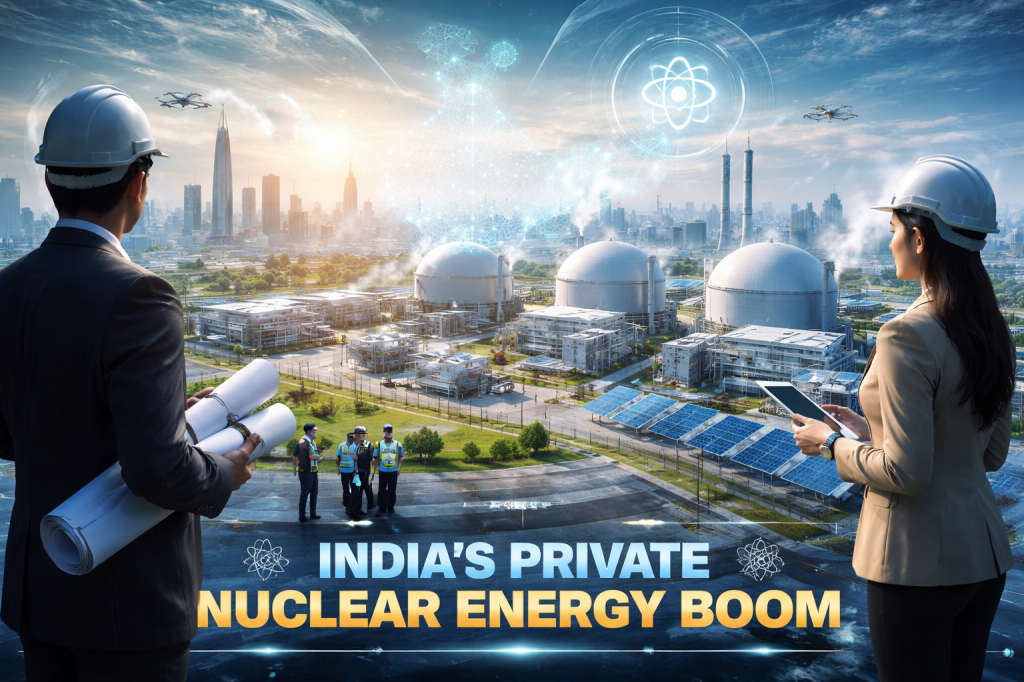
India’s atomic energy program, once guarded behind layers of state control and strategic secrecy, is undergoing its most profound transformation since independence. For decades, nuclear energy remained the exclusive domain of the Department of Atomic Energy (DAE) and Nuclear Power Corporation of India Ltd., shaped by geopolitical compulsions, technology denial regimes, and a deliberate policy of insulation from market forces.
But with the passage of the SHANTI Bill 2025, India has signalled a decisive break from this history. The country is inviting private players—not as peripheral vendors, but as co-architects of a future where nuclear power becomes central to clean energy, industrial competitiveness, and national security.
A Historic Policy Break: From State Monopoly to Shared Governance
The SHANTI Bill 2025 dismantles the restrictive framework of the 1962 Atomic Energy Act and the Civil Liability for Nuclear Damage Act, enabling private sector participation across the nuclear value chain through joint ventures, ownership, and operation of next-generation reactors such as small modular reactors (SMRs).
For the first time, companies can:
- Build and operate nuclear plants
- Manufacture reactor components
- Participate in limited fuel-cycle activities
- Co-design SMR clusters for industrial and digital ecosystems
Foreign investment up to 49% FDI adds strategic depth by enabling technology partnerships with global innovators while maintaining majority Indian ownership.
Why Private Players Matter: The Economic and Strategic Rationale
1. Accelerating India’s Nuclear Capacity Needs
India’s ambitions—22 GW nuclear capacity by 2032 and 100 GW by 2047—require unprecedented capital, engineering capability, and project execution speeds. State monopolies alone cannot shoulder the burden of financing, constructing, and maintaining such complex systems.
Private participation opens pathways to:
- Faster project completion
- Lower capital costs via competitive procurement
- High-efficiency modular manufacturing models
- A deeper domestic supplier ecosystem
This mirrors global precedents in countries like the United States, France, and South Korea, where public-private cooperation catalysed nuclear scaling.
2. Technology Migration and Digital Integration
The 2020s marked the rise of AI-driven industries, hyperscale data centers, and energy-intensive computing. SMRs are being positioned as the next-gen power backbone for:
- AI data farms
- Green hydrogen facilities
- Industrial clusters
- Defence applications
Private players bring agility and innovation—qualities essential for integrating nuclear with the emerging digital-industrial landscape.
3. Enhancing Energy Security
With coal’s future uncertain and renewables facing intermittency, India needs a stable baseload. Nuclear energy provides:
- High-density, low-carbon power
- Geo-strategic autonomy
- Resilience against global fuel price shocks
- A hedge against climate-driven volatility
Private entry strengthens the energy transition by diversifying the institutional architecture of nuclear power.
What Private Players Can—and Cannot—Do
Permitted Areas
Private players can now operate in:
- Power generation
- Reactor operation
- Nuclear component manufacturing
- Uranium conversion below government-set thresholds
- SMR and next-gen reactor design with international partners
This opens new frontiers for conglomerates like Adani Group, Tata Power, and Jindal Nuclear Power, who are already exploring multi-gigawatt investments.
Restricted Areas (State Monopoly Continues)
Certain activities remain strategically sensitive and fully under government control:
- Uranium enrichment beyond defined purity thresholds
- Spent fuel reprocessing
- Heavy water production
- Core nuclear material custody
- National waste repositories
This hybrid model safeguards national security while unleashing market efficiency.
The First Wave of Private Nuclear Projects
Major industrial groups have already begun negotiations:
- Adani Group is pursuing eight 200 MW SMRs in Uttar Pradesh through a PPP model with NPCIL.
- Tata Power has indicated interest in next-gen reactor technologies and large-scale capacity expansion.
- Jindal Nuclear Power is evaluating up to 18 GWe investment potential aligned with India’s 2047 roadmap.
These projects represent not just energy investments, but long-term industrial bets on India’s clean-power transformation.
Critical Outlook: The Opportunities and Fault-lines Ahead
1. Regulatory Preparedness
While the SHANTI Bill grants statutory independence to the Atomic Energy Regulatory Board, India still needs:
- Global-standard safety audits
- Transparent environmental norms
- A robust liability system that balances innovation with accountability
The tiered liability framework (₹100–3,000 crore) is a step forward, but its real-world enforceability will be tested as private participation scales.
2. Supply Chain and Skill Ecosystem
India must build:
- Indigenous nuclear fabrication clusters
- Precision engineering hubs
- Radiation safety training centres
- A specialised nuclear startup ecosystem
Without these, the sector risks replicating the delays that plagued earlier mega projects.
3. Financing Risks
Nuclear projects require 40–60 year liability and revenue models. Financing via traditional bank lending will be inadequate. India will need:
- Sovereign backstop guarantees
- Green bonds
- Carbon credit monetization
- International climate finance
4. Public Trust & Transparency
Greater private involvement requires much higher levels of community engagement and transparency. India must evolve from a secrecy-first culture to a safety-first, trust-first model of governance.
Historical Perspective: Why This Reform Took Seven Decades
For decades, India’s nuclear program evolved under conditions of:
- Post-independence strategic vulnerability
- Technology embargoes after 1974
- The need for self-reliance under global restrictions
- Tight state control to prevent proliferation risks
Only after 2008—post the India-US civil nuclear agreement—did India begin integrating with the global nuclear ecosystem.
The SHANTI Bill is therefore not just a reform—it is the culmination of a 70-year strategic journey from isolation to partnership.
Futuristic Outlook: What India’s Nuclear Future Could Look Like by 2047
If reforms are executed effectively, India’s atomic sector could witness:
1. Nuclear-Powered Industrial Corridors
SMR clusters powering:
- Electronics manufacturing
- Green hydrogen hubs
- Rare-earth magnets industry (critical for India’s China+1 strategy)
2. AI-Driven Reactor Management
Digital twins, predictive safety analytics, robotics for maintenance—turning India into a leader in nuclear automation.
3. Civil-Military Fusion for Strategic Autonomy
Advanced nuclear propulsion, satellite systems synchronization, and precision-timed defence architecture.
4. India as a Global SMR Exporter
With private manufacturing capabilities, India can become a global supplier of affordable, modular nuclear solutions for developing nations by the 2030s.
#NuclearReforms #SHANTIBill #AtomicEnergyIndia #PrivateParticipation #SMRRevolution
#EnergySecurity #CleanPowerTransition #NuclearManufacturing #AERBRegulation #India2047
 "Connecting communities, empowering nations: Unifying the Regional and Global Economy ."
Leave a comment