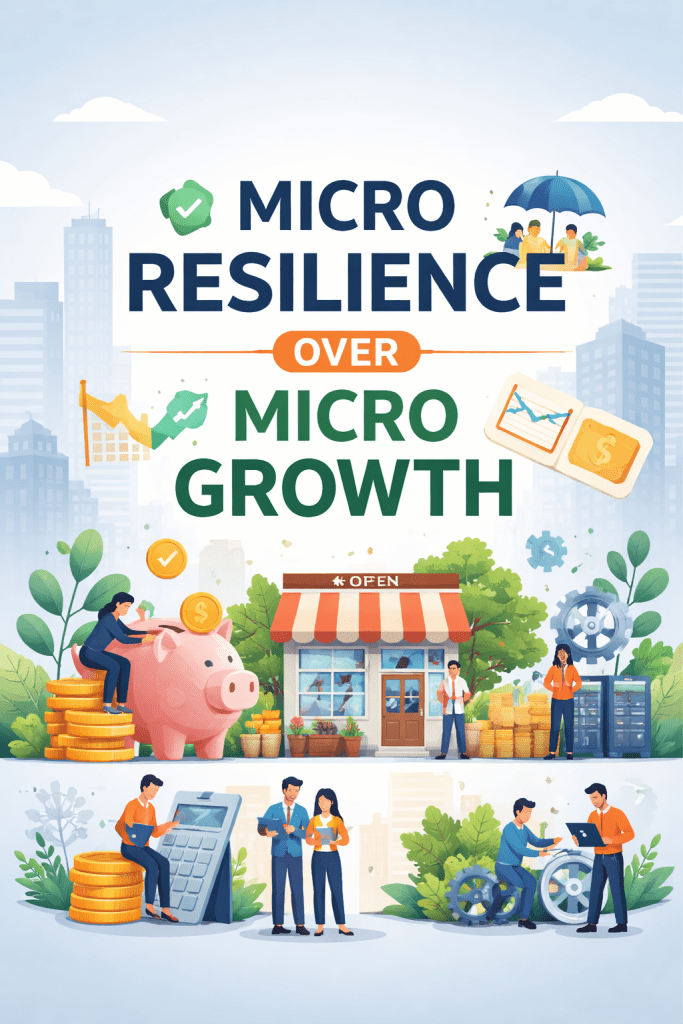
For decades, economic progress was measured by expansion—higher consumption, rising credit, and greater risk-taking at the household and small-business level. Growth was not just encouraged; it was expected. Yet, across economies today, a subtle but profound shift is underway. At the micro level, resilience is replacing growth as the dominant economic behaviour.
Households and small firms are not collapsing. They are recalibrating. Savings are being prioritised, debt is being avoided, and risk-taking is steadily declining. This is not a temporary pause—it signals the emergence of a new economic phase shaped by lived experience rather than macro optimism.
A Behavioural Shift Rooted in Experience
Historically, periods of rapid micro-level growth followed moments of confidence—post-war reconstruction, financial liberalisation in the 1990s, or the credit-fuelled expansion of the early 2000s. In each case, households borrowed freely, entrepreneurs expanded aggressively, and risk was rewarded.
The current cycle is different because it follows multiple overlapping shocks: a global financial crisis, a pandemic, supply-chain breakdowns, inflation spikes, and geopolitical fragmentation. These events have left a deep behavioural imprint. Even where incomes are stable, economic memory is shaping caution.
Households now prefer liquidity over leverage. Small firms value survival over scale. Expansion is no longer the default aspiration.
Savings Before Spending: The New Micro Logic
Across income groups, savings behaviour has changed. Rather than saving for future consumption, households are saving for shock absorption—health emergencies, job uncertainty, rent hikes, or education costs. This is precautionary saving driven not by pessimism, but by realism.
For small firms, retained earnings are replacing borrowed capital as the preferred buffer. Cash reserves are treated as strategic assets. Growth investments are postponed unless they offer immediate efficiency gains.
This shift matters because micro-level saving suppresses discretionary demand, slowing the very growth policymakers seek to stimulate.
Debt Aversion After a Credit-Heavy Era
The previous growth model relied heavily on credit expansion. Easy money lowered barriers to borrowing, encouraging consumption and entrepreneurial risk-taking. That model now appears fragile.
Rising interest rates, volatile incomes, and heightened uncertainty have made debt feel dangerous rather than empowering. Households are reducing credit-card usage and postponing large purchases. Small businesses are wary of loans unless repayment is clearly aligned with cash flows.
Debt is no longer seen as a growth tool—it is increasingly viewed as a risk multiplier.
Risk-Taking Retreats to the Margins
Entrepreneurial risk-taking has not vanished, but it has become selective. New ventures are leaner, smaller, and often defensive—focused on replacing income rather than creating scale. Expansion is incremental, not exponential.
This is especially visible in micro and informal enterprises, where owners prioritise flexibility, low fixed costs, and diversified income streams. Risk is managed through adaptability, not ambition.
Historically, falling risk appetite at the micro level has preceded periods of slower but more stable growth. The challenge is that innovation also slows when risk-taking declines too far.
Why This Is a Resilience Phase, Not a Recession
This moment should not be mistaken for economic collapse. Employment exists. Production continues. Consumption persists—though selectively. What has changed is the purpose of economic behaviour.
The micro economy is no longer chasing upside; it is protecting downside.
This distinction is critical. In expansion phases, growth policies amplify optimism. In resilience phases, the same policies can misfire if they push leverage or risk without addressing underlying insecurity.
What This Means for the Next Decade
If resilience remains the dominant micro behaviour, future growth will look different. It will be:
slower, but potentially more durable
less credit-driven, more savings-based
focused on efficiency, not excess
biased toward stability over scale
Policy frameworks, financial products, and business models will need to adapt. Growth strategies that ignore micro-level caution will struggle to gain traction.
At the same time, innovation will likely emerge in areas that reduce risk—healthcare, energy efficiency, digital services, and income-stabilising platforms—rather than speculative consumption.
The Economy Is Learning to Breathe Before It Runs
Micro resilience replacing micro growth is not a failure of capitalism or ambition. It is an adaptive response to a more uncertain world. Households and small firms are teaching the economy a quiet lesson: endurance matters before expansion.
Whether this resilience becomes a foundation for healthier growth—or a ceiling that limits future dynamism—will depend on how well economic systems respond to the realities of lived economics, not just aggregate indicators.
The next growth cycle, whenever it arrives, will not be built on excess. It will be built on trust, stability, and confidence restored from the ground up.
#MicroResilience
#HouseholdEconomics
#PrecautionarySavings
#DebtAversion
#RiskRetreat
#GroundEconomy
#MSMEStrategy
#EconomicBehaviour
#ResiliencePhase
#FutureOfGrowth
 "Connecting communities, empowering nations: Unifying the Regional and Global Economy ."
Leave a comment