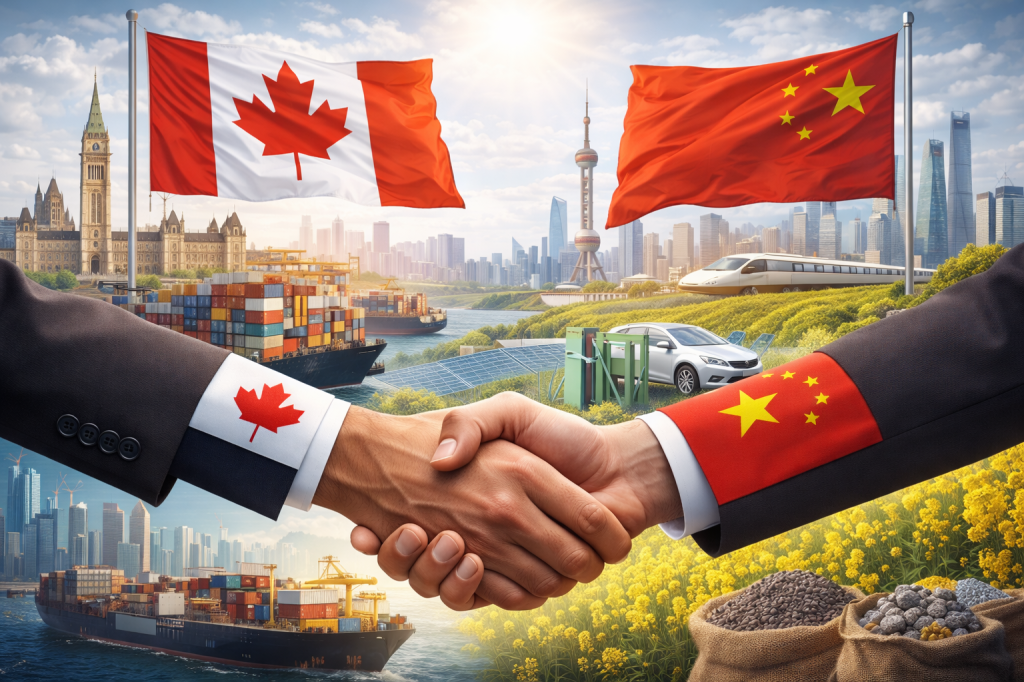
Canada’s decision to enter a new trade arrangement with China—lowering tariffs on Chinese electric vehicles while securing tariff cuts for Canadian canola—marks a striking reconfiguration of North American geopolitics. What makes this moment even more consequential is not just the deal itself, but the public endorsement from U.S. President Donald Trump. His statement, “If you can get a deal with China, you should do that,” signals an unexpected permissiveness at a time when Washington and Beijing remain locked in strategic rivalry. The Canada–China deal is not merely a bilateral economic arrangement; it is a window into shifting global alignments, industrial constraints, and the dilemmas facing mid-sized economies navigating a polarized world economy.
A Historical Reset in Ottawa–Beijing Relations
Canada’s relationship with China has oscillated for decades—ranging from early enthusiasm in the 1970s to mistrust in the last decade fuelled by diplomatic tensions, detentions, and national security concerns. This agreement marks the first major forward-looking engagement since relations deteriorated in the late 2010s. Historically, Canada depended heavily on China as a market for agricultural exports, especially canola, before political tensions led to punitive barriers. By reopening this channel, Canada is not “returning” to the past—it is entering a recalibrated, more transactional, more strategic relationship.
The tariff cut on canola seeds expected by March 1 revives a high-value export stream worth billions to prairie farmers. Ottawa appears to be balancing domestic agricultural interests with the unavoidable reality that China will remain a central global buyer, regardless of geopolitical headwinds.
The EV Clause: Canada Bets on Market Access Over Protectionism
The most surprising element is Canada’s willingness to permit up to 49,000 Chinese EVs annually at a tariff of 6.1%. At a time when the U.S. and EU are hardening barriers against Chinese electric vehicle manufacturers, Canada is taking a contrarian path—driven by:
EV affordability concerns
Domestic supply shortages
Consumer demand outpacing domestic production
Pressure to decarbonize rapidly
China today is the world’s largest EV producer, with cost efficiencies unmatched by Western automakers. Canada’s move is both pragmatic and controversial: it accepts China’s industrial lead in the short term while trying to secure bargaining power for Canadian exporters.
Trump’s Approval: Strategic Signal or Tactical Flexibility?
Trump’s endorsement is geopolitically loaded. During his earlier term, Trump framed China as the United States’ primary economic adversary. Yet in 2026, he appears more flexible—at least toward allies striking independent deals.
This approval may reflect three deeper realities:
1. The U.S. cannot fully dictate its allies’ China policies anymore.
2. North America’s supply chains—especially for EVs and critical minerals—are too interconnected to enforce strict decoupling.
3. Trump’s second-term economic agenda prioritizes bilateral transactional gains rather than grand strategy.
Canada is effectively testing the boundaries of U.S. tolerance, and Trump’s reaction suggests a recalibration of Washington’s expectations from its closest ally.
A Strategic Pragmatism from Ottawa: Carney’s Doctrine Emerges
Prime Minister Mark Carney’s statement—“We’re recalibrating Canada’s relationship with China—strategically, pragmatically, and decisively”—signals a doctrine that blends realism with economic necessity.
Three pillars define this approach:
Diversify without decoupling
Negotiate advantages in sectors where Canada is globally competitive
Avoid ideological framing of economic policy while still managing security risks
Carney seems to be positioning Canada as a country that can cooperate with China economically while aligning with the U.S. on security issues—a difficult but increasingly necessary balancing act.
A Future Shaped by Critical Minerals, EV Competition, and Middle-Power Diplomacy
Looking ahead, this deal may serve as a template for future cooperation on critical minerals—an area where Canada holds strategic importance. With China dominating global rare-earth processing and Canada emerging as a critical minerals supplier, the geopolitical calculus is unmistakable: each side holds something the other needs.
The EV tariff quota may help Canada strengthen its domestic EV adoption while buying time to nurture its own battery ecosystem. Meanwhile, China secures market access in a G7 economy, which strengthens its global EV strategy amid rising Western restrictions.
Over the long term, this Canada–China deal could spill over into areas such as renewable energy supply chains, green technologies, and agri-trade. But it also raises serious risks: overdependence, exposure to geopolitical retaliation, and vulnerability to U.S. policy shifts after 2026.
Conclusion: A Small Deal With Big Implications
The Canada–China trade deal appears modest on paper, yet its significance lies in timing, signaling, and strategic context. As global supply chains fragment and alliances harden, Canada is taking a bold middle-path—one that blends economic necessity with geopolitical manoeuvring. The future of this recalibrated relationship will be shaped by whether Canada can maintain strategic autonomy while managing the expectations of both Washington and Beijing.
In an era defined by economic weaponization, tariff diplomacy, and technological competition, this agreement is more than a trade deal—it is a test of Canada’s ability to navigate a turbulent global order.#CanadaChinaTrade
#StrategicRecalibration
#ElectricVehicleTransition
#CanolaDiplomacy
#GreenIndustrialPolicy
#CriticalMinerals
#MultipolarEconomy
#SupplyChainRealignment
#TradePragmatism
#FutureOfGlobalTrade
 "Connecting communities, empowering nations: Unifying the Regional and Global Economy ."
Leave a comment