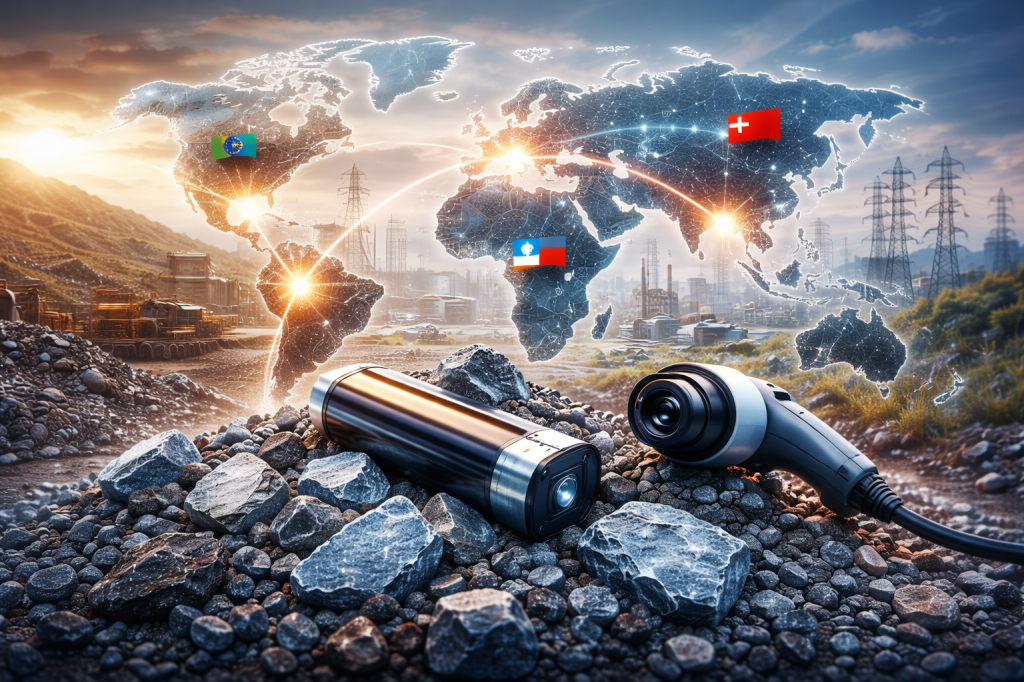
For more than a century, nations have competed for control over natural resources—from oil in West Asia to copper in Latin America—but the 21st century’s equivalent race is unfolding around critical minerals. These minerals—lithium, cobalt, manganese, rare earth elements—are the backbone of batteries, electric vehicles, renewable energy systems, defence hardware, and high-technology manufacturing. Yet unlike oil, whose supply eventually diversified over time, today’s critical minerals supply chains remain far more geographically concentrated, creating vulnerabilities that could define the next phase of global geopolitical tensions.
The Historical Roots of a New Resource Race
Critical minerals were not always “critical.” For decades, they were niche inputs used primarily in electronics or specialty alloys. Their strategic importance grew sharply after 2008, when global climate commitments and rapid electrification accelerated demand for lithium-ion batteries and rare-earth magnets. By the mid-2010s, China understood the future value of these minerals and began consolidating control across mining, processing, and downstream manufacturing. In parallel, African nations like the Democratic Republic of the Congo (DRC) emerged as dominant extraction hubs for cobalt, while refining remained heavily dependent on East Asia.
This historical imbalance—producers in the Global South, processors in China, and buyers in the West—laid the foundation for today’s fragile and high-risk supply chain.
Extreme Concentration Creates Global Chokepoints
A few countries now dominate each stage of the mining-to-manufacturing chain. China accounts for around 70% of global lithium chemical production and nearly 95% of battery-grade manganese sulfate—a staggering level of concentration for technologies central to global energy transition. Meanwhile, the DRC controls roughly 70% of global cobalt output, making the EV sector deeply dependent on a single politically volatile jurisdiction.
Such concentration is not merely a commercial risk—it is a structural vulnerability for global industry. A single political decision, export restriction, civil conflict, or trade retaliation could disrupt entire value chains of electric vehicles, solar power, semiconductor manufacturing, and renewable energy storage.
Why This Matters: A Geopolitical Fault Line in the Making
In a world increasingly structured around technology, minerals are the new power lever. China’s dominance in refining and processing is not accidental—it is a product of long-term industrial strategy, subsidies, state-backed investments abroad, and deep control over downstream industries such as EVs and high-performance magnets. The West, in contrast, outsourced material processing decades ago due to environmental regulations and high labor costs, and is now trying to reverse-engineer supply chains already tightly controlled by Beijing.
This creates a structural tension: Western economies need minerals, but the majority of minerals and processing capacity are controlled by economies that may not share the same strategic outlook.
Supply Chain Risks Go Beyond Geopolitics
The risks are not purely geopolitical. They include:
Environmental and social instability in mining regions like the DRC, where artisanal mines, child labor, and conflict financing pose ethical challenges.
Price volatility, which can swing sharply based on small supply disruptions, as seen in lithium’s extreme boom-and-bust between 2022 and 2024.
Technological lock-ins, where nations dependent on foreign processing capacity may lose bargaining power in emerging green-tech industries.
Shock transmission, where disruptions in one mineral cascade into multiple technologies simultaneously, threatening EV production, grid storage, and defence manufacturing.
The interconnectedness of critical minerals makes each choke point a systemic risk for the global economy.
Looking ahead, the world faces a crucial question: can supply chains built for efficiency survive in a world that demands resilience? Several trends point to an impending transformation.
1. Strategic Diversification Will Become a National Security Priority
Countries from the U.S. to Australia, Japan, India, and the EU are pouring billions into alternative supply lines—new mines, refining facilities, strategic mineral partnerships, and public–private alliances. The goal is not simply to diversify but to de-risk dependence on single sources.
2. New Mineral Frontiers Will Emerge
Latin America, Africa, and Australia will see a wave of investments in lithium, rare earths, and processing capacity. India too aims to build a complete rare-earth and magnet value chain, supported by public-private partnerships and international collaborations.
3. Circular Mineral Economies Will Gain Momentum
Recycling, urban mining, and reuse of battery materials could supply more than 20–30% of global demand by the mid-2030s, reducing exposure to geopolitical hot spots.
4. Technology Will Reshape the Mineral Map
Innovation in sodium-ion batteries, solid-state batteries, and magnet-free motors may reduce reliance on specific minerals altogether. Technology—not geology—may determine who wins the next phase of this competition.
A New Era of Resource Diplomacy
The world is entering a phase where mineral diplomacy will be as important as oil diplomacy was in the 20th century. But unlike oil, which had multiple producers and well-established markets, critical minerals have narrow extraction zones, limited refining capacity, and tight technological dependencies. Trade blocs, mineral alliances, and resource-sharing partnerships will shape the geopolitical map for decades.
Countries that secure mineral resilience today will own the green and digital economies of tomorrow. Those that fail may find themselves technologically constrained and strategically vulnerable.
The World Is at a Turning Point
Critical minerals are no longer just industrial inputs—they are the foundation of national competitiveness, energy security, and technological sovereignty. The concentration of supply in a handful of countries represents a structural vulnerability that could trigger future geopolitical and economic disruptions. The next decade will determine whether the world diversifies its mineral base or deepens its dependence on a fragile and highly concentrated system.
In essence, the future of global power will be shaped not only by who controls technologies—but by who controls the minerals that power those technologies.
#CriticalMinerals
#SupplyChainRisk
#GeopoliticalTensions
#ChinaDependency
#MineralSecurity
#EnergyTransition
#BatteryMetals
#ResourceDiplomacy
#StrategicAutonomy
#FutureTechnologies
 "Connecting communities, empowering nations: Unifying the Regional and Global Economy ."
Leave a comment