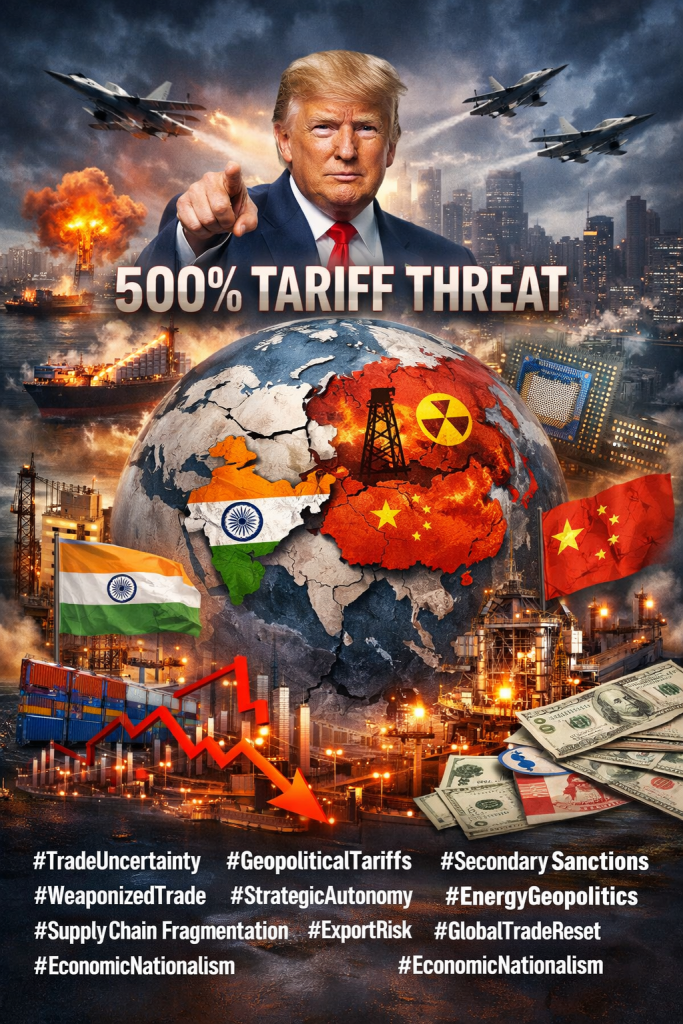
Trade wars have always arrived dressed as morality plays. From the Smoot–Hawley tariffs of the 1930s to the technology embargoes of the 2010s, economic instruments have repeatedly been repurposed as geopolitical weapons. The current proposal emerging from Washington—backed publicly by Donald Trump—to impose up to 500% tariffs on countries purchasing Russian oil and uranium marks a new and far more extreme chapter in this long history. If enacted, the Sanctioning Russia Act of 2025 would not merely punish Russia; it would redefine how trade, sovereignty, and alliance politics interact in a fractured global economy.
What makes this moment distinct is not only the scale of the proposed tariff, but its logic. Tariffs are no longer being used to correct trade imbalances or protect domestic industries. They are being designed as secondary sanctions—tools to coerce third countries such as India and China into aligning with US geopolitical objectives. This represents a structural shift in the global trading system.
From Free Trade to Conditional Trade
For nearly three decades after the Cold War, global trade expanded under the assumption that commerce would gradually soften political conflict. Energy trade, in particular, was treated as sacrosanct—too vital to be weaponized without triggering systemic shocks. That assumption has collapsed since 2022. Russian oil flows were redirected, discounts became strategic tools, and energy markets fragmented along political lines.
The proposed 500% tariff crosses a psychological threshold. It signals that access to the US market—still the world’s largest consumer economy—may now be conditional not just on economic behavior, but on geopolitical alignment. In effect, this introduces a new doctrine: trade compliance through financial deterrence. For export-driven economies, such a doctrine creates radical uncertainty because it turns long-term trade planning into a political gamble.
India and China: Strategic Autonomy Under Pressure
India and China sit at the epicenter of this turbulence. Both expanded Russian energy purchases after Western sanctions, driven by pragmatic economic logic: discounted oil, energy security, and inflation management. India, in particular, framed its position as one of “strategic autonomy,” arguing that developmental needs cannot be subordinated to great-power rivalry.
A 500% tariff threat destabilizes this balancing act. Even if never fully implemented, the signal alone is enough to rattle financial markets, disrupt export contracts, and raise the cost of capital for firms perceived as geopolitically exposed. India’s labor-intensive export sectors—textiles, seafood, engineering goods—are especially vulnerable. For China, the implications run deeper into advanced manufacturing, potentially affecting electric vehicles, semiconductors, and clean-energy supply chains that remain partially dependent on Western markets.
What is striking is the asymmetry embedded in enforcement. Markets already sense that geopolitical weight, supply-chain indispensability, and negotiation leverage may determine how harshly such measures are applied. This perception alone weakens the credibility of a rules-based trading order.
Global Trade at an Inflection Point
The broader consequence is a sharp erosion of predictability. Global trade growth, once driven by efficiency and scale, is now constrained by political risk premiums. Currency volatility, rising insurance costs, and fragmented logistics are no longer temporary shocks—they are becoming structural features of international commerce.
For emerging economies, this is particularly damaging. Small and medium exporters lack the balance-sheet strength to absorb sudden tariff shocks or reroute supply chains overnight. The result is a silent consolidation: weaker firms exit, stronger ones survive by aligning with geopolitically “safe” markets. Over time, this leads to fewer players, less competition, and higher prices—an inflationary bias baked into the global system.
A Futuristic Outlook: Weaponized Interdependence
Looking ahead, the real danger is normalization. If a 500% tariff becomes thinkable today, future crises may justify even more extreme economic penalties. Trade would cease to be a neutral platform for growth and become an extension of strategic warfare—a world of weaponized interdependence where every invoice carries political risk.
Countries like India face a stark choice: accelerate diversification of export markets, deepen regional trade arrangements, and build domestic demand buffers—or accept permanent vulnerability to external policy shocks. Multilateral institutions, already weakened, may struggle to arbitrate disputes when power politics override negotiated rules.
History suggests that such phases do not end quietly. They culminate either in a new equilibrium—with clearer blocs and reduced interdependence—or in economic crises that force recalibration. The current tariff threat is less about Russia and more about signaling a future where trade is no longer free, but conditional, strategic, and coercive.
In that sense, the proposed 500% tariff is not just a policy proposal. It is a warning shot across the bow of the global trading system—one that tells exporters, investors, and policymakers alike that the age of predictable globalization is over, and the era of geopolitical commerce has fully arrived.
#TradeUncertainty
#GeopoliticalTariffs
#SecondarySanctions
#WeaponizedTrade
#StrategicAutonomy
#EnergyGeopolitics
#SupplyChainFragmentation
#ExportRisk
#GlobalTradeReset
#EconomicNationalism
 "Connecting communities, empowering nations: Unifying the Regional and Global Economy ."
Leave a comment