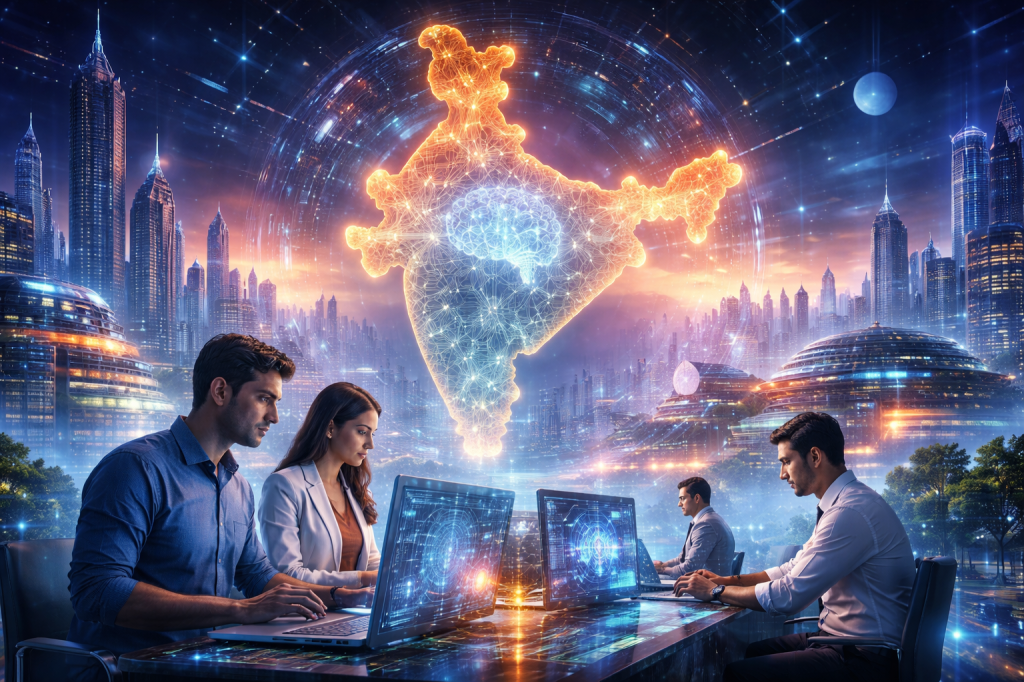
The question of whether India can lead the global artificial intelligence race is no longer speculative—it is structural. History shows that technological leadership does not emerge merely from invention, but from the ability to combine talent, capital, policy, and scale into a self-reinforcing system. AI today sits at a similar inflection point as electricity in the early 20th century or the internet in the late 1990s. India stands unusually well placed at this junction, yet leadership is not guaranteed. It will depend on whether India converts comparative advantages into durable technological sovereignty.
From IT Services to Intelligence Infrastructure: A Historical Shift
India’s earlier technology story was defined by services. The IT boom of the 1990s and 2000s integrated India into global value chains, but largely as an execution hub rather than a frontier innovator. AI marks a decisive break from that past. Unlike traditional software outsourcing, AI leadership depends on control over data, compute, models, and deployment ecosystems. This is where India’s trajectory becomes interesting. The country is no longer merely supplying engineers to global firms; it is beginning to assemble the components of a domestic AI stack.
Global rankings now place India just behind the US and China in overall AI vibrancy, a reflection of talent depth, startup formation, and expanding infrastructure. This is historically significant: it is the first time India appears in the top tier of a general-purpose technology race at such an early stage.
Talent at Scale: India’s Structural Advantage
India’s strongest AI asset is human capital. With millions of engineers, data scientists, and domain specialists, India has the largest pool of AI-skilled professionals in the world. This is not just a volume story; it is increasingly a quality story. Indian engineers are deeply embedded in global AI labs, cloud platforms, and semiconductor firms, creating a powerful feedback loop of skills, exposure, and ambition.
Cities like Bengaluru, Hyderabad, and Delhi-NCR are emerging as AI-native clusters rather than extensions of IT parks. Startups are forming across generative AI, computer vision, speech technologies, and applied AI for enterprise and public services. Historically, such clustering is how technological leadership consolidates—Silicon Valley for semiconductors, Shenzhen for hardware, and now potentially Indian cities for applied AI at population scale.
Yet talent alone does not create leadership. Without domestic opportunities for frontier research and model building, the best minds will continue to migrate toward global incumbents. Retaining talent requires ambition at home.
State Capacity and the Return of Industrial Policy
One of the most underestimated shifts in India’s AI story is the active role of the state. The IndiaAI Mission marks a departure from laissez-faire technology policy toward strategic capacity-building. Public investment in large-scale compute infrastructure, shared GPU access, multilingual datasets, and national AI platforms signals recognition that AI is no longer just a private-sector concern—it is national infrastructure.
Historically, countries that led transformative technologies aligned state capacity with private innovation. The US did this with defense-driven computing and the internet; China did it with telecom and platforms. India is attempting a similar alignment, but with a democratic and inclusion-oriented framing. If execution matches intent, this could allow startups, researchers, and public institutions to access resources previously monopolized by Big Tech.
The risk, however, lies in bureaucratic drag and fragmented implementation. AI leadership requires speed. Delays in procurement, access rules, or coordination between ministries could blunt the impact of otherwise bold policy.
The Missing Middle: Data, R&D, and Frontier Models
Despite momentum, India faces serious structural constraints. The most critical is data. While India generates massive digital exhaust through public platforms, much of this data is fragmented, unstructured, or legally constrained. Global AI leaders benefit from decades of proprietary datasets, refined through commercial feedback loops. India must invent new data marketplaces, privacy-preserving data-sharing frameworks, and incentives for high-quality annotation at scale.
Equally important is R&D intensity. India’s research spending remains modest relative to GDP, limiting the country’s ability to train frontier models or shape foundational architectures. Without investment in deep research—algorithms, chips, systems—India risks becoming a power user of global AI rather than a rule-maker.
This distinction matters. Leadership in AI is not just about adoption; it is about defining standards, ethics, architectures, and long-term trajectories.
Where India Could Lead Differently
India’s path to AI leadership will not mirror that of the US or China. Its comparative advantage lies in applied, population-scale AI. Sectors like agriculture, healthcare, education, logistics, climate adaptation, and governance offer real-world complexity unmatched elsewhere. AI systems trained and deployed in these environments could become global benchmarks for inclusive, low-cost, high-impact intelligence.
Multilingual AI is another frontier. With dozens of living languages and dialects, India can shape the future of non-English AI systems—an area where global models remain weak. If India succeeds here, it could influence how AI reaches the next billion users worldwide.
A 2030 Scenario: Leadership or Leverage?
By 2030, India will almost certainly be a major AI power. The deeper question is whether it will be a leader or a leveraged participant. Leadership means shaping models, standards, and markets. Leverage means using AI built elsewhere, efficiently and at scale.
The difference will be determined in the next five years—by investment choices, institutional reforms, data governance frameworks, and the courage to fund long-horizon research. India has the ingredients. History suggests that moments like this are rare. Whether India converts potential into primacy will define not just its AI future, but its broader role in the 21st-century global order.
In that sense, the AI question is not merely technological. It is civilizational.
#ArtificialIntelligence
#IndiaAI
#DigitalSovereignty
#ComputeInfrastructure
#AIEcosystem
#DataGovernance
#TalentAtScale
#FrontierTechnology
#InclusiveInnovation
#FutureOfWork
 "Connecting communities, empowering nations: Unifying the Regional and Global Economy ."
Leave a comment