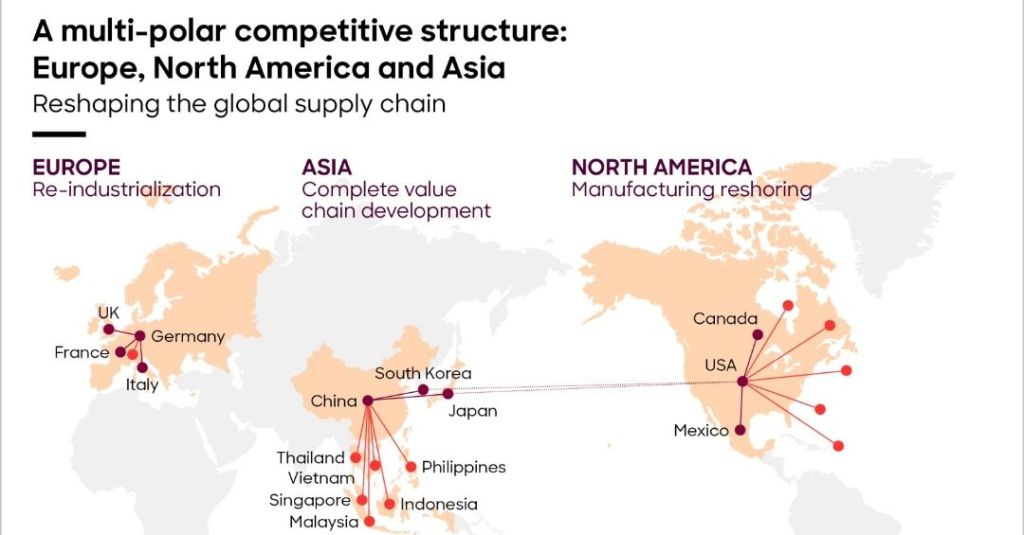
Asia in 2025 stands at a decisive historical juncture. After four decades of export-led growth, demographic dividends, and deepening integration with global markets, the region now confronts a convergence of shocks that are structural rather than cyclical. US tariff pressures, fragmented global trade, slowing demand in advanced economies, persistent inflation in essential goods, and internal constraints such as debt, aging populations, and productivity fatigue are reshaping Asia’s growth model. Unlike past crises, these challenges are interconnected, long-term, and geopolitical in nature—forcing Asian economies to rethink not just growth rates, but growth strategies.
The New External Shock: Trade, Tariffs, and Geopolitics
The global trading system that enabled Asia’s rise is no longer neutral. US tariffs—whether explicit or embedded through industrial policy, security screening, and local-content rules—have altered market access conditions. Asia’s exporters are discovering that competitiveness is no longer defined solely by cost, scale, or efficiency, but by political alignment, supply-chain security, and regulatory compatibility. Slowing global demand, particularly in Europe and parts of North America, has further compressed export volumes, while trade routes remain vulnerable to geopolitical flashpoints across the Red Sea, Taiwan Strait, and South China Sea.
China: From Engine to Constraint
China faces a profound transition. The post-investment, post-property growth model has reached its limits, with high local-government debt, weak consumer confidence, and demographic aging acting as structural brakes. Manufacturing remains formidable, but export markets are increasingly politicised, and inward foreign investment is more selective. China’s challenge is not collapse, but recalibration—shifting from volume-driven growth to productivity, technology sovereignty, and domestic demand without triggering financial instability.
India: Growth with Frictions
India remains one of the fastest-growing large economies, yet its challenges are subtler. Inflation in food and energy periodically constrains consumption, while job creation struggles to keep pace with demographic pressure. Global protectionism complicates export ambitions, even as India seeks to position itself as a manufacturing alternative to China. The deeper question is whether India can convert macro growth into broad-based industrial and employment expansion without fiscal overreach.
Japan: Aging, Debt, and Strategic Relevance
Japan confronts a demographic reality unmatched in scale. An aging population, high public debt, and weak domestic demand limit traditional growth levers. Yet Japan’s strategic relevance is rising as supply chains diversify away from China. The challenge lies in translating geopolitical importance into domestic revitalisation—through productivity gains, labour participation reforms, and advanced manufacturing leadership.
South Korea: Caught Between Cycles and Concentration
South Korea sits at the frontier of technology and trade vulnerability. Heavy reliance on semiconductors and electronics exposes the economy to global demand cycles and geopolitical export controls. Household debt and property-linked financial risks add domestic fragility. Korea’s future growth depends on diversification beyond a narrow set of champions and navigating technology nationalism without losing global market share.
ASEAN: Fragmented Strength, Shared Vulnerability
Southeast Asia’s major economies—Indonesia, Vietnam, and Thailand—are benefiting from supply-chain relocation, yet face internal constraints. Infrastructure gaps, rising energy costs, and dependence on external demand expose vulnerabilities. While demographics are favourable in parts of ASEAN, productivity growth and institutional capacity lag behind ambitions to become true manufacturing and innovation hubs.
Singapore: Stability in a Volatile World
Singapore exemplifies resilience, but even it is not insulated. As a trade- and finance-dependent hub, global slowdown and financial tightening directly affect growth. The challenge is sustaining relevance as capital becomes more cautious, compliance costs rise, and regional competition intensifies.
Pakistan and Bangladesh: Debt and Demand Pressures
Pakistan and Bangladesh face acute macroeconomic stress. External debt, currency pressures, energy inflation, and reliance on a narrow export base constrain policy space. These economies highlight a broader Asian risk: growth without buffers becomes fragile when global conditions tighten.
A Structural Turning Point for Asia
Historically, Asia thrived by integrating into a rules-based global economy, absorbing technology, and scaling production. In 2025, that playbook is under strain. Policy-driven trade, demographic shifts, climate stress, and technological bifurcation are forcing a transition from expansion to optimisation. The future Asian growth model will be less about exporting more and more about exporting smarter—embedding resilience, value addition, and strategic alignment into business decisions.
The Futuristic Outlook: From Growth to Governance
Asia’s next phase will reward economies that treat policy, demography, and technology as core economic inputs rather than external constraints. Businesses will need to design supply chains for disruption, not efficiency alone. Governments will be compelled to balance industrial policy with fiscal realism. Those who succeed will not necessarily grow fastest, but they will grow most sustainably. Asia is not declining—but it is undeniably changing, and the decisions made now will define its role in the global economy for decades to come.
#Asia2025
#GeoeconomicShift
#TradeFragmentation
#IndustrialPolicy
#SupplyChainResilience
#DemographicTransition
#DebtOverhang
#InflationPressure
#StrategicAutonomy
#GrowthModelReset
 "Connecting communities, empowering nations: Unifying the Regional and Global Economy ."
Leave a comment