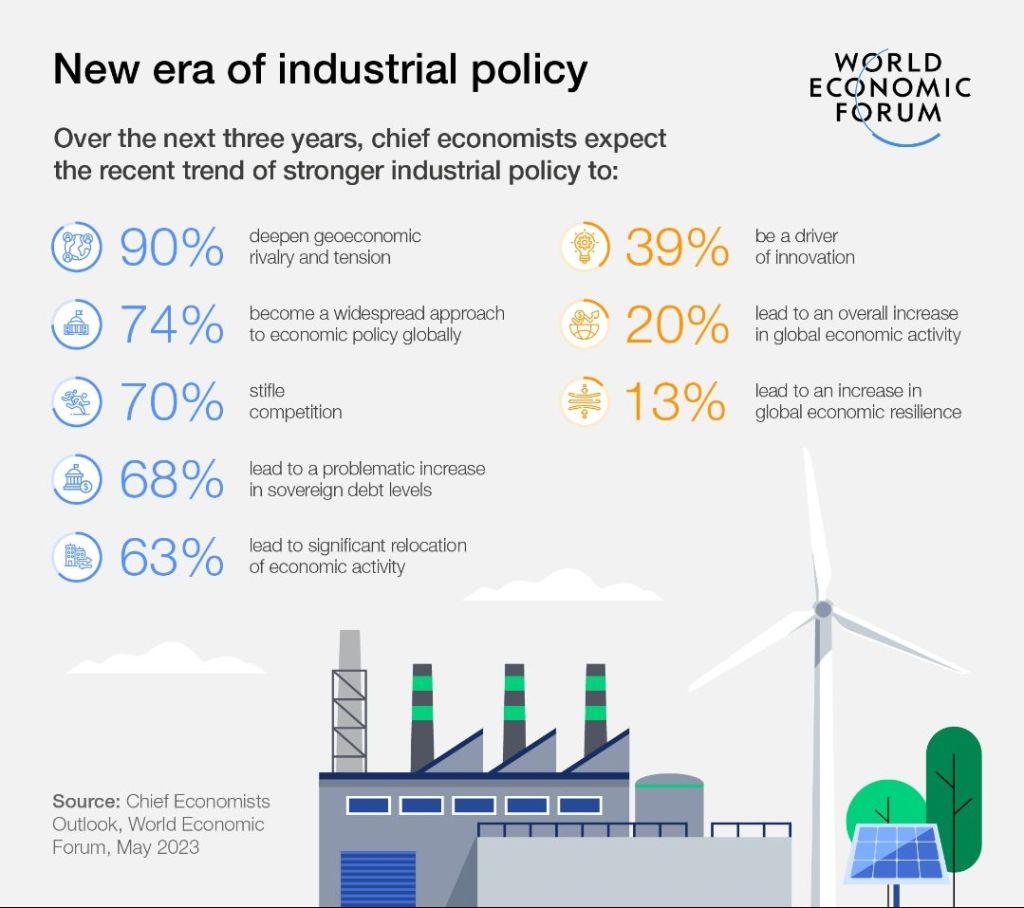
For nearly four decades, global economic thinking was dominated by the belief that open markets, minimal state intervention, and cost-based efficiency would naturally allocate capital to its most productive uses. Industrial policy was treated as an outdated relic—associated with protectionism, fiscal waste, and political favoritism. That intellectual consensus has now decisively broken down.
Across the United States, the European Union, and much of Asia, governments are no longer passive referees of the market. They are active architects—deploying subsidies, local-content rules, licensing regimes, and strategic procurement to deliberately steer private investment. What is emerging is not a temporary policy deviation, but a structural reordering of how capitalism itself functions in a geopolitically fragmented world.
From Neutral Markets to Strategic States
Historically, industrial policy has surfaced during moments of systemic stress. Wartime mobilization in the 1940s, reconstruction in post-war Europe and Japan, and East Asia’s export-led growth models all relied heavily on state direction. The neoliberal turn of the 1980s sidelined these lessons, arguing that global competition and capital mobility would discipline inefficiency better than governments ever could.
The 2020s have reversed that logic. Supply-chain shocks, pandemic disruptions, energy insecurity, climate transition costs, and intensifying geopolitical rivalry have exposed the fragility of hyper-globalized, cost-optimized production systems. Governments now see industrial capacity not merely as an economic variable, but as a strategic asset tied to national security, employment resilience, and political stability. Markets have not disappeared—but they increasingly operate within policy-designed corridors.
Subsidies as Signals, Not Distortions
Modern industrial subsidies differ fundamentally from the old model of blanket protection. They are targeted, conditional, and explicitly future-oriented—aimed at semiconductors, clean energy, defense manufacturing, critical minerals, biotechnology, and digital infrastructure. These subsidies act less as price distortions and more as strategic signals, shaping long-term expectations about where demand, regulation, and public procurement will converge.
For firms, the calculus of investment has shifted. Internal rate of return is no longer driven solely by labor costs, logistics efficiency, or scale economies. It increasingly depends on alignment with public policy objectives—decarbonization pathways, domestic value-addition thresholds, data sovereignty norms, and security screening requirements. Capital flows now chase regulatory certainty as much as market size.
Local-Content Rules and the Re-Geography of Production
Local-content requirements—once dismissed as trade barriers—have returned as central tools of industrial strategy. By tying incentives and market access to domestic production, governments are effectively reshaping the geography of manufacturing. This does not mean full de-globalization; rather, it marks a shift toward “policy-anchored globalization,” where supply chains are re-routed through politically aligned jurisdictions.
The implication is profound: comparative advantage is no longer defined only by natural endowments or factor costs, but by institutional compatibility. Countries and firms that fail to align with dominant policy regimes risk exclusion—not through tariffs, but through standards, certifications, procurement rules, and subsidy eligibility criteria that quietly gate market access.
Strategic Procurement as Industrial Infrastructure
Public procurement has emerged as one of the most powerful yet understated instruments of the new industrial policy. Governments are using their purchasing power to create guaranteed demand for strategic sectors—effectively underwriting scale, reducing risk, and accelerating technology diffusion. Defense contracts, grid expansion, railways, health systems, and digital public infrastructure now double as industrial incubation platforms.
This blurs the traditional boundary between public spending and private investment. Firms embedded in these procurement ecosystems gain not just revenue, but learning effects, balance-sheet stability, and political legitimacy. Over time, this creates industrial ecosystems that are difficult for purely market-driven competitors to displace.
Why Policy Alignment Now Defines Market Access
The most critical shift is conceptual: market access is no longer neutral. Cost competitiveness and operational efficiency still matter, but they are increasingly insufficient. What matters just as much is whether a firm—or an entire value chain—fits within the policy architecture of the target market. Carbon intensity, origin of inputs, data governance practices, labor standards, and ownership structures all influence access conditions.
This transforms industrial strategy from a back-office compliance function into a core business decision. Firms that treat policy as an exogenous constraint will struggle. Those that integrate policy foresight into capital allocation, location strategy, and technology choices will dominate the next phase of global competition.
A Futuristic Outlook: The Age of Policy-Conditioned Capitalism
Looking ahead, industrial policy is likely to become more sophisticated, not less. Expect tighter coupling between climate policy and trade, deeper screening of cross-border investments, and greater use of digital traceability to enforce rules invisibly. The global economy is moving toward a system where economic efficiency is filtered through political legitimacy and strategic trust.
This does not signal the end of markets, but the end of market innocence. Free-market orthodoxy assumed that efficiency alone would determine winners. The emerging order recognizes that in a world of systemic risk, markets require direction—and that power increasingly lies with those who can align enterprise strategy with the long arc of public policy.
In the industrial economy of the future, success will not belong to the cheapest producer, but to the most policy-aligned one.
#IndustrialPolicy
#StrategicState
#PolicyDrivenMarkets
#LocalContentRules
#SubsidyEconomics
#GeopoliticalCapitalism
#StrategicProcurement
#SupplyChainRealignment
#MarketAccess
#FutureOfIndustry
 "Connecting communities, empowering nations: Unifying the Regional and Global Economy ."
Leave a comment