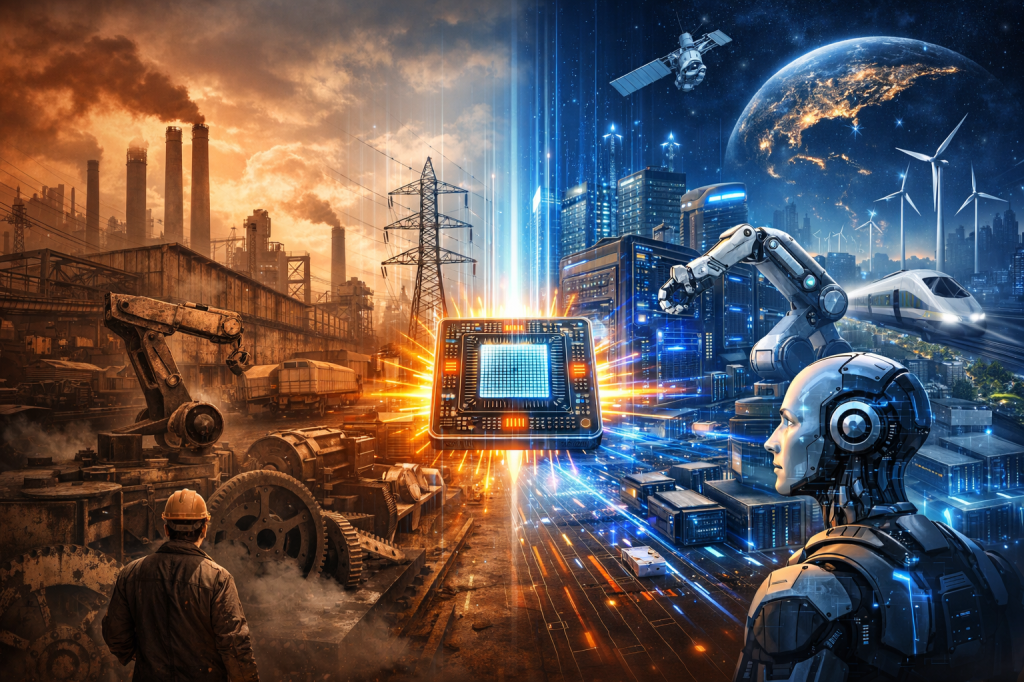
The global manufacturing landscape in 2025 is marked by an unusual contradiction: factories across major economies remain subdued, while investment in technology, AI hardware, and critical infrastructure is booming. This divergence is not merely cyclical—it represents a structural realignment of industrial priorities that began after the 2008 financial crisis and accelerated dramatically post-Covid. A historical lens reveals that traditional manufacturing has always mirrored global demand, interest-rate cycles, and capital expenditure confidence. Today, however, even with moderating inflation and stabilising supply chains, large firms continue to delay major capex decisions. The hesitation reflects deeper fault-lines: geopolitical uncertainty, carbon-related trade barriers, a sharp rise in financing costs after a decade of cheap capital, and the increasing unpredictability of global consumption cycles.
Manufacturing: A Subdued Sector Facing Tight Financial Conditions
Factory activity remains sluggish across the US, Europe, Japan, and many Asian manufacturing hubs. Purchasing Managers’ Index (PMI) readings have repeatedly hovered around or below the 50-line that separates expansion from contraction. Historically, manufacturing revived quickly after global shocks—examples include the rebounds after the 1997 Asian crisis, the 2001 tech bust, and even the 2008 crash once stimulus packages kicked in. The current stagnation stands out because firms are deliberately choosing to delay or scale down capex. High interest rates have made borrowing expensive, and uncertainties around energy transitions, trade fragmentation, and supply-chain re-shoring have made long-term investments riskier. Companies are now prioritising incremental upgrades rather than new plants, creating a cautious and narrow investment cycle.
Capital Goods: The Resilience of Infrastructure-Led Orders
Despite weak manufacturing activity, orders for capital goods—especially in grid infrastructure, defence, rail, and clean energy—remain remarkably resilient. These segments benefit from strong government spending, long pipeline visibility, and national-security imperatives. Historically, infrastructure-driven capital expenditure has been countercyclical. The US Interstate project in the 1950s, Europe’s post-war reconstruction, Japan’s rail expansion, and China’s infrastructure-led growth in the 2000s all illustrate how state-backed spending can create parallel growth cycles even during private-sector stagnation. Today, energy transition requirements—such as modernising grids, strengthening domestic defence industries, and decarbonising transport—are driving a similar wave. Electric grid upgrades, green hydrogen infrastructure, semiconductor fabs, and strategic railway projects are absorbing capital even as conventional manufacturing hesitates.
Technology & AI: The New Industrial Engine
The strongest momentum in 2025 is undoubtedly in technology, AI hardware, data centres, and semiconductors. AI-related capital spending has created a powerful second engine of industrial growth—one that mirrors the transformative waves of the steam engine, electricity, and the 1990s digital revolution. Historically, every major technological shift triggered a reallocation of capital: factories electrifying in the early 20th century, the transistor-led boom post-1950, and the dot-com surge in the late 1990s. Today’s AI wave is even broader because artificial intelligence is both a technology and an infrastructure category. Data centres, specialised chips, high-end cooling systems, and advanced robotics are attracting sustained investment even as traditional sectors stagnate. This is creating a two-speed industrial economy: legacy manufacturing—textiles, basic metals, machinery—faces low demand and low margins, while AI-linked sectors enjoy rising valuations, global capital flows, and strong policy support.
The Two-Speed Industrial Economy: A Structural Shift, Not a Phase
The divergence between flat factory activity and booming AI-linked investment is not temporary. It represents a structural bifurcation of global industry that will shape the next decade. The world is moving toward an economy where:
Capital flows favour digital and AI infrastructure over traditional factories
Policy is increasingly an industrial input—carbon rules, export controls, and national-security regulations shape where companies build, invest, and source materials
Manufacturing competitiveness depends more on energy security, data capacity, and AI adoption than labour costs alone
The historical model of manufacturing-led growth—seen in Japan (1960s), South Korea (1980s), and China (2000s)—is being replaced by a hybrid model of “manufacturing + computational capacity.” Nations that fail to invest in semiconductor ecosystems, power infrastructure, and AI computing capacity risk falling behind despite having strong manufacturing bases.
The Next Phase of Industrial Transition
Looking ahead, the global industrial landscape will likely evolve into three layers:
1. Resilient Infrastructure and Defence Manufacturing
These sectors will grow steadily, supported by geopolitics, climate mandates, and long-term national strategies.
2. Explosive Growth in AI and Computational Manufacturing
Data centres, chip fabrication, advanced robotics, and industrial automation will dominate capital expenditure trends.
3. Slow, Selective Recovery of Traditional Manufacturing
Only those manufacturers who integrate AI, digitisation, and low-carbon technologies will regain competitiveness; others will continue to stagnate.
Countries that successfully synchronise these three layers—balancing traditional sectors with AI-intensive growth—will define the next industrial revolution. The rest risk becoming spectators in a world where industrial power is no longer measured by factories alone, but by the ability to combine physical production with digital intelligence.
ManufacturingSlowdown
#GlobalCapexTrends
#IndustrialTransformation
#AIInfrastructure
#SemiconductorInvestment
#CapitalGoodsResilience
#EnergyTransitionEconomy
#TwoSpeedIndustry
#FactoryActivityOutlook
#TechDrivenGrowth
 "Connecting communities, empowering nations: Unifying the Regional and Global Economy ."
Leave a comment