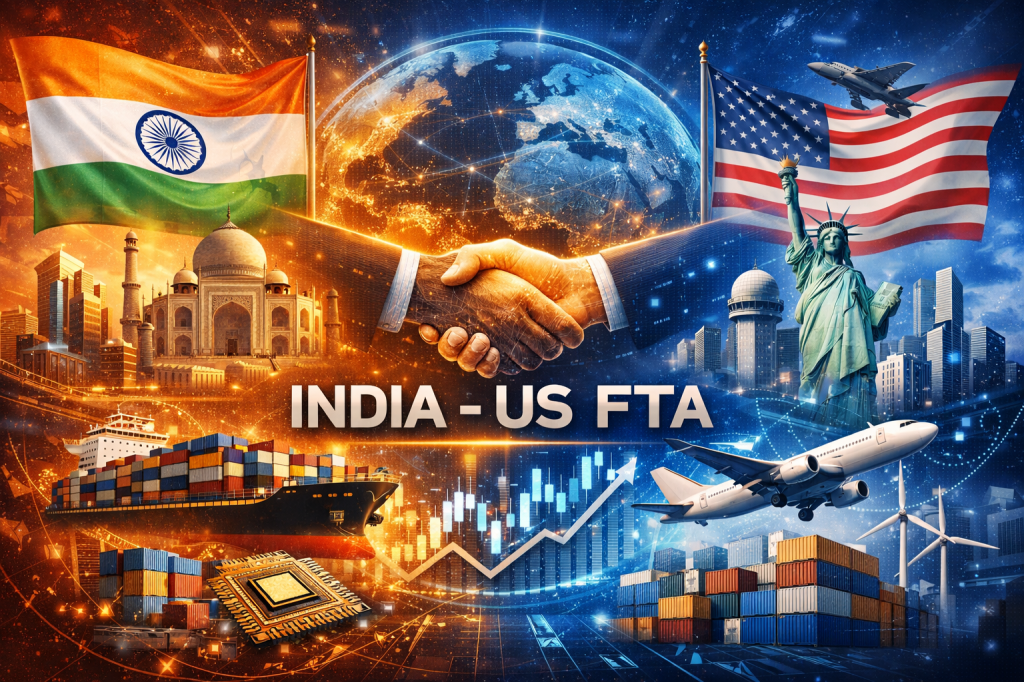
A Relationship Shaped by History, Not Habit
The idea of an India–US Free Trade Agreement has resurfaced many times over the past three decades, only to stall at the intersection of economics and politics. Unlike India’s trade engagements with the EU, ASEAN, or even the UK, a US trade deal has never been a natural extension of geography or supply-chain logic. It has always been a strategic negotiation, shaped as much by geopolitics, domestic constituencies, and ideological preferences as by tariffs and market access.
In the 1990s and early 2000s, India and the US viewed trade through fundamentally different lenses. India saw trade as a developmental tool requiring protection for farmers, MSMEs, and infant industries. The US approached trade as a market-opening instrument driven by corporate access, intellectual property protection, and regulatory harmonisation. That structural mismatch explains why a comprehensive FTA never materialised earlier, even as bilateral trade expanded steadily.
Yet history has also shown that trade has often followed strategy, not led it. The civil nuclear agreement, defence cooperation, and technology partnerships were concluded without a formal trade pact—suggesting that economic integration between India and the US has always been asymmetric, selective, and politically mediated.
Why the Current Moment Is Different
The present phase of negotiations is unfolding in a radically altered global context. Globalisation as it existed in the 2000s has fractured. Supply chains are no longer optimised only for cost, but for resilience, trust, and geopolitical alignment. In this environment, India is no longer merely a large emerging market—it is increasingly viewed in Washington as a systemic counterweight to China in manufacturing, technology, and regional security.
At the same time, India’s own economic posture has changed. With manufacturing ambitions, production-linked incentives, and an explicit push to integrate into global value chains, New Delhi recognises that selective trade liberalisation—especially with large developed markets—can serve as a catalyst for investment, technology transfer, and scale.
This explains why negotiations have progressed faster than in previous attempts. The current framework approach reflects a pragmatic recognition on both sides that a single, comprehensive, WTO-plus FTA may be politically unviable—but a sequenced, modular agreement might succeed.
The Real Fault Lines Beneath the Optimism
Despite positive signals, the India–US trade conversation is built on unresolved structural tensions.
For the United States, the priority remains reducing its trade deficit and opening Indian markets for agriculture, automobiles, dairy, digital services, and high-value manufactured goods. For India, these very sectors are politically sensitive, employment-intensive, and socially consequential. Any rapid opening risks domestic backlash and long-term vulnerability.
Tariffs are only the visible part of the dispute. The deeper disagreements lie in:
data governance and digital sovereignty
intellectual property regimes in pharmaceuticals and technology
agricultural subsidies and food security mechanisms
standards, certification, and regulatory autonomy
The recent use of punitive tariffs by the US—linked to geopolitical concerns such as energy sourcing—highlights a deeper reality: trade is now an extension of strategic leverage. This introduces uncertainty for India, which seeks predictability and rules-based engagement rather than discretionary pressure.
For Indian exporters, especially in textiles, gems and jewellery, seafood, and labour-intensive manufacturing, the absence of tariff certainty has become a growth constraint. But for policymakers, conceding ground without reciprocal certainty risks undermining long-term industrial strategy.
A Likely Shape of the Final Agreement
The most plausible future is not a classic FTA, but a hybrid bilateral trade architecture.
In the near term, a limited first-phase agreement focusing on tariff rationalisation, trade facilitation, and select sectoral access appears achievable. This would offer immediate relief to exporters, reduce headline tariffs, and stabilise business sentiment without forcing India into politically costly concessions.
The second phase—if and when it materialises—would move into deeper waters: services trade, investment protection, digital trade rules, and regulatory cooperation. Progress here will depend less on negotiators and more on political alignment at the highest level, both in New Delhi and Washington.
Crucially, the deal is unlikely to be static. Unlike traditional FTAs, an India–US arrangement will probably include review clauses, safeguard mechanisms, and built-in renegotiation triggers, reflecting the volatile global environment.
Strategic Gains Beyond Trade Numbers
Even a limited agreement would have implications far beyond bilateral trade volumes.
For India, it would:
anchor its manufacturing ambitions within trusted supply chains
enhance investor confidence, particularly from US-linked capital
strengthen its negotiating position in other FTAs
reinforce its role as a rule-shaper rather than rule-taker
For the US, it would:
diversify supply chains away from overdependence on East Asia
secure a large democratic market aligned with its strategic worldview
create long-term influence over emerging regulatory frameworks
In this sense, the India–US trade agreement is less about tariff lines and more about shaping the economic architecture of the Indo-Pacific.
The Long-Term Outlook: Managed Integration, Not Full Liberalisation
Looking ahead, expectations must remain realistic. The future of an India–US FTA lies not in deep liberalisation but in managed integration. India will continue to protect critical sectors tied to livelihoods and sovereignty. The US will continue to prioritise enforceability and market access.
The success of the agreement will depend on whether both sides accept that asymmetry is not a flaw, but a feature of the relationship. If flexibility, sequencing, and mutual restraint prevail, the agreement could evolve into a durable economic pillar of the broader strategic partnership.
If not, it risks becoming another ambitious framework that delivers incremental gains but falls short of transformational impact.
In a fragmented global economy, even that may be enough.
#IndiaUSFTA
#StrategicTrade
#SupplyChainRealignment
#ManagedLiberalisation
#Geoeconomics
#MarketAccess
#TradeResilience
#IndoPacificEconomy
#RegulatorySovereignty
#FutureOfTrade
 "Connecting communities, empowering nations: Unifying the Regional and Global Economy ."
Leave a comment