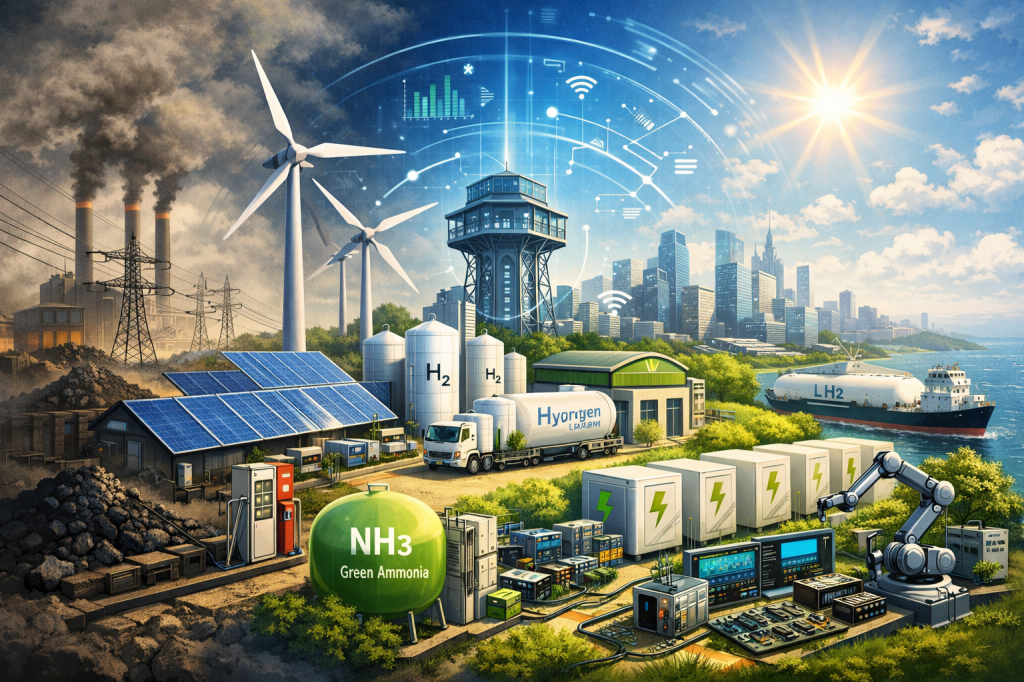
The moment renewables overtook coal in global power generation marks more than a symbolic milestone—it signals a deep structural shift in how the world produces, distributes, and consumes energy. For over a century, energy transitions moved slowly, constrained by infrastructure lock-in, geopolitics, and capital intensity. Coal to oil took decades; oil to gas followed a similar arc. The renewables transition, however, is unfolding at a far faster pace, driven by technology learning curves, climate imperatives, and changing political economy.
This turning point is not merely about replacing one fuel with another. It represents a re-engineering of the entire energy system—generation, grids, storage, industrial inputs, and manufacturing ecosystems—reshaping economic geography and industrial competitiveness for decades to come.
From Capacity Expansion to System Manufacturing
The early phase of the renewables era was defined by capacity addition: more solar parks, more wind farms, larger installed megawatts. That phase is now maturing. The bottlenecks have shifted away from generation and toward system integration.
Investment gravity is moving decisively into grids, storage technologies, power electronics, and energy carriers such as hydrogen and green ammonia. These are not peripheral add-ons; they are the backbone of a renewables-dominant system. Without advanced transmission infrastructure, intermittent generation becomes unreliable. Without storage, price volatility intensifies. Without power electronics and digital control systems, grids become fragile rather than resilient.
This shift has profound implications for energy manufacturing. Value creation is migrating upstream into equipment, components, and system-level engineering—transformers, inverters, electrolyzers, battery chemistries, and smart-grid software. Energy is no longer just a resource sector; it is becoming a sophisticated manufacturing and technology domain.
Volatility as a Feature, Not a Failure
Despite the long-term structural momentum, the short term remains turbulent. High financing costs, abrupt policy reversals, and regulatory uncertainty—particularly in the US and parts of Europe—are introducing stop-start investment cycles. Renewable developers face margin pressure even as demand rises, while manufacturers confront overcapacity in some segments and shortages in others.
This volatility is often misread as a sign of weakness in the transition. Historically, however, every major industrial transformation—from railways to electrification to digital infrastructure—has passed through similar phases of boom, correction, and consolidation. What appears as instability at the firm level often reflects deeper system realignment at the macro level.
Critically, fossil-fuel systems were never stable either; their volatility was absorbed through subsidies, strategic reserves, and geopolitical power. Renewables are experiencing their turbulence in the open, without a century of institutional cushioning—yet still expanding.
Energy Manufacturing as the Next Industrial Core
Looking ahead, energy manufacturing is entering a multi-decade structural upcycle. This is not a demand-led cycle tied to GDP growth alone, but a transition-driven cycle anchored in policy mandates, climate constraints, and technological substitution. Unlike traditional commodity cycles, this upcycle rewards resilience, scale-plus-innovation, and system integration rather than volume alone.
Countries that master energy manufacturing—across grids, storage, hydrogen, and power electronics—will shape future industrial hierarchies. Energy security will be defined less by access to fuels and more by control over technologies, standards, and supply chains. The competition will increasingly resemble advanced manufacturing races rather than resource diplomacy.
A New Political Economy of Power
At a deeper level, the renewables transition is altering the political economy of energy itself. Coal and oil centralized power—economically and geopolitically. Renewables decentralize generation but re-centralize manufacturing, standards, and finance. This creates new fault lines: between countries that generate clean power and those that manufacture clean systems; between regions that export electrons and those that export equipment.
The long arc is clear. Energy is no longer just about keeping the lights on—it is becoming a strategic industrial platform shaping trade, employment, and technological sovereignty. The crossing of renewables over coal is therefore not the end of an era, but the beginning of a far more complex and consequential one.
#RenewablesTransition
#EnergyManufacturing
#GridModernisation
#EnergyStorage
#PowerElectronics
#GreenHydrogen
#GreenAmmonia
#IndustrialUpcycle
#EnergySecurity
#Decarbonisation
 "Connecting communities, empowering nations: Unifying the Regional and Global Economy ."
Leave a comment