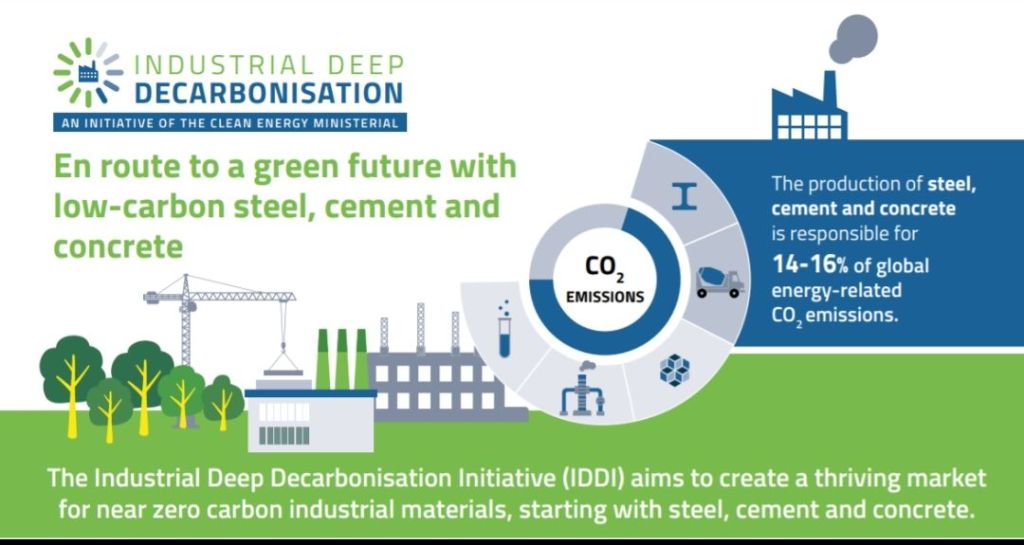
For much of modern economic history, steel and cement have been reliable barometers of growth. From post-war reconstruction in Europe to China’s infrastructure super-cycle of the 2000s, rising tonnage signaled expanding cities, factories, and transport networks. Even today, global infrastructure demand remains broadly steady, anchored by public spending, urbanisation in emerging economies, and the political necessity of visible capital formation. Roads, metros, ports, housing, and renewable-energy installations continue to consume vast quantities of core materials.
Yet the sector has entered a structural inflection point. The question is no longer whether steel and cement will be demanded, but which steel and which cement will be allowed into future markets.
From Cost Competitiveness to Carbon Competitiveness
Historically, competitiveness in core infrastructure materials rested on three pillars: scale, energy costs, and logistics. Countries with cheap coal, abundant limestone, or large blast furnaces dominated global trade. That model is now being steadily dismantled by carbon pricing, border adjustment mechanisms, and green public procurement rules.
Carbon Border Adjustment Mechanisms (CBAM-type frameworks), explicit carbon taxes, and embedded-emissions reporting are quietly transforming trade policy into climate policy. Market access is increasingly conditional not just on price and quality, but on verified emissions intensity. This marks a profound shift: environmental externalities that were long ignored or socialised are being priced directly into cross-border trade.
The implication is stark. Two producers selling identical volumes at similar prices may face radically different futures depending on their emissions profiles. In effect, carbon intensity is becoming a non-tariff barrier — and a powerful one.
Technology as the New Gatekeeper
Investment trends reveal where the sector is heading. Capital is flowing less into capacity expansion and more into technological re-engineering: low-carbon steel pathways using hydrogen or electric arc furnaces, blended and composite cements that reduce clinker content, waste-heat recovery systems, digital energy-management platforms, and carbon-capture pilots.
This signals a deeper transformation. Steel and cement are no longer purely “materials industries”; they are evolving into technology-embedded sectors. Data, process control, and lifecycle emissions accounting are becoming as critical as kilns and furnaces. Firms that fail to upgrade may still sell domestically for a while, but their export optionality — and eventually their access to global finance — will shrink.
Public Spending, Private Constraints
Governments worldwide continue to rely on infrastructure spending as a macroeconomic stabiliser. Fiscal multipliers remain attractive, and infrastructure projects are politically visible. This keeps aggregate volumes resilient. However, public procurement itself is changing. Green procurement standards increasingly favour low-emission materials, forcing even domestically oriented producers to adapt.
At the same time, private capital is becoming more selective. Banks, insurers, and long-term investors are scrutinising transition risks: stranded assets, regulatory shocks, and carbon-related cost escalation. Traditional capacity-heavy balance sheets without credible decarbonisation pathways are starting to look risky rather than robust.
A Future Defined by Access, Not Output
Looking ahead, the steel and cement sectors are likely to experience a paradoxical phase. Volumes may hold or even grow in absolute terms, supported by infrastructure needs and urban expansion. But market access will narrow. Only producers aligned with low-carbon standards, transparent reporting, and technology upgrades will retain flexibility across geographies.
This creates a two-tier global system: one tier of technologically advanced, low-emission producers integrated into global supply chains, and another of carbon-intensive producers increasingly confined to protected or less regulated markets. Over time, even those domestic refuges may erode as climate policy converges.
The historical lesson is clear. Industries that once thrived on scale alone eventually face moments when technology and regulation redraw the rules. Steel and cement are now at that moment. In the next decade, competitiveness will be measured less by how much is produced, and more by how it is produced — and whether the world is willing to accept it.#LowCarbonSteel #GreenCement #CarbonPricing #CBAM #GreenProcurement #InfrastructureTransition #IndustrialDecarbonisation #EmissionsIntensity #SustainableConstruction #FutureMarketAccess
 "Connecting communities, empowering nations: Unifying the Regional and Global Economy ."
Leave a comment