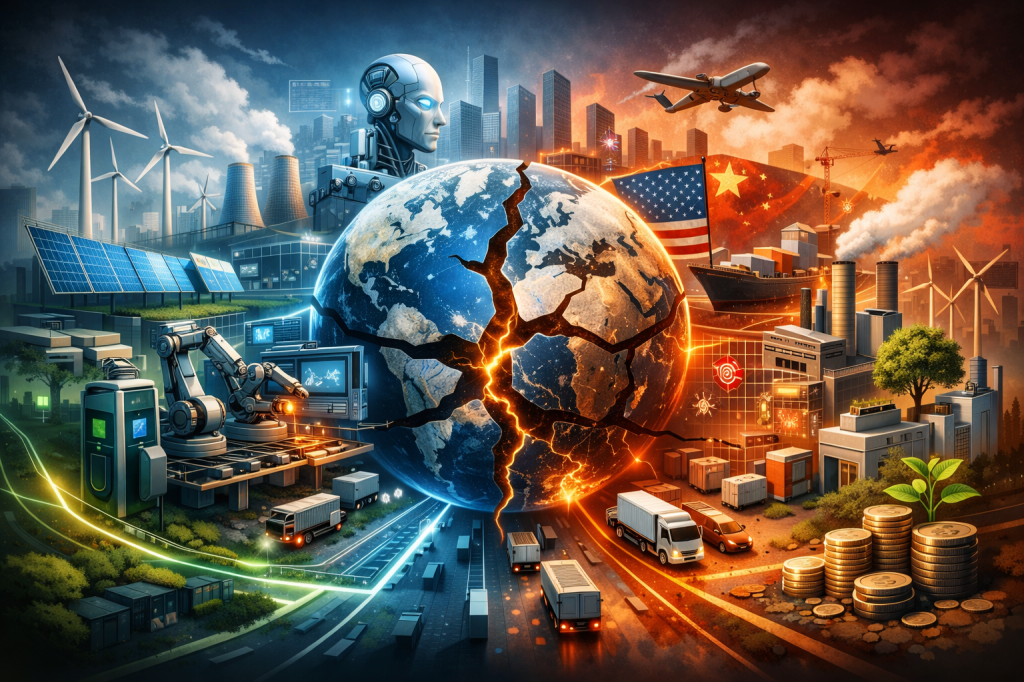
For much of the post–World War II period, global industry moved in broad cycles. Manufacturing booms and busts were largely synchronized across regions and sectors, driven by common forces—interest rates, commodity prices, trade volumes, and consumer demand. Steel, chemicals, autos, capital goods, and infrastructure tended to rise and fall together. That world is now decisively behind us.
Today’s global industrial economy is fragmenting into vertical-specific trajectories. Each sector is increasingly shaped by its own mix of policy mandates, technological disruption, sustainability rules, geopolitical exposure, and capital discipline. Demand still matters, but it no longer dominates outcomes on its own.
From Cycles to Structural Divergence
Historically, industrial cycles were demand-led. Post-war reconstruction, China’s infrastructure boom, and the globalization wave of the 1990s and early 2000s created a rising tide that lifted most sectors simultaneously. Efficiency, scale, and cost leadership were the winning strategies. Firms that expanded capacity fastest often emerged strongest when the cycle turned.
The current phase is fundamentally different. Weak or uneven demand now coexists with pockets of strong investment. Some industries remain under pressure despite macro recovery, while others attract capital even in slow-growth environments. This divergence reflects a shift from cyclical capitalism to structurally filtered capitalism—where access to markets, finance, and policy support is conditional rather than automatic.
Policy, Sustainability, and Geopolitics as Core Drivers
Industrial competitiveness is no longer determined only by productivity and price. Policy frameworks and regulatory alignment increasingly define who can sell, where, and at what cost. Carbon pricing, border-adjustment mechanisms, green public procurement, and disclosure norms are reshaping cost curves and market access across sectors.
At the same time, geopolitics has moved from the background to the balance sheet. Trade realignments, technology controls, friend-shoring strategies, and security-driven industrial policy are fragmenting global supply chains. Industries exposed to strategic materials, critical technologies, or national security concerns face entirely different risk-reward equations than those tied to local or non-strategic demand.
In this environment, compliance is no longer a cost center—it is a survival threshold.
Where Capital Is Actually Flowing
Global capital allocation patterns reveal this shift clearly. Investment is no longer chasing volume growth alone; it is gravitating toward sectors and business models aligned with long-term transition logic.
Energy-transition industries—renewables, grid infrastructure, electrification technologies, low-carbon materials—continue to attract patient capital despite near-term volatility. These sectors benefit from policy visibility, regulatory tailwinds, and multi-decade demand certainty.
Compliance- and resilience-linked sectors are also gaining prominence. Firms that help industries meet emissions norms, trace supply chains, manage cyber risk, or comply with complex regulatory regimes are becoming essential infrastructure rather than optional services.
Automation and productivity technologies represent the third pillar. With labor constraints, cost pressures, and demand uncertainty, firms are investing in AI, robotics, data analytics, and digital systems not to expand aggressively, but to defend margins and remain viable. Productivity-led competitiveness is replacing scale-led dominance.
Strategy Over Scale in the Next Industrial Phase
The bottom line is stark. The global industrial economy is no longer converging toward a single recovery path. It is splitting into multiple vertical-specific futures, each governed by its own rules of success. Large balance sheets and sheer output capacity no longer guarantee resilience. Strategic alignment does.
Firms and sectors that adapt to transition economics—by embedding sustainability, regulatory intelligence, and technology into their core strategies—will continue to grow even in a low-synchronization world. Those that rely on volume expansion without structural alignment risk becoming stranded assets, regardless of their historical scale.
The next phase of industrial growth will be selective, structural, and transition-driven. It will reward adaptability over size, foresight over inertia, and strategy over volume. In this fragmented future, the question is no longer who produces the most—but who evolves the fastest.
#IndustrialFragmentation
#EnergyTransition
#SustainabilityRules
#Geopolitics
#Automation
#Productivity
#CapitalAllocation
#RegulatoryCompliance
#SupplyChainResilience
#StrategicAdaptability
 "Connecting communities, empowering nations: Unifying the Regional and Global Economy ."
Leave a comment