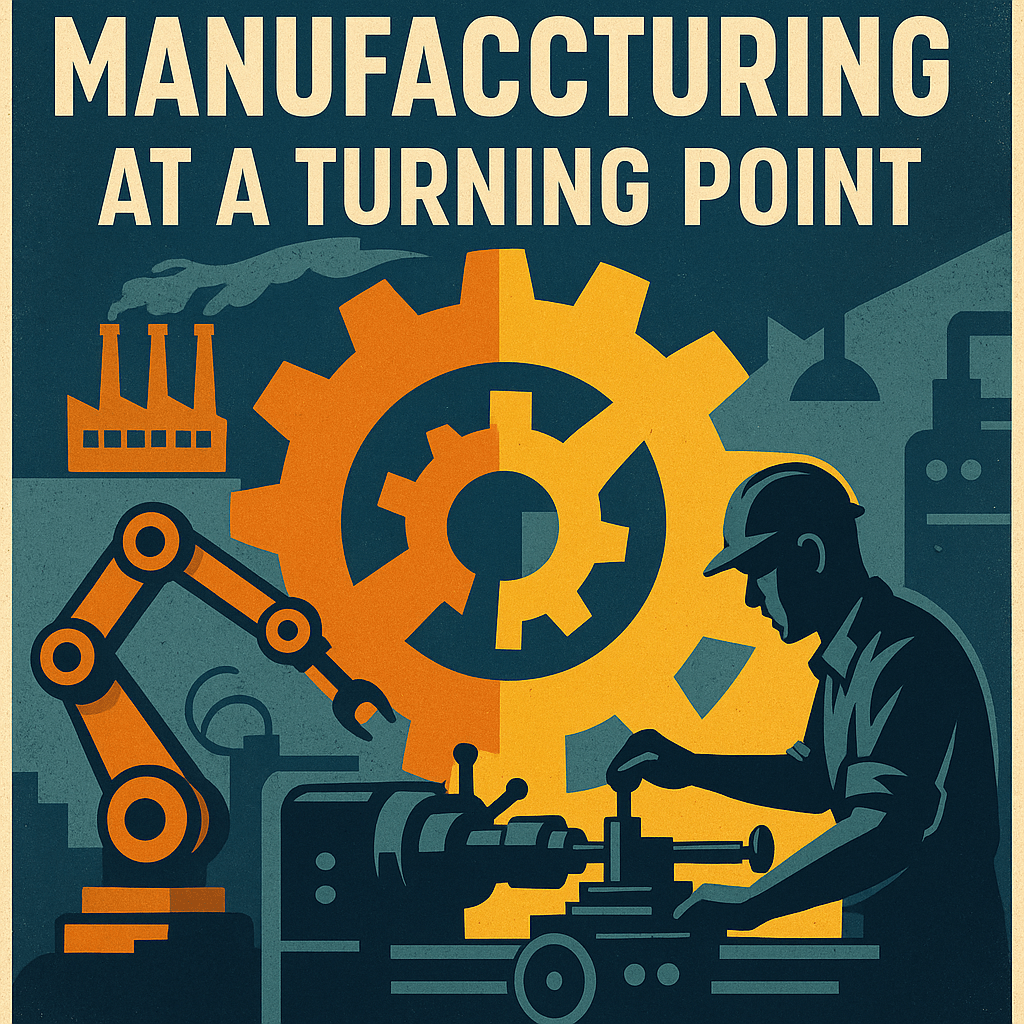
Global manufacturing today stands at a structural crossroads rather than a temporary slowdown. Recent Purchasing Managers’ Index (PMI) readings across major industrial regions—including the United States, Europe, and Asia—show persistent contraction through November. Soft domestic demand, tariff uncertainties, and shifting global trade relations continue to weigh on factory sentiment. What may appear as a routine industrial slump is, in fact, part of a broader transition that reflects deeper shifts in industrial priorities and investment behaviour.
Weak Demand and Investment Hesitation
The decline in new orders and output is most visible in capital goods and heavy industry. Companies are delaying equipment upgrades, slowing expansion plans, and exercising caution toward capital expenditure. This behaviour is driven not only by inflation and higher borrowing costs, but also by geopolitical uncertainty, supply chain reconfiguration, and the increased cost of trade compliance. Historically, such moments—whether in the early 1980s manufacturing correction or the post-2008 recovery cycle—have not simply resulted in contraction; instead, they have often preceded shifts in industrial logic and technology adoption. The present phase appears similar: a pause driven by strategic reconsideration rather than collapse.
Commodity Signals and Industrial Intent
A striking contradiction emerging from current market behaviour is the divergence between weak factory activity and strong movement in metal commodity prices, especially copper. Copper, considered a bellwether for industrial health, typically falls when manufacturing contracts. Yet today it is rising, reflecting strong future expectations rather than present weakness. This indicates that the coming industrial demand is likely tied to infrastructure, electrification, energy transition, and grid-scale investment rather than traditional consumption-led manufacturing. It suggests markets are preparing for long-term industrial shifts aligned with climate targets, clean technology expansion, and national industrial policy.
Transition Toward a New Industrial Model
The signals point toward a manufacturing transition defined by three major trends. First, the shift from scale-based mass production to high-value, capability-driven production—robotics, automation systems, semiconductor equipment, precision components, and advanced materials. Second, the move from consumer-driven cycles toward infrastructure and systems investment, driven by climate commitments, energy security, and digital connectivity. Third, the gradual pivot from fossil-intensive manufacturing to clean-tech ecosystems including electric vehicles, battery supply chains, hydrogen systems, renewable power infrastructure, and power electronics. Much like earlier industrial transformations—from steam to electricity or from analog to digital—the current transition is not linear but systemic.
What Lies Ahead
Looking toward the next three to five years, the manufacturing landscape may become more specialized, regionalized, and technologically intensive. Policy support—from industrial subsidies to carbon-market mechanisms—will likely determine the pace of this evolution. Artificial intelligence, automation, and reshored manufacturing capacity are expected to redefine cost and productivity structures. Instead of uniform globalized supply chains, diversified strategic ecosystems may emerge, particularly in geographies offering predictable regulation, low-carbon industrial pathways, and competitive infrastructure.
A Pause Before Acceleration
The weakening of traditional manufacturing indicators is real and measurable, but it may be misleading if interpreted purely as economic distress. The strength in commodities tied to future infrastructure and transition technologies suggests this slowdown represents the end of one industrial phase and the early construction of another. Traditional manufacturing may remain under pressure in the near term, but beneath the surface, a new model—cleaner, digital, infrastructure-led, and strategically aligned—is forming. The global industrial cycle is not shrinking; it is redefining itself.
#ManufacturingShift
#IndustrialTransition
#GreenIndustry
#CapitalGoods
#EnergyInfrastructure
#SupplyChainRealignment
#FutureFactories
#CommoditySignals
#CleanTechManufacturing
#IndustrialPolicy
 "Connecting communities, empowering nations: Unifying the Regional and Global Economy ."
Leave a comment