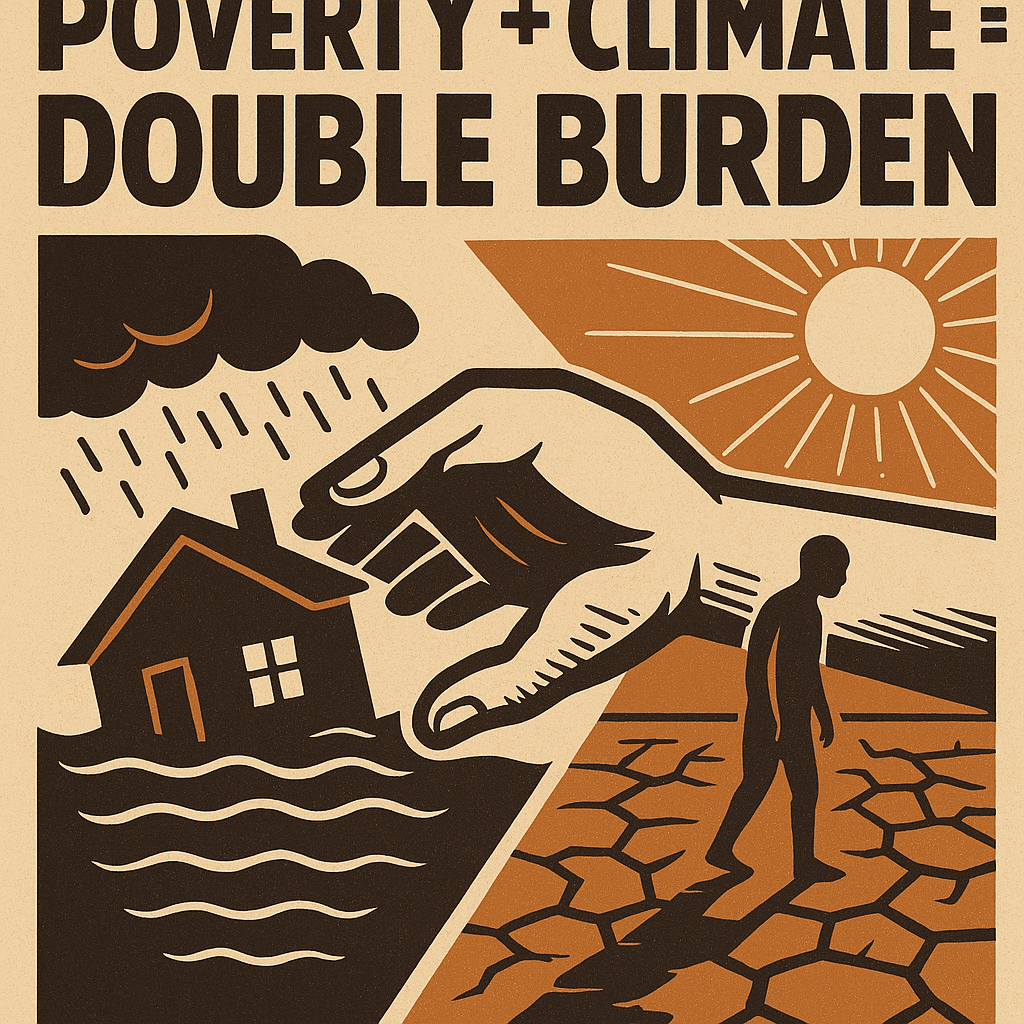
For decades, global development strategies treated poverty and climate change as two separate problems—one belonging to the social sector, the other to the environment. But the world today is witnessing a dangerous convergence: those who contribute the least to emissions are paying the highest price.
Poverty + Climate = A Multiplying Crisis
Historically, poverty was fought with welfare schemes and food security measures—roads, ration shops, micro-credit. But the economic shocks of the pandemic and the intensifying climate crisis have rewritten the logic of vulnerability. According to global estimates, over 3.3 billion people live in regions highly exposed to climate hazards like heatwaves, floods, cyclones, and crop failures. Most of them are in Africa, South Asia, and small island nations—areas already struggling with limited health systems, informal work, and weak safety nets.
This double burden is reshaping development economics: if rising temperatures destroy crops, if cyclones wipe out homes, if drought makes migration the only option—poverty rebounds even where progress was previously achieved. That means climate adaptation is now a poverty-reduction strategy, not just an environmental one. Interventions must account for the real risks ahead: future cities flooded by sea-level rise, farm incomes crushed by unpredictable seasons, and domestic resources diverted from education and health to disaster relief.
The Next Frontier of Social Policy
Global growth has not translated into equal dignity for all. Even in advanced economies, rights-based social protection remains incomplete:
Persons with disabilities face employment gaps exceeding 40–50% in many countries.
Ageing populations in Europe, Japan, and even China are stressing pension and care systems.
Child welfare remains fragile in conflict-affected nations, where education loss risks lifelong disadvantage.
Women and informal workers remain outside formal safety nets, especially in developing countries.
The historical arc of welfare—from charity to entitlements—shows a clear evolution: people must be protected not because they are vulnerable, but because they have rights. The future demands inclusive governance that recognizes diverse needs: universal healthcare delivery, digital social protection systems, climate-responsive insurance, and community-led resilience planning.
Human Development vs. Short-Term Growth
For much of the 20th century, GDP growth was treated as the ultimate success indicator. But the Human Development Reports, since 1990, proved a powerful truth: economic growth without equity can deepen social divisions. Even today, several fast-growing economies report:
High multidimensional poverty
Unequal access to clean water, schooling, and healthcare
Rising distrust in institutions
Deepening climate vulnerability
Without human development, economies become brittle—wealth at the top cannot compensate for structural fragility below. Markets thrive when people thrive: skilled workers, healthy families, and climate-resilient communities are economic multipliers, not welfare liabilities.
What Must Change
The future of development lies in integration, not sector silos. Key shifts required include:
1. Climate-linked social protection: Insurance, livelihoods diversification, resilient housing, and early-warning systems for the poor.
2. Universal access to human capabilities: Healthcare, digital learning, skilling, nutrition, mental well-being.
3. Community-driven governance: Local bodies empowered with climate finance and social budgets tailored to real conditions.
4. Sustainability as a core economic measure: New metrics beyond GDP—tracking resilience, access, participation, and planetary balance.
Unless sustainability and equity anchor policy design, future generations may inherit economies that grow on paper but collapse in the face of climate and social shocks.
The Humanity Test of the 21st Century
Climate change is the biggest inequality amplifier the world has ever seen. The true measure of progress is not how fast an economy grows, but how fairly it protects its people—especially those with the least power. When development policies succeed in lifting people up while safeguarding the planet, societies not only become more resilient—they become more just.#ClimateJustice
#HumanDevelopment
#SocialProtection
#ResilienceEconomy
#InclusiveGovernance
#SustainabilityTransition
#EquityAndAccess
#GlobalPovertyChallenge
#RightsBasedDevelopment
#FutureOfWelfare
 "Connecting communities, empowering nations: Unifying the Regional and Global Economy ."
Leave a comment