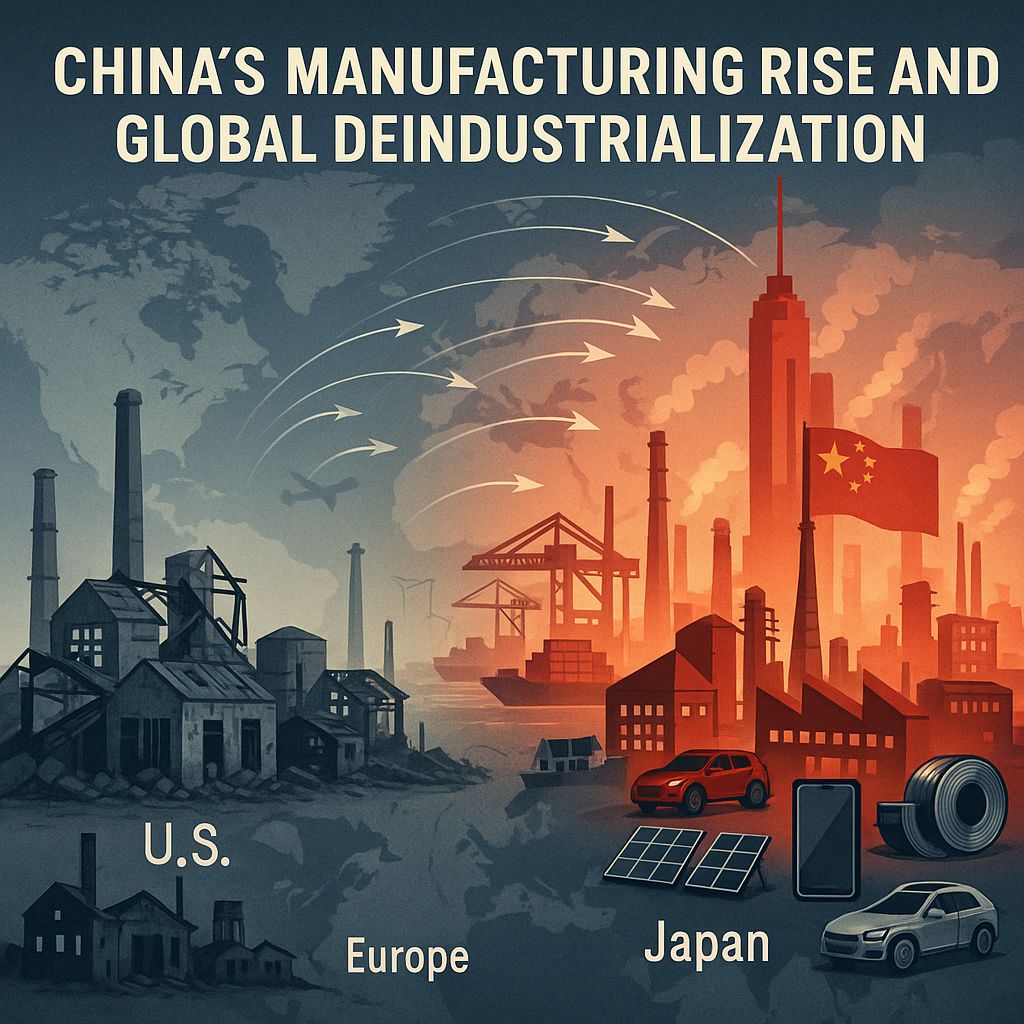
Over the last 40 years, the world economy has quietly reorganized around a single industrial center: China. What began in the late 1970s with controlled reforms evolved into the most concentrated manufacturing ecosystem in modern history—powered by subsidies, labour scale, logistics efficiency, and state-backed vertical integration. As China expanded its industrial footprint, many countries experienced import-led deindustrialization—a structural shift where local factories could no longer compete, leaving hollowed-out industrial towns, labour displacement, and declining economic complexity.
This story is not just about economics—it is about power, resilience, and the future of global supply chains.
United States: Manufacturing Shock and Strategic Reset
The U.S. experienced the most documented wave of China-driven industrial displacement after China’s WTO accession in 2001.
- Jobs lost: Research links 2 to 2.4 million manufacturing job losses (1999–2011) to Chinese import penetration.
- Products most affected:
- Steel and aluminum: Surges triggered layoffs in Pennsylvania, Ohio, and Indiana.
- Electronics: Smartphones, displays, microelectronics assembly shifted almost entirely to China.
- Furniture and textiles: Carolina-based industries collapsed under price pressure.
The U.S. response since 2018 reflects a new thesis: industrial policy and national security are now inseparable. Tariffs, reshoring, CHIPS and clean manufacturing subsidies mark a structural pivot—not just protectionism, but an attempt to rebuild capacity in semiconductors, electric vehicles, batteries, and advanced machinery.
European Union: The “Second China Shock”
Europe’s relationship with China shifted from cooperation to competition, especially after Chinese dominance in climate manufacturing.
- Industries hit hardest:
- Solar PV: Europe once led solar technology; today, China controls 75%+ of the global supply chain, forcing EU producers like SolarWorld to shut doors.
- Automotive: German automakers now face a price war in EVs, with Chinese EVs up to 35% cheaper.
- Machine tools and chemicals: Chinese subsidies eroded competitiveness in German industrial clusters.
Factories are closing in Germany and Italy, even as European producers expand their next plants in China—a strategic irony symbolizing dependency.
United Kingdom: The Industrial Decline Accelerates
The UK’s deindustrialization predates China—but Chinese imports accelerated its speed and scale, especially post-Brexit.
- Sectors most affected:
- Steel: Output fell 29% in 2024; British Steel’s Scunthorpe closure became symbolic of systemic erosion.
- Textiles and apparel: Cheap Chinese imports wiped out historic mills in Manchester and Leicester.
- Consumer electronics: Once a growing sector, now almost fully imported.
The UK has yet to articulate an industrial revival strategy with global competitiveness.
Japan: The Electronics Displacement Effect
Japan—once the global center of electronics innovation—experienced strategic erosion as China scaled.
- Products impacted:
- LCD panels, semiconductors, phone components
- Consumer electronics brands (Sharp, Panasonic, Sony devices)
Japan shifted to high-tech niches (robotics, automotive components, advanced materials) but lost mass-market manufacturing dominance.
Australia and Global Commodity Economies: Overcapacity Ripple Effects
Australia’s dependence on resource exports created an unintended exposure: China’s overcapacity in steel and construction materials.
- Steel mining and value-added processing weakened, with Australia exporting raw ore while importing finished Chinese steel—an inverse industrial logic.
This mirrors patterns across Latin America, Africa, and Southeast Asia: raw materials go to China; finished products return.
Emerging Markets: Opportunity or Dependence?
Countries like Mexico, Vietnam, Turkey, and India gained manufacturing market share—but often as extensions of China’s supply chain, not competitors.
For example: Country Opportunity Dependency Risk Product Areas Vietnam Electronics assembly boom Heavy reliance on Chinese components Smartphones, ICT hardware Mexico Nearshoring for U.S. Chinese firms dominate investment footprint EVs, appliances India Policy-backed manufacturing push High import dependence in machinery and battery supply chain Electronics, solar modules, EVs
A Historical Perspective: From Industrial Revolution to Industrial Concentration
- 1900–1950: Europe and the U.S. dominated manufacturing.
- 1950–1980: Japan and later the East Asian tigers rose.
- 2000–2025: China became the world’s factory; no other nation has held over 30% of global manufacturing output in modern history.
The current debate is not whether China replaces others, but whether the world has allowed a single point of industrial failure.
The Future Outlook: Fragmentation, Re-industrialization, and Strategic Decoupling
Three scenarios define the next decade:
✔ 1. Controlled Global Diversification
Countries restructure supply chains across Mexico, India, Southeast Asia—reducing but not severing dependence.
✔ 2. Strategic Reindustrialization
U.S., EU, Japan pursue industrial sovereignty in:
- Semiconductors
- Defense
- Batteries
- Clean energy
- AI-enabled manufacturing
✔ 3. Dual Industrial Worlds
A China-led supply chain network and a Western alliance supply network coexist, competing on price, control, and technology.
Conclusion: From Shock to Strategy
China’s manufacturing success reshaped the world—not only economically, but geopolitically. The challenge now is not to reverse China’s role but to rebalance global industrial resilience, create distributed manufacturing hubs, and prevent a future where industrial capability—and therefore power—is dangerously centralized.
The next decade will determine whether the world moves from deindustrialization to strategic re-industrialization—or accepts a permanently asymmetric manufacturing order.
#Deindustrialization #ChinaManufacturing #GlobalTrade #Reshoring #IndustrialPolicy #EVRevolution #SolarPV #ManufacturingShift #FutureOfIndustry #Geoeconomics
.
 "Connecting communities, empowering nations: Unifying the Regional and Global Economy ."
Leave a comment