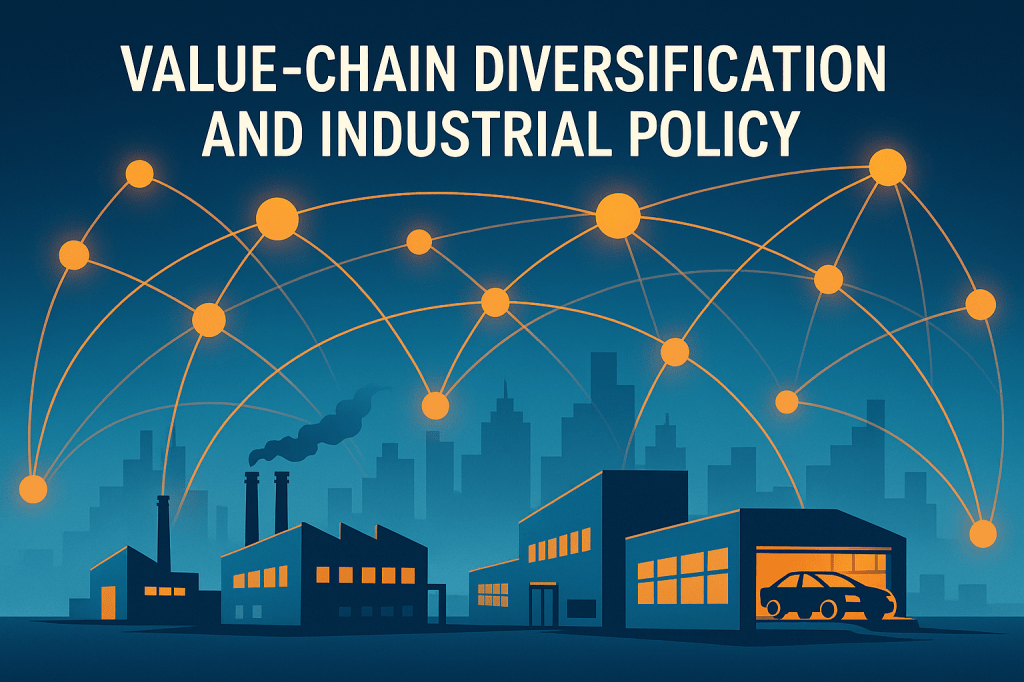
The global production system is undergoing one of its most profound rearrangements since the late 20th-century offshoring wave. The shift is not abrupt like the oil shocks of the 1970s nor purely efficiency-driven like globalization in the early 2000s. Rather, it is a slow but structural re-sorting driven by geopolitics, supply-chain risks, industrial policy activism, and technological realignments.
In this evolving landscape, value-chain diversification is not merely a strategic choice—it is becoming a structural requirement. For emerging markets, this transition opens a rare historical window, but whether they capitalize on it depends on how quickly they can align policy, capacity, and credibility.
A Historical Lens: From Scale to Resilience
Over the past three decades, the world economy followed a relatively predictable manufacturing pattern: large-scale, centralized production hubs—primarily China and parts of East Asia—served as the world’s industrial backbone. Cost efficiency, specialization, and mega-factory scale defined competitiveness.
Today, that logic is weakening.
Events such as pandemic disruptions, semiconductor shortages, war-driven commodity shocks, and rising tariff walls have exposed vulnerabilities in hyper-concentrated supply systems. What was once efficient became risky; what was once lean became fragile.
The emerging rule is simple:
Resilience now matters as much as cost and scale.
New Demand Patterns: Agility Over Monoliths
As production rebalances, global value chains are shifting toward more diversified, flexible networks. Instead of relying on a single mega-supplier, firms are increasingly adopting a “multi-node” sourcing architecture.
This transition favors:
- Mid-sized, flexible suppliers
- Countries offering predictable policy environments
- Jurisdictions with trade neutrality
- Regulatory transparency and faster approvals
- Ability to localize intermediate production
Agility is becoming a competitive edge. The future supplier is not necessarily the largest—but the most adaptive.
Emerging Markets: A Once-In-A-Generation Opening
The current restructuring creates space for regions that historically sat at the periphery of global manufacturing. Countries in Southeast Asia, South Asia, Latin America, and parts of Africa are increasingly discussed as viable alternatives in global boardrooms.
However, not all emerging markets will benefit equally. The winners will be those that can demonstrate three things: Strategic Factor Why It Matters Emerging Winner Traits Stable trade relations Reduces geopolitical exposure FTAs, multi-polarity positioning Competitive cost structures Keeps production commercially viable Low labor cost + productivity focus Regulatory clarity & speed Reduces hidden risks and delays Single-window, predictable rules
Countries that rely solely on low wages or tax holidays will struggle. Industrial policy now needs strategic intent—not incentives alone.
Industrial Policy 2.0: From Subsidies to Ecosystems
The industrial policies emerging today are less about subsidizing production and more about building technological, logistics, and institutional foundations.
A forward-looking industrial policy includes:
- Component and intermediate goods ecosystems rather than just final assembly
- Standardization, certification, and quality frameworks
- Research, testing, and innovation infrastructure
- Skills pipelines connected to industry—not just education
- Digital and physical logistics capabilities (ports, cloud, AI-enabled tracking)
In short, industrial policy is moving from “factory attraction” to “ecosystem architecture.”
A Futuristic Outlook: Distributed Manufacturing and Networked Production
The next decade may not produce another single manufacturing superpower. Instead, it is likely to produce a distributed manufacturing map, where:
- Production is split across multiple flexible nodes
- Digital supply-chain visibility replaces physical oversight
- Automation and AI blur the boundary between scale and adaptability
- Nations compete on regulatory efficiency—not just labor cost
Regional manufacturing clusters—South Asia for electronics, Southeast Asia for automotive, North America for resilient near-shoring, Africa for resource-linked manufacturing—may become the new structure of global value chains.
Fragmentation vs. Cooperation
While diversification offers resilience, it also risks fragmentation. Competing industrial policies, tariff escalations, and overlapping security-oriented trade restrictions could slow global innovation and raise long-term production costs.
The biggest challenge ahead may not be technology, cost, or talent—but coordination.
A Redefined Competitive Landscape
The re-sorting of global value chains is more than a response to shocks—it represents a shift in the operating logic of globalization. For emerging markets, the moment is both an opportunity and a test.
Those that build agility, regulatory predictability, and supply-chain credibility will rise as the new nodes of global manufacturing. Those that rely on legacy advantages risk being bypassed.
The future does not belong to the biggest producers—it belongs to those who are fast, strategic, and resilient.
 "Connecting communities, empowering nations: Unifying the Regional and Global Economy ."
Leave a comment