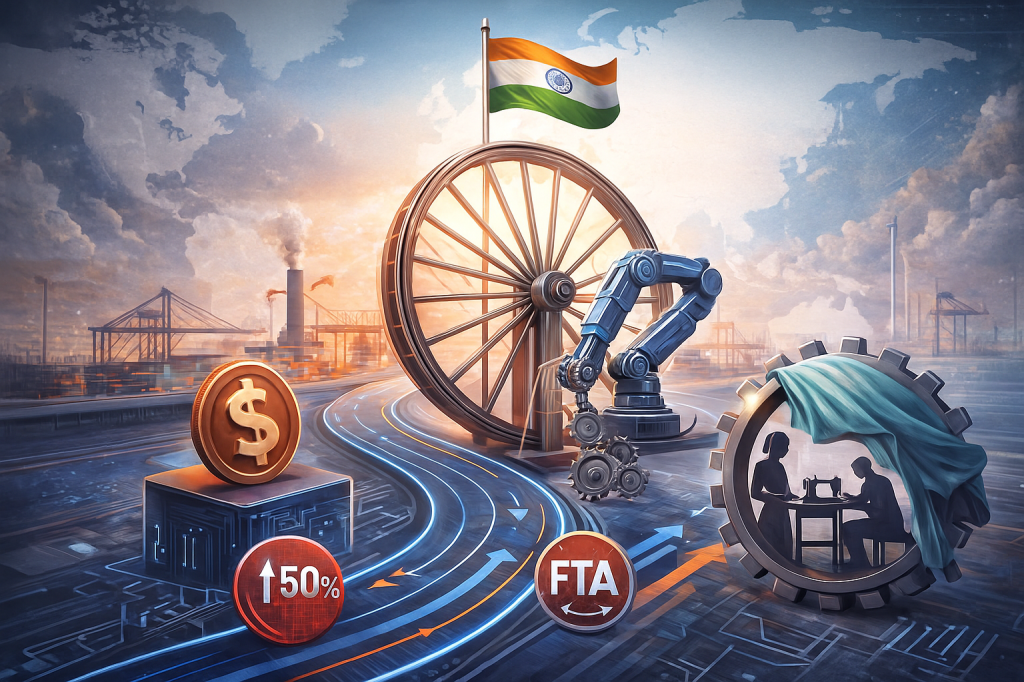
India’s textiles and apparel industry stands at a defining crossroads — not because of a single disruption, but because of the convergence of tariffs, technology, and labour dynamics that are reshaping global competitiveness. The recent policy shifts, global protectionism, and emerging supply-chain restructurings have created a paradoxical moment: pressure and opportunity coexist.
This is not just another industrial cycle — it resembles earlier turning points in Indian textile history: the shift from handloom to powerloom in the 1970s, the MFA quota era of the 1990s, and the post-WTO integration in the 2000s. But unlike earlier cycles driven primarily by market demand, the current phase is being shaped by geopolitics, trade agreements, automation, and synthetic textile capability.
India’s Textile Identity Was Built on Cotton — the Future May Not Be
India’s textiles strength has been historically rooted in natural fibres — cotton, wool, silk, and jute. Cotton alone accounted for more than half of all apparel exports for decades. This aligned with India’s climate, farm practices, and cultural preference.
But the world has shifted.
Today, man-made fibres (MMF) and blended fabrics dominate global demand, especially in athleisure, performance wear, technical textiles, and fast fashion. The rise of global brands, synthetic fast-moving fashion cycles, and sustainability-driven materials science means:
India can no longer compete with a cotton-first mindset in a synthetic-first world.
The ongoing policy reforms appear to recognise this reality — finally.
Tariff Shock: A 50% U.S. Duty and the Survival Mode of Exporters
The announcement of a 50% tariff on Indian textile exports to the U.S. has triggered what exporters describe as a “survival-mode economy.”
Export orders have slowed, margins are collapsing, and price undercutting among Indian firms has intensified — a dangerous race to the bottom.
For many MSMEs, the tariff shock is not just an economic penalty — it is a strategic forcing function. The old export model based purely on cost arbitrage no longer works.
Three outcomes are now emerging:
- Exports shifting toward non-U.S. markets through diversification and rupee-trade mechanisms.
- Automation and labour rationalisation as factories attempt to protect shrinking margins.
- Exporters positioning for FTA-led rebound, especially with markets like the EU, GCC, and UK.
Regulatory Relief and the Technology Window
In a move widely welcomed by industry clusters like Surat, Ludhiana, Tirupur, and Panipat, the government has postponed the Omnibus Technical Regulation (OTR) for textile machinery to 2026.
This delay is not just regulatory breathing space — it is a strategic technological buffer.
It keeps the pipeline open for:
- High-speed looms from China
- Precision knitting machines from Korea
- Technical textile lines from Germany
- Automated finishing systems from Europe and Japan
Indian machinery manufacturers are improving but still do not meet the scale and specifications demanded by MMF-driven global buyers. The postponed regulation gives India time to build capacity while enabling a major capex cycle in MMF and technical textiles.
This could be the same inflection point that Vietnam experienced between 2013–2020.
FTAs and Export Momentum: The Global Map Is Changing
Despite tariff barriers, India’s textile exports to 111 countries have grown in April–September 2025, with exports to 38 markets rising over 50%.
This aligns with the broader ambition of achieving $100 billion in textile exports by 2030.
India’s emerging FTA architecture — particularly with the EU, UK, and GCC — is altering South Asian competitive dynamics.
Bangladesh, once India’s strongest rival, is beginning to recalibrate as:
- India gains advantages in rules-of-origin
- Automation reduces labour-intensive dependency
- India scales supply chain localisation in MMF and polyester
The competitive map is no longer only about wages — it is about ecosystems, technology, logistics, and trade privileges.
Labour Reform: The New Industrial Bargain
India’s labour reforms, especially standardised rules on hiring flexibility, skilling, and factory compliance, are positioning the textile sector closer to global manufacturing norms.
But this comes with a hard truth:
The future of Indian textiles will employ fewer workers per unit output but require more skilled workers per machine line.
Employment will shift from:
- Stitching floors → automation lines
- Unskilled labour → trained machine operators
- Basic apparel → engineered apparel and technical textiles
This is not job loss — it is job evolution.
The Next 5–10 Years Will Decide India’s Position
India has a narrow but decisive window.
The forces shaping the next phase include: Driver Impact Tariffs and geopolitical realignment Pushes diversification + FTA-centric growth Technology access and mechanisation Defines productivity and global competitiveness MMF transition and sustainability Drives market alignment with global buyers Logistics and multimodal expansion Reduces cost disadvantage Branding and value-added exports Moves India away from commodity pricing
India Must Not Miss the Textile Industrial Revolution — Again
India’s textile industry has always been embedded in civilisation, culture, and commerce.
But history shows one uncomfortable pattern:
India often dominated the textile world culturally — but lost economically when the world changed technologically.
The Mughal cotton era lost to the British mechanical loom.
The post-independence cotton boom lost to synthetic fibre revolutions in Korea, China, and Taiwan.
Today, another transition is here — and this time, the stakes are global, technological, and irreversible.
If India aligns tariffs, technology, labour reform, and FTA leverage — this is the decade where India can reshape the global textile order.
If not, history risks repeating — as a missed industrial opportunity.
#TextileTransformation
#MMFRevolution
#FTAAdvantage
#TariffShock
#SmartManufacturing
#SurvivalToScale
#TechDrivenGrowth
#LabourReformShift
#GlobalCompetitiveness
#IndiaExportVision
 "Connecting communities, empowering nations: Unifying the Regional and Global Economy ."
Leave a comment