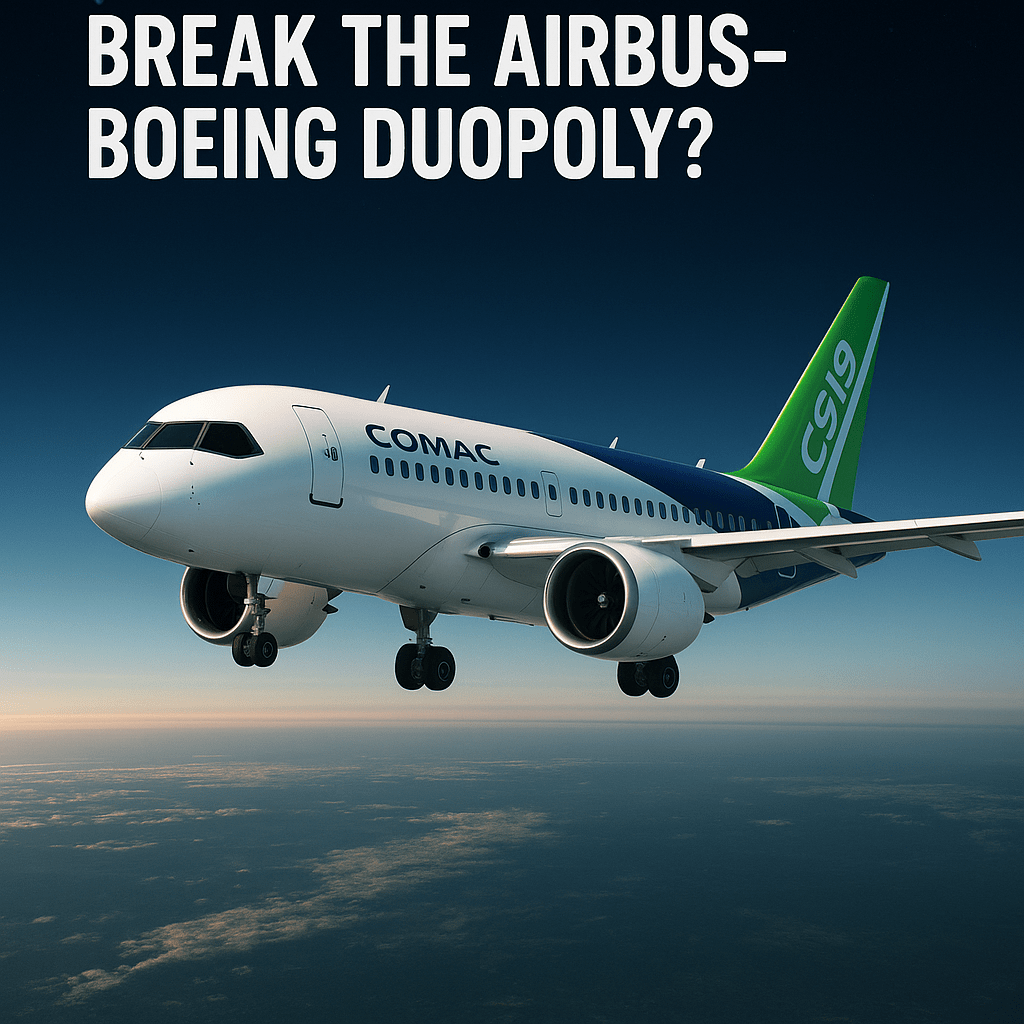
For nearly five decades, the global commercial aviation industry has functioned under a stable but highly concentrated power structure — the duopoly of Airbus and Boeing. From the 1980s onward, every serious challenger either faded (McDonnell Douglas), merged (Lockheed), or pivoted to niche markets (Bombardier, Embraer). The scale, certification barriers, and technological complexity of large commercial jets created natural monopolies, making the sector virtually impossible to enter.
Against this backdrop, the Chinese COMAC C919 is not merely a new aircraft — it is a strategic disruption. It symbolizes China’s ambition to break dependence on Western aerospace technology, reshape the rules of global trade, and eventually claim a seat at the top of the aviation pyramid.
Why the C919 Matters: Data Signals a Structural Shift
Unlike previous aerospace experiments in emerging economies, the C919 has crossed several thresholds that historically determined success:
✔ Meaningful order book
300 orders, representing almost one-quarter of global orders for single-aisle jets above 150 seats — an unprecedented share for a first-time entrant.
China’s Big Three — Air China, China Eastern, China Southern — have each ordered 100+ jets and expect 10–12 annual deliveries per airline by 2027.
✔ Early commercial deployment
Five C919s delivered in 2025, modest in scale yet proof of production capability — a stage many challengers never reached.
✔ Industrial state backing + protected domestic market
No other aviation challenger has ever launched with:
The world’s largest aviation market as a guaranteed buyer
Policy support, financing support, and long-term industrial alignment
An import-substitution strategy to replace Airbus and Boeing inside China
Even if international adoption is slow, China alone can keep the program commercially alive.
The Biggest Barrier to Global Disruption
Despite its progress, the C919 cannot yet fully participate in global aviation markets:
Certification Authority Status Possible Timeline
CAAC (China) Approved Active
EASA (Europe) Not approved Expected 2028+
FAA (United States) Not approved Possibly beyond 2028
Select emerging markets Under review Example: Nigeria exploring approval
Without EASA and FAA certification, the C919 will remain largely confined to China + emerging markets. But once certification barriers fall, global competition dynamics may change permanently.
From Duopoly to Possible Triopoly
🔹 Short-term: Local substitution
China will progressively replace Airbus and Boeing in domestic fleets, redirecting billions in aircraft spending toward its own aerospace ecosystem.
🔹 Medium-term: Emerging-market penetration
Countries in Africa, Latin America, Middle East, and ASEAN — concerned with cost, financing, and supply access — may buy C919s earlier than Western markets.
🔹 Long-term: Shifting global power structures
If COMAC:
Achieves mass production
Builds a global maintenance ecosystem
Secures supply-chain independence
then the world could move toward a three-player structure (triopoly) — the first such change since the 1970s.
Not by sudden displacement, but by gradual dilution of Airbus–Boeing dominance.
Lessons from Japan & South Korea
Industry Legacy Powers Entrant Status Today
Automobiles U.S./Europe Japan Full disruption (Toyota, Honda)
Consumer electronics U.S./Europe Japan + Korea Full disruption (Sony, Samsung)
Shipbuilding Europe/U.S. Korea + China Full disruption (global dominance)
Civil aviation Boeing/Airbus China (C919) Trajectory resembles early auto industry
If history repeats itself, cost-efficient mass manufacturing + large domestic scale may eventually transform C919 from a national project into a global force.
The Real Strategic Question
C919 is not only about the aviation market.
It is about control over chokepoint technologies — jet engines, avionics, certification, global supply chains, and geopolitical leverage. Aviation technology historically mirrors strategic power, not just economics.
Therefore, the duopoly challenge is not merely industrial. It is:
technological
geopolitical
regulatory
supply-chain dependent
And the world is entering an era where states — not just markets — decide industrial winners.
Three Possible Scenarios for 2035
Scenario Probable Outcome
Status Quo Extension Airbus & Boeing retain dominance; C919 remains mostly domestic
Triopoly Formation C919 gains access to emerging markets + partial Western certification
Strategic Realignment Fragmented aviation world with regional certification blocs (West vs China)
The second scenario — triopoly is the most likely, provided COMAC:
stabilizes production
develops export financing
secures a global servicing network
The C919 will not break the duopoly overnight, but it has already broken the illusion of unbreakability.
The world’s aviation order is undergoing slow disruption, not revolution. And disruption historically begins not with a global takeover, but with a foothold in the home market.
The same pattern that produced Toyota, Samsung, and COSCO may now be unfolding in aerospace.
The Airbus–Boeing duopoly is no longer permanent.
The C919 is the beginning of a new competitive reality — one that will reshape aviation economics, supply chains, and geopolitics for decades.
#C919 #AviationTriopoly #GlobalAerospaceShift #ChinaAviation #AirbusBoeingDuopoly #CivilAerospaceCompetition #EmergingMarketsAviation #GeopoliticsOfAerospace #FutureOfAirTravel #COMACRevolution
 "Connecting communities, empowering nations: Unifying the Regional and Global Economy ."
Leave a comment