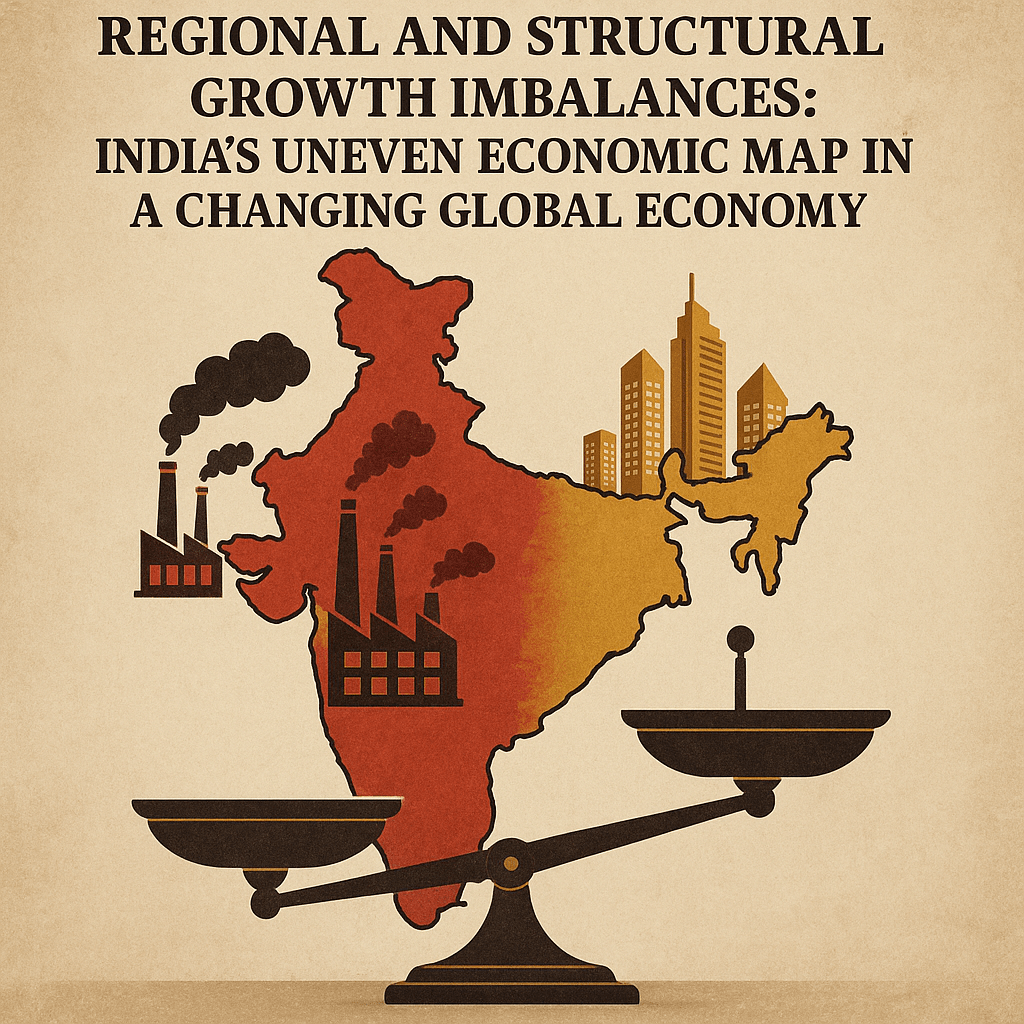
India’s economic success story has often been narrated through headline GDP figures, rapid digitalisation, expanding exports and the rise of new industries. Yet beneath this national growth lies a stark truth that economists and policymakers can no longer ignore — regional and structural growth imbalances are widening, both within the country and across the world. On one hand, India’s lagging states — particularly in eastern and central belts — continue to struggle with low industrialisation, inadequate infrastructure and slower job creation. On the other hand, the global economy is undergoing structural transformations driven by technology, automation, and the gig economy, reshaping business models and altering what “development” means in the 21st century.
Historically, India’s pattern of growth has been uneven since the 1991 reforms. States with better human capital, stronger industrial bases and early adoption of market-friendly policies — such as Maharashtra, Gujarat, Tamil Nadu, Karnataka and later Telangana — created clusters of manufacturing and services. Meanwhile, Bihar, UP, Jharkhand, Odisha, parts of the Northeast and Rajasthan lagged behind, trapped in structurally weak development cycles driven by low investment, skill deficits, and administrative bottlenecks. The divergence became self-reinforcing: states that grew faster attracted more capital and talent, while slower-growing states lost both.
Today, this divergence has entered a new phase. India’s high-growth hubs are now aligned with global tech-driven value chains, while lagging regions are still dependent on low-productivity agriculture or informal employment. The risk is not merely inequality — it is the creation of two different economic realities within the same country. If left unaddressed, this imbalance could reduce India’s long-term growth potential and create social and political fault lines.
Globally, a parallel transformation is unfolding. Structural shifts — accelerated by digital technologies, AI, automation and platform-based business models — are redefining competitiveness and labour markets. The gig economy is expanding rapidly across sectors such as logistics, mobility, retail services, cloud work and creative industries. While these changes create new income pathways and business opportunities, they also raise difficult questions: Are jobs becoming less secure? Is innovation replacing traditional labour faster than economies can adjust? Will future growth benefit everyone — or only the digitally skilled?
When India’s regional imbalance intersects with global structural change, the challenge becomes even sharper. States that integrate quickly with new-age digital and manufacturing sectors will continue to surge ahead. Others risk being structurally excluded from the future of work. The urgency now is not about redistributing subsidies or increasing transfers, but about creating competitive capacities everywhere — plug-and-play industrial zones, world-class skilling systems, logistics integration, and digital-platform access for MSMEs and youth in every state.
A futuristic outlook demands reframing development priorities. Instead of benchmarking lagging regions against old metrics of agriculture vs. industry, the focus must shift toward future-compatible development ecosystems — from electronics clusters in the East to green-energy hubs in the central belt, from gig-based workforce platforms for rural workers to tech-enabled agriculture for small farmers. The 2030s will reward economies that can build linkages: skills–technology–innovation–infrastructure, not isolated policy interventions.
Ultimately, India’s ambition to become a multi-trillion-dollar economy will depend not on how fast a few states grow, but on how evenly opportunity spreads. The goal is not equal outcomes — it is equal access to growth pathways. The window is open, but narrow. If regions left behind are integrated into futuristic value chains, India becomes a global model of inclusive modernisation. If not, the country risks creating a dual economy — competitive on the surface, fragile underneath.
Balanced regional development in the age of structural global change is not merely an economic agenda. It is a national competitiveness agenda, a social stability agenda, and ultimately, a civilisational development agenda.
BalancedRegionalGrowth#
StructuralTransformation#
DigitalEconomyIndia#
FutureOfWork#
GigEconomyEvolution#
TechDrivenDevelopment#
InclusiveIndustrialization#
HumanCapitalInvestment#
EconomicCompetitivenessIndia#
RegionalDevelopmentStrategy#
.
 "Connecting communities, empowering nations: Unifying the Regional and Global Economy ."
Leave a comment