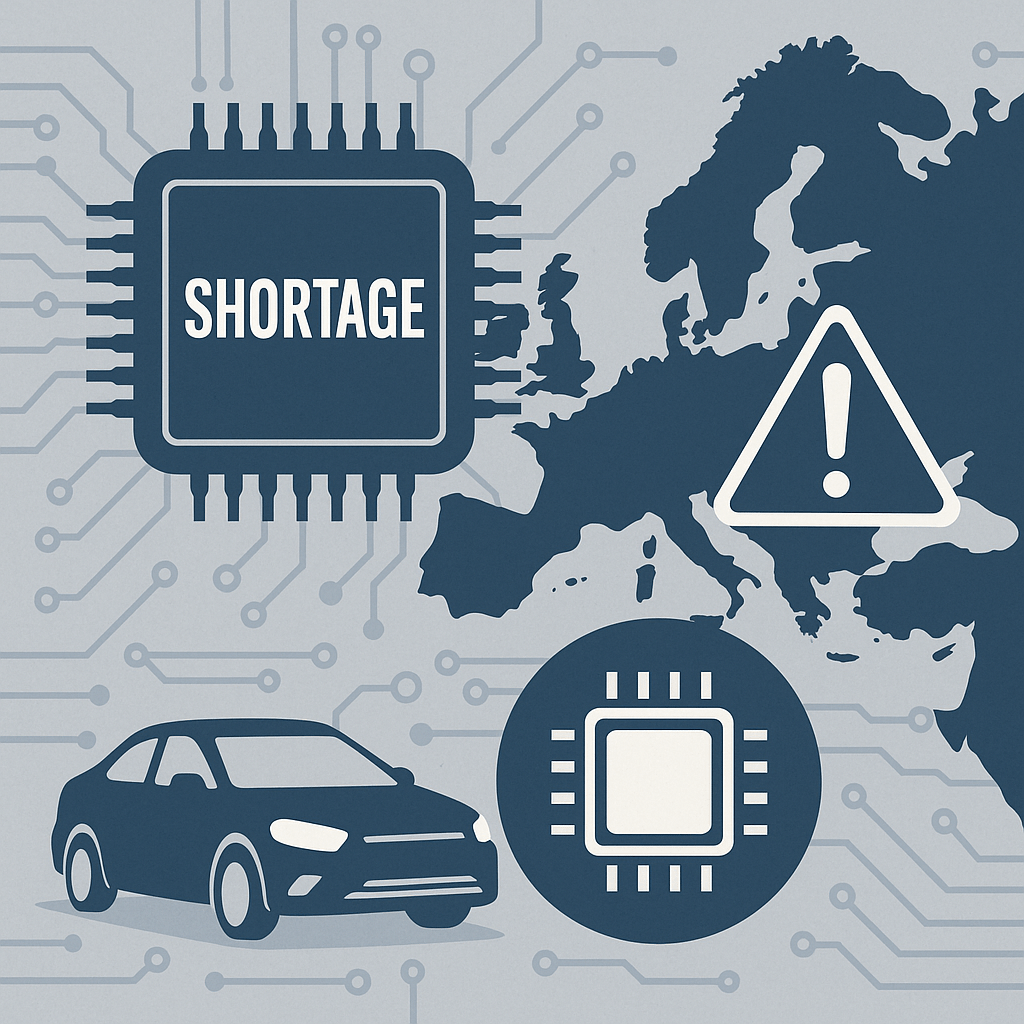
The deepening semiconductor shortage facing Europe’s automotive sector is more than a temporary industrial disturbance — it is a historic reminder of how fragile modern manufacturing systems remain, even after decades of globalisation, automation, and digital sophistication. As wafer shipments linked to the Nexperia–China conflict risk drying up by mid-December, Europe’s carmakers once again confront a reality exposed brutally during the 2020–21 chip crisis: a single bottleneck in a hyper-specialised supply chain can freeze entire industries.
Europe’s leading OEMs have spent years optimizing for efficiency, not resilience. This has created deep structural dependence on a small constellation of semiconductor suppliers — largely located in geopolitically sensitive regions and subject to export controls, ownership disputes, and national-security interventions. The tension between Nexperia (headquartered in the Netherlands) and its Chinese subsidiary now highlights a pattern repeated throughout global chip history: the political economy of semiconductors is inseparable from global industrial stability.
From the emergence of Japan’s chip dominance in the 1980s to the later rise of Taiwan and South Korea, nations have weaponised semiconductor capabilities to project power. Today’s conflicts — whether U.S.–China tech rivalry, European scrutiny of foreign acquisitions, or China’s own tightening of export regimes — simply extend this longstanding pattern. The new twist is that industries are now more semiconductor-intensive than ever. A modern electric vehicle requires nearly twice the chip content of an internal combustion engine vehicle. Household appliances are increasingly embedded with sensors. Mobility systems depend on silicon for navigation, autonomy, and battery management.
This means that even small disruptions cascade like dominoes. If wafer flow stops in December, vehicle output, electronics manufacturing, and even appliance production could face stoppages or slowdowns across Europe. The first wave of chip shortages in 2021 already erased billions in lost automotive revenue globally. A new wave — now layered with geopolitical hostility — risks being sharper and more prolonged.
Why Old Strategies Will Not Work in the 2030s
Europe cannot rely on traditional risk-management tools like forecasting, just-in-time procurement, or supplier diversification alone. These were strategies built for peacetime international trade — not for an era where industrial policy, geography, and great-power rivalry shape every node of the chip ecosystem.
The next decade will reward economies that adopt:
Contingency Sourcing Ecosystems: OEMs must build multi-regional supplier networks, including North America, East Asia, and emerging players across India and Southeast Asia.
Strategic Stockpiling of Critical Components: Much like energy security strategies, chip reserves for essential categories (automotive MCUs, power semiconductors, sensors) will become standard practice.
Vertical Integration and In-house Chip Design: Tesla, Apple and BYD already benefit from designing their own chips. European players must accelerate this pathway.
State-supported semiconductor capacity: The EU Chips Act is a start, but production-scale fabs, packaging facilities, and testing centres must be operationalised rapidly, not in slow policy cycles.
Europe’s Repeated Missed Opportunities
Europe once led in sensor technologies, power electronics, and automotive semiconductors — areas still critical today. However, slow investment, fragmented industrial strategies, and dependence on Asian manufacturing left the continent with a shallow semiconductor footprint.
This crisis echoes earlier episodes:
1980s–90s: Europe lost digital logic leadership to the U.S. and Japan.
2000s: Foundry capacity migrated to Taiwan and South Korea.
2020s: EV transition accelerated Europe’s chip intensity, widening its exposure.
The present crisis is therefore not sudden — it is cumulative.
Futuristic Lens: What 2035 Manufacturing Will Look Like
By the mid-2030s, global manufacturing will be shaped by AI-integrated supply chain forecasting, automated re-routing of inventory, and on-device computing that reduces dependency on external servers. But all of this still requires one irreplaceable foundation: chips.
Who controls chip capacity controls industrial destiny.
Europe’s automotive sector — and its wider manufacturing ecosystem — therefore stands at a critical turning point. The Nexperia-China dispute is the latest signal that supply-chain resilience is no longer optional; it is existential.
The Takeaway
The semiconductor shock is not just about shortages — it is about the shifting architecture of global power. The lesson from history is clear: nations that fail to secure strategic technologies become dependent on those that do. For Europe, the time for incremental adjustments is over. What is required now is a bold, forward-looking recalibration of manufacturing strategy, technological investment, and geopolitical positioning.
This crisis is a warning — and an opportunity — to rewrite the future of Europe’s industrial competitiveness.
 "Connecting communities, empowering nations: Unifying the Regional and Global Economy ."
Leave a comment