From Local Hiccups to Global Shocks
The globalization of trade since the late 20th century turned supply chains into vast, interdependent networks spanning continents. What began as an efficiency revolution—outsourcing, lean inventories, and just-in-time production—created systems optimized for cost but not for resilience.
Historically, disruptions were local: a flood in Thailand might affect rice exports; a strike at a U.S. port might delay shipments. But after 2008, global integration deepened, and risks became systemic. The COVID-19 pandemic (2020-22) was the first true global supply shock of the modern era—halting manufacturing hubs in China, freezing logistics routes, and exposing the fragility of “just-in-time” models.
Crisis Examples: From COVID-19 to the Red Sea Blockade
COVID-19 Pandemic: Lockdowns and health restrictions shattered production continuity. Semiconductor shortages crippled industries from smartphones to automobiles.
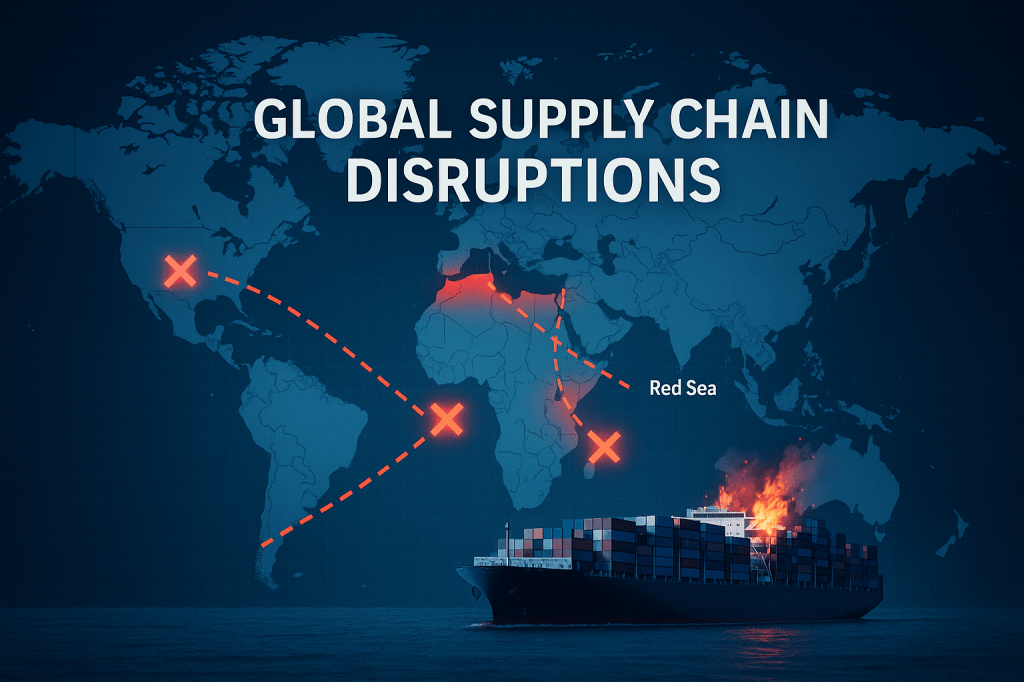
Red Sea Shipping Crisis (2024-25): Drone and geopolitical attacks on commercial vessels in the Red Sea forced rerouting via the Cape of Good Hope, adding two weeks of transit time and raising freight costs by over 60%.
These disruptions cascaded through the global economy—causing shortages of electronics, automotive parts, and consumer goods, and revealing that efficiency without buffers is a dangerous illusion.
The Cost of Fragility
Rising Logistics Costs: Freight rates surged up to fivefold during COVID-19 and again during the Red Sea crisis, squeezing margins for manufacturers and retailers.
Production Delays: Auto makers from Japan to Germany faced months-long backlogs as chips and components got stuck in transit.
Reduced Profitability: Firms dependent on thin-margin global sourcing faced negative earnings, while those with regionalized supply networks fared better.
The IMF estimated global GDP losses from supply disruptions at 1.3% annually (2020-22)—a figure that rivals the cost of some regional wars.
A Future of Supply Chain Re-Architecture
Global supply chains are entering a “de-risking” era, not de-globalization. The lesson is not to abandon global trade but to build redundancy and agility.
Regionalization: Firms are diversifying from “China-centric” supply chains toward “China-plus-one” or even “friend-shoring” models, involving countries like Vietnam, India, and Mexico.
Digital Resilience: Predictive analytics, AI-based logistics tracking, and blockchain-enabled traceability are transforming how disruptions are anticipated and managed.
Strategic Stockpiles: The return of “just-in-case” inventory marks a pragmatic middle path between cost control and security of supply.
Green Logistics: Climate-induced disruptions—floods, droughts, and heatwaves—are forcing a pivot to sustainable logistics, low-carbon shipping, and energy-efficient transport systems.
From Supply Chains to Supply Ecosystems
By 2035, supply chains will evolve into dynamic, data-driven ecosystems rather than rigid linear chains.
AI-Powered Supply Hubs: Predictive algorithms will reroute shipments before a disruption even hits.
Smart Contracts: Blockchain will enable self-executing trade documentation, cutting delays and fraud.
Resilient Infrastructure: Investment in inland ports, high-speed rail freight, and 3D-printing clusters near consumption zones will localize risk.
From Efficiency to Resilience
The next decade will redefine what global efficiency means. The goal is no longer the cheapest route—it is the most adaptive route.
Natural disasters, pandemics, and geopolitical shocks will recur, but nations and companies that embrace agility, digital transparency, and multi-regional integration will emerge stronger. The resilience revolution has begun—and it may become the defining competitive edge of the 21st century.
#GlobalSupplyChain
#TradeDisruption
#RedSeaCrisis
#PandemicImpact
#LogisticsResilience
#AIinLogistics
#EconomicStability
#SupplyChainInnovation
#Sustainability
#FutureOfTrade
 "Connecting communities, empowering nations: Unifying the Regional and Global Economy ."
Leave a comment