From Industrial Aspirations to Global Ambitions
India’s manufacturing story has been one of persistent potential. Since the early years of independence, successive plans—from the Second Five-Year Plan under Nehru to the Make in India initiative—have recognized manufacturing as the backbone of economic progress. Yet, while agriculture’s share in GDP has steadily declined and services have surged past 50%, manufacturing remains stagnant at around 15–17% of GDP.
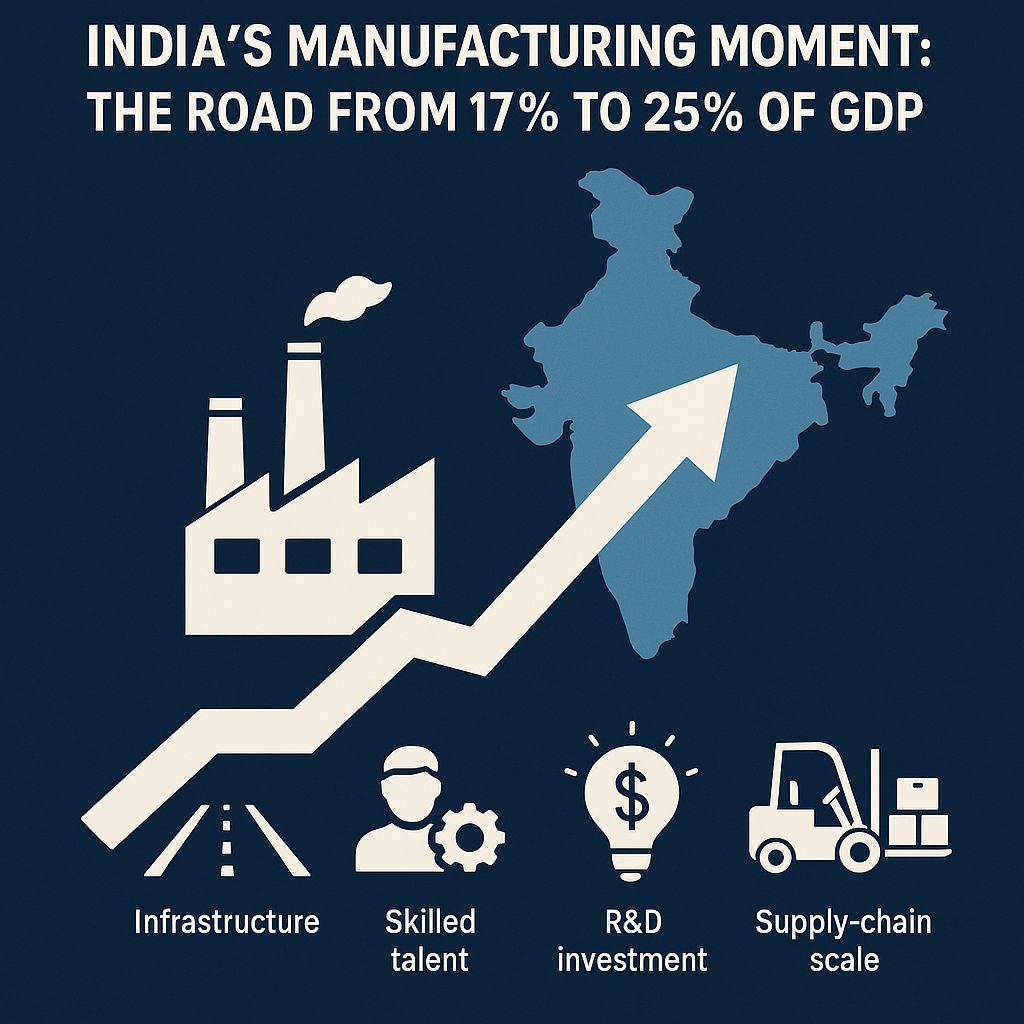
This underperformance isn’t for lack of ambition. India’s long-stated goal has been to raise manufacturing’s share to 25% of GDP, translating into over 100 million jobs by 2047—the centenary of independence. But turning that vision into reality requires more than slogans; it demands structural transformation.
Advanced Manufacturing and Value Chain Depth
The emerging industrial roadmap emphasizes “advanced manufacturing”—a shift from assembly-line production to high-tech, high-precision, innovation-driven systems. This aligns with global trends: automation, AI, robotics, and Industry 4.0 have redefined productivity.
For India, integration into global value chains (GVCs) is crucial. Currently, India contributes mostly to lower stages of production (such as intermediate goods or component assembly). Deepening this participation—by moving into design, innovation, and branding—will determine how much real value India captures.
Sectors like electronics, semiconductors, electric vehicles, and green hydrogen present opportunities where India can leapfrog if industrial policy aligns with technological investment and export strategy.
Building the Industrial Foundation
To achieve this transformation, India must address several enabling pillars:
1. Infrastructure and Industrial Corridors
The Delhi-Mumbai Industrial Corridor, Chennai-Bengaluru Corridor, and new PM Gati Shakti nodes are critical. Efficient logistics, dedicated freight corridors, and port connectivity can reduce the “India cost” that often erodes competitiveness.
2. Skilled Human Capital
The workforce of the future needs digital literacy, automation skills, and technical training. The Skill India Mission and collaboration with industry must evolve beyond basic training to include advanced manufacturing certifications and apprenticeships.
3. R&D and Innovation Ecosystem
India spends less than 0.7% of GDP on R&D, compared to 2–4% in developed economies. Building innovation clusters—particularly near universities and industrial parks—can help bridge this gap. A dedicated manufacturing innovation fund could further incentivize private R&D.
4. Supply Chain Scale and Resilience
The pandemic exposed the fragility of global supply chains. India’s push for Atmanirbhar Bharat (self-reliance) must focus on strategic resilience rather than isolation—building diversified domestic and regional value chains that complement global trade rather than replace it.
The Cost of Inaction: A USD 5.1 Trillion Shortfall Risk
If India fails to close its structural manufacturing gap, estimates suggest a USD 5.1 trillion shortfall in cumulative economic output by 2047. This shortfall would directly translate into lost jobs, weaker exports, and slower income growth.
Moreover, without robust industrial growth, India’s demographic dividend risks turning into a demographic burden—millions entering the labor force without meaningful employment opportunities. The services sector, while vibrant, cannot absorb this volume of semi-skilled labor.
Policy Momentum and Execution Imperative
The good news is that policy momentum is accelerating. Recent moves like the Production Linked Incentive (PLI) schemes, National Logistics Policy, and Green Industrial Transition Plans signal a proactive stance.
However, execution remains India’s Achilles’ heel. Delays in land acquisition, logistics bottlenecks, and regulatory uncertainty often blunt policy impact. A whole-of-government approach—aligning central and state actions—will be essential.
Equally critical is financial deepening: ensuring MSMEs (which form the backbone of manufacturing) have access to affordable credit, technology upgradation funds, and export insurance.
India’s Manufacturing 2047
By 2047, the manufacturing landscape could look dramatically different—if India sustains reform momentum:
Smart factories integrating AI, robotics, and IoT will become standard.
Green manufacturing—low-carbon, resource-efficient production—will define competitiveness.
Digital twins and predictive analytics will optimize efficiency across value chains.
Regional specialization clusters (for example, Tamil Nadu in electronics, Gujarat in chemicals, Punjab in agro-tech) will anchor growth.
Global alliances in critical technologies—semiconductors, batteries, and green hydrogen—will give India strategic leverage.
The Decisive Decade
India’s ambition to make manufacturing 25% of GDP is not just a numerical goal—it’s a defining challenge of national capability. The world is rebalancing supply chains, and India’s demographic advantage, strategic location, and policy alignment present a once-in-a-century opening.
But vision without execution will not suffice. The next decade will determine whether India remains a mid-tier manufacturing economy or emerges as the factory of the future—driven by skill, scale, and sustainability.
#IndiaManufacturing #AdvancedManufacturing #IndustrialCorridors #SkillIndia #MakeInIndia #GlobalValueChains #AtmanirbharBharat #Manufacturing2047 #EconomicGrowth #IndustrialTransformation
 "Connecting communities, empowering nations: Unifying the Regional and Global Economy ."
Leave a comment