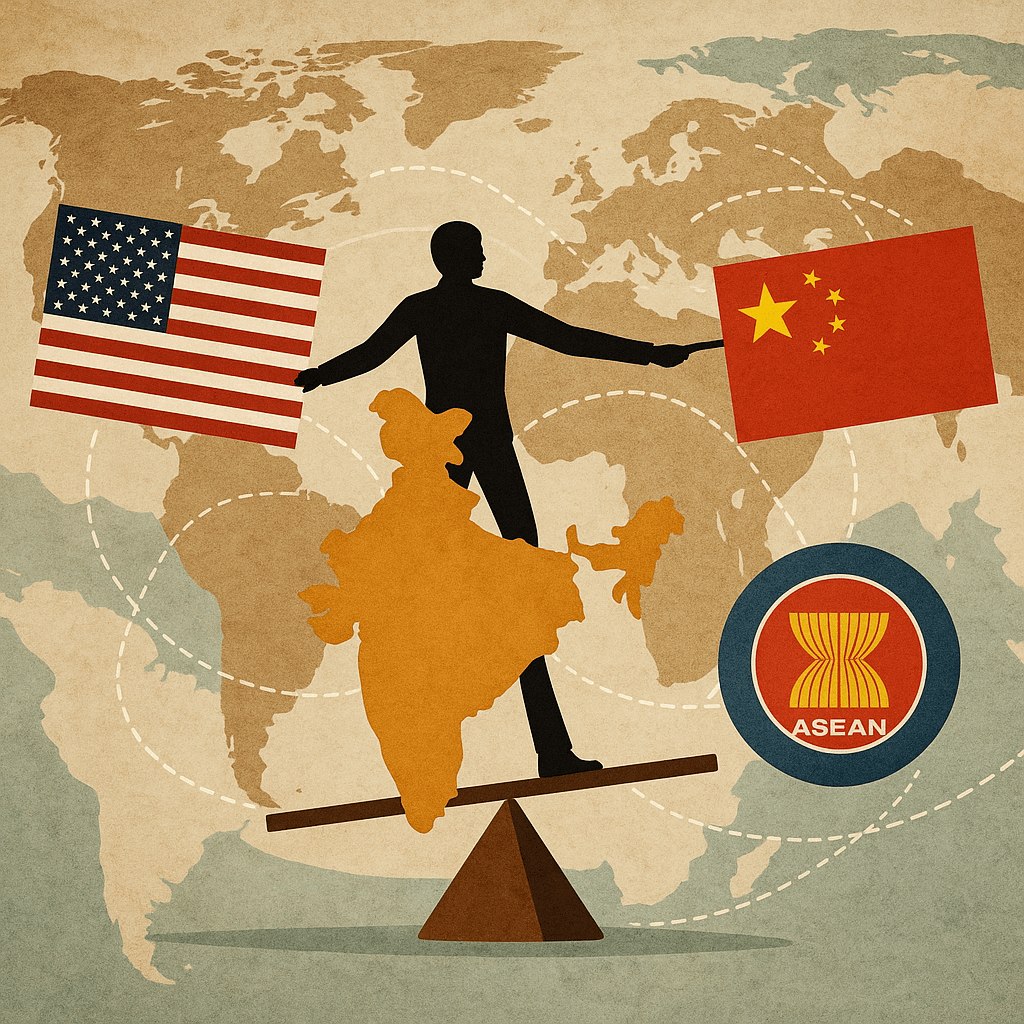
India’s foreign policy is entering a pivotal phase as tectonic shifts reshape the global power balance. With the United States and China locked in prolonged strategic competition and ASEAN navigating internal realignments, India has emerged as a pragmatic power — balancing security imperatives, economic partnerships, and its doctrine of strategic autonomy.
Strategic Autonomy and Multipolar Engagement
India’s core foreign policy principle — alignment without alliance — remains its strongest strategic lever. Rather than choosing sides, New Delhi prefers flexible coalitions based on issues and interests.
This has allowed it to engage simultaneously with Washington’s Indo-Pacific strategy, Beijing’s regional recalibration, and Moscow’s renewed outreach, reflecting a nuanced “multi-vector diplomacy.”
High-level meetings between Prime Minister Narendra Modi and President Xi Jinping in recent months mark a cautious attempt to stabilize relations after years of tension. At the same time, deepening ties with Russia through energy and defense cooperation underscore India’s resistance to geopolitical binaries. This flexibility enables India to pursue growth while maintaining independence from rigid global blocs.
Security and Defense Partnerships: Between Trust and Transaction
Even amid tariff disputes and energy friction, India and the US recently signed a 10-year defense framework agreement, underscoring their mutual need for strategic stability in the Indo-Pacific.
The deal extends cooperation in emerging defense technologies, joint exercises, and intelligence-sharing — a sign that both nations see partnership as essential to maintaining balance against coercive regional powers.
However, India’s defense diversification continues: from buying Russian S-400 systems to co-developing platforms with France and collaborating with Japan and Australia under the Quad. This multi-layered defense diplomacy reinforces India’s intent to stay strategically autonomous yet globally integrated.
Economic and Regional Repositioning: The ASEAN Pivot
India’s economic diplomacy now looks firmly Eastward. After its cautious exit from RCEP, New Delhi has redoubled efforts to strengthen ties with ASEAN economies — whose combined GDP exceeds $3 trillion. Through the India–ASEAN Connectivity Initiative, the Digital Partnership Corridor, and investments in infrastructure, logistics, and supply-chain integration, India is embedding itself into Southeast Asia’s growth story.
ASEAN’s evolving stance — seeking balance between the US and China — offers India a platform to project influence without confrontation. For ASEAN members wary of China’s economic dominance, India’s growing digital, manufacturing, and energy sectors present a viable diversification partner. This aligns with Western economies’ “China+1” de-risking strategies, giving India added leverage in the global supply chain realignment.
Navigating the Trade and Tariff Crosswinds
India’s immediate challenges include managing the fallout from US tariff hikes and a widening trade deficit with China (which exceeded $100 billion in 2024–25).
To mitigate this, New Delhi is expanding its export footprint in ASEAN, Africa, and Latin America, focusing on sectors like electronics, pharmaceuticals, agri-tech, and green energy.
By coupling its Make in India 2.0 manufacturing reforms with Production-Linked Incentive (PLI) schemes, India seeks to convert global uncertainty into opportunity — positioning itself as a resilient manufacturing hub and investment destination.
Hedging for a Multipolar Future
India’s current trajectory is not about neutrality but purposeful flexibility.
Its challenge lies in leveraging partnerships without losing policy sovereignty — whether in defense, digital infrastructure, or trade architecture. As the US recalibrates its Indo-Pacific strategy, China consolidates economic dominance, and ASEAN redefines its centrality, India’s pragmatic stance allows it to serve as a stabilizing bridge.
The coming decade will test whether India can translate this balancing act into sustained influence — transforming from a “swing state” into a shaping power in the emerging multipolar order.
#StrategicAutonomy #IndoPacific #IndiaASEAN #USChinaTensions #Geoeconomics #MultipolarWorld #SupplyChainResilience #ForeignPolicy #TradeStrategy #GlobalSouth
 "Connecting communities, empowering nations: Unifying the Regional and Global Economy ."
Leave a comment