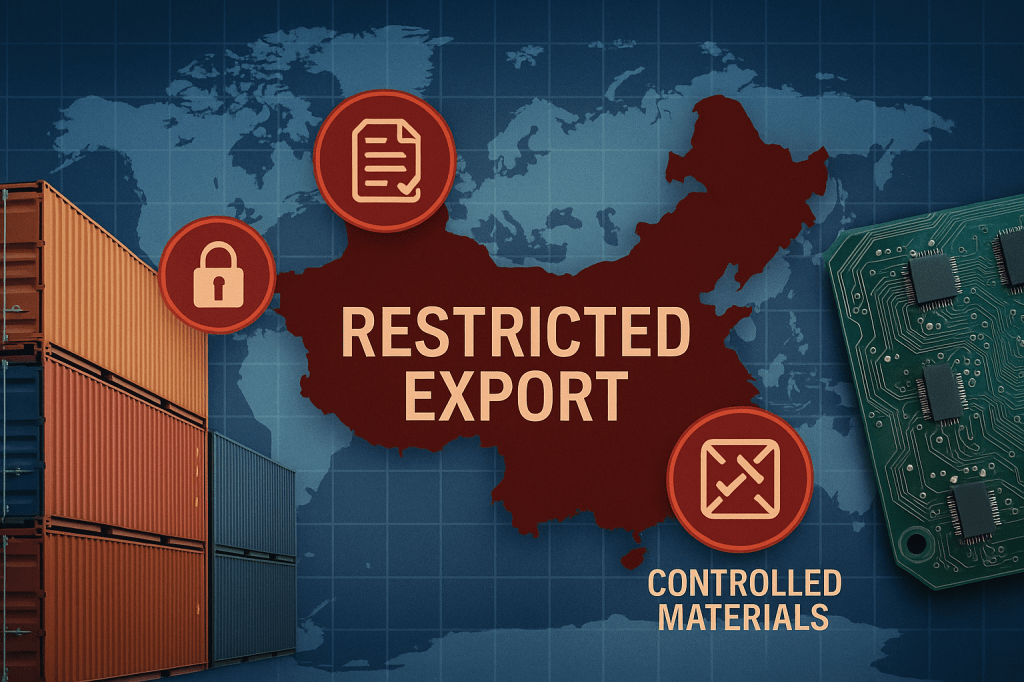
From Tariffs to Technology Controls
On 9 October 2025, China’s Ministry of Commerce unveiled a sweeping expansion of its export-control regime, targeting rare earths, lithium batteries, artificial graphite, and superhard materials. More strikingly, it introduced extraterritorial provisions, implying that goods produced outside China but using Chinese inputs may still fall under Chinese export jurisdiction.
This announcement represents far more than a regulatory update — it is a strategic shift in global trade governance. It signals that the era of tariff wars is morphing into an era of regulatory and technological sovereignty, where control over materials and know-how becomes a geopolitical instrument.
From Resource Diplomacy to Strategic Leverage
Historically, China’s dominance in critical minerals — particularly rare earth elements — dates back to the 1980s, when it began prioritizing mineral processing as part of its industrial modernization. By the early 2000s, it supplied over 90% of the world’s rare earths, enabling leadership in green technologies, defense components, and electronics manufacturing.
In 2010, China briefly restricted exports of rare earths to Japan after a maritime dispute — a moment that revealed the strategic power of resource control. Since then, the global community has viewed Chinese supply chains not merely as economic partners but as potential chokepoints.
The 2025 controls are the culmination of this historical evolution — from defensive protectionism to proactive techno-nationalism.
Regulatory Depth: The New Layer of Complexity
The expanded regime covers rare earths, lithium-ion battery components, artificial graphite, and superhard materials — all of which underpin the energy transition, semiconductor fabrication, and EV ecosystems.
Equally transformative is the extraterritorial clause. Much like the U.S. Export Administration Regulations (EAR) that restrict third-party exports involving American technology, China’s new rules assert a jurisdictional reach beyond its borders. This is a major departure from its traditional inward-focused trade policy, effectively creating a mirror image of Western control regimes.
For European and German firms, especially those embedded in multi-country supply chains, this introduces an entirely new compliance challenge. Companies must now trace the origin of inputs, assess exposure to Chinese technologies, and implement multi-jurisdictional compliance mapping.
Economic and Geopolitical Implications
1. From Tariffs to Regulation:
Traditional tariff wars can be quantified and negotiated; regulatory barriers, by contrast, are structural and enduring. This shift means that market access is increasingly determined by policy alignment, not just cost competitiveness.
2. Supply-Chain Risk Redefined:
Firms once focused on diversifying manufacturing locations; now they must diversify technological and material dependencies. The challenge is not “Made in China” versus “Made elsewhere,” but “Made with Chinese inputs.”
3. Technological Containment Loop:
The controls are both defensive (to prevent leakage of strategic materials) and retaliatory (to counter U.S. and EU semiconductor restrictions). The world may be entering a containment loop, where each side regulates to retaliate, leading to a fragmented techno-trading system.
4. European Exposure:
Germany’s EV and renewable-energy industries — heavy users of Chinese graphite, lithium, and permanent magnets — face particular exposure. Unless supply diversification accelerates, Europe’s green transition could face strategic bottlenecks.
Toward Regulatory Geoeconomics
The future of global trade will not be decided in tariff schedules but in control lists, licensing procedures, and export-compliance algorithms. Companies will need to build compliance intelligence systems, conduct geo-risk audits, and design traceability infrastructure that spans continents.
In the long term, we may see the rise of parallel supply-chain ecosystems:
A China-centric bloc (serving parts of Asia, Africa, and Latin America) emphasizing affordability and access.
A Western compliance bloc prioritizing transparency, ESG standards, and regulatory assurance.
This dual structure could reshape industrial geography — from lithium extraction in Africa to battery manufacturing in Europe — with nations choosing sides based on market access and technology dependence.
Policy and Business Imperatives
Compliance First: Multinationals must integrate export-control reviews into procurement and design stages, not as a post-production check.
Strategic Sourcing: Governments and firms must invest in non-Chinese supply chains, even at short-term cost.
Diplomatic Balancing: For trade policy, the challenge lies in maintaining strategic autonomy without isolation — ensuring national security without fragmenting the global economy.
The Era of “Invisible Barriers”
China’s 2025 export-control expansion marks a turning point — a regulatory redrawing of global trade boundaries. Unlike tariffs, these controls are opaque, selective, and long-lasting, signaling a deeper transformation where laws, not logistics, define trade routes.
For global firms and policymakers, the message is clear: the next decade of globalization will be shaped not by open markets, but by controlled flows of materials, data, and technology. Navigating this new reality demands foresight, adaptability, and above all, strategic regulatory literacy.
#ChinaTrade #ExportControls #RareEarths #Lithium #GlobalSupplyChains #TechSovereignty #RegulatoryRisk #TradePolicy #GeoEconomics #FuturisticOutlook
 "Connecting communities, empowering nations: Unifying the Regional and Global Economy ."
Leave a comment